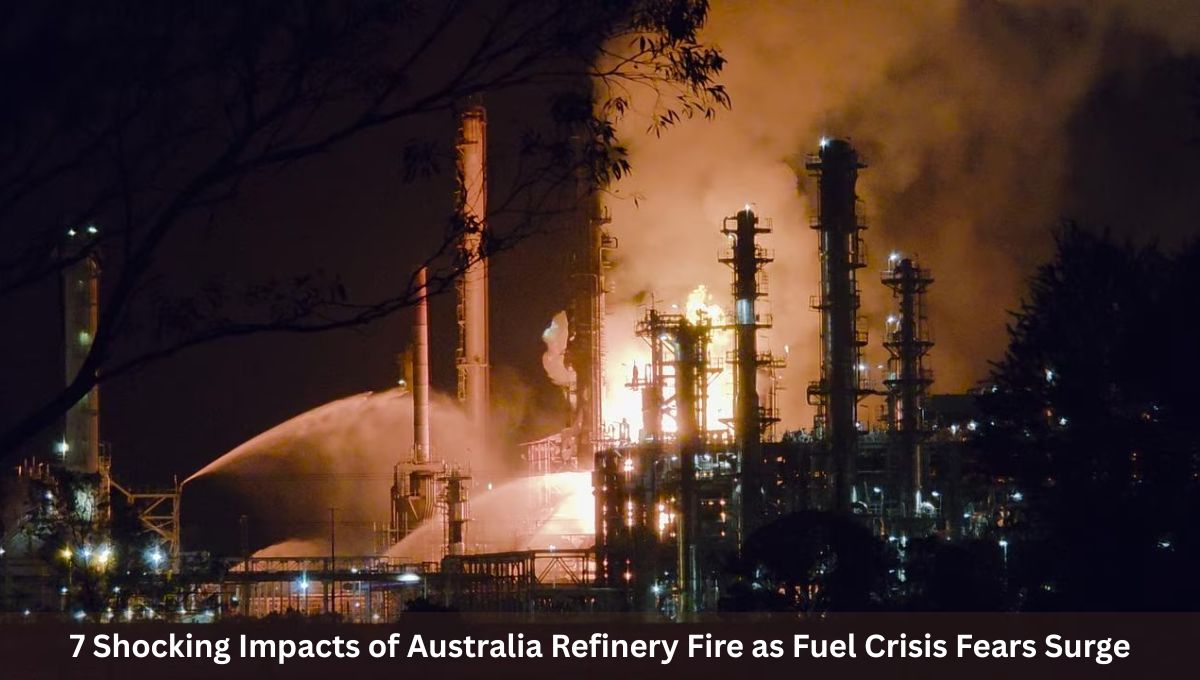
7 Shocking Impacts of Australia Refinery Fire as Fuel Crisis Fears Surge amid Middle East tensions. A major fire at Viva Energy’s Geelong refinery in southern Australia has sent shockwaves through global energy markets, raising concerns over fuel supply disruptions at a time when the world is already grappling with instability caused by the Middle East conflict.
The blaze, which broke out late Wednesday night, initially raged out of control before being contained and later extinguished after nearly 13 hours.
While authorities confirmed no injuries, the incident has triggered widespread concern about its impact on Australia’s fuel supply, given the refinery’s critical role in the country’s energy infrastructure.
7 Shocking Impacts of Australia Refinery Fire as Fuel Crisis Fears Surge
Where and How the Fire Broke Out
Late-Night Explosions Spark Emergency Response
Emergency services were alerted at approximately 11:15 pm after multiple reports of explosions and flames at the refinery in Geelong, a major industrial hub located southwest of Melbourne.
Fire Rescue Victoria confirmed that the blaze involved highly flammable liquid fuels and gases, making it particularly dangerous and complex to control.
Firefighters described the incident as “ferocious,” with flames rapidly escalating from a localized fire into a large-scale industrial blaze.
Cause: Likely Equipment Failure
Preliminary assessments suggest the fire may have been triggered by an equipment failure—possibly a leak or malfunction within the petrol-processing section of the refinery.
Authorities, along with environmental and safety agencies, have launched a detailed investigation to determine the exact cause.
Fire Contained but Not Without Consequences
13-Hour Battle to Control the Blaze
Fire crews battled the flames overnight, eventually bringing the situation under control around midday Thursday.
Although the fire has been extinguished:
- Parts of the refinery remain offline
- Safety checks are ongoing
- Full operations have not yet resumed
Specialist hazardous materials teams were deployed to monitor air and environmental safety, ensuring no harmful contamination affected nearby communities.
No Injuries, Successful Evacuation
One of the most significant positives from the incident is that no injuries were reported.
Workers on site were safely evacuated, highlighting effective emergency protocols and preparedness.
Why the Geelong Refinery Matters
A Strategic Energy Asset
The Geelong refinery is one of only two remaining oil refineries in Australia, making it a vital component of the nation’s energy system.
It:
- Processes up to 120,000 barrels of oil per day
- Supplies over 50% of fuel in Victoria
- Contributes roughly 10% of Australia’s total fuel demand
The facility produces a wide range of fuels, including petrol, diesel, jet fuel, and liquefied petroleum gas (LPG).
Impact on Fuel Production
Initial reports indicate:
- Petrol production has been significantly affected
- Diesel and jet fuel production continues but at reduced levels
- Some refinery units are operating at minimum capacity for safety
7 Shocking Impacts of the Refinery Fire
1. Immediate Pressure on Fuel Supply
Even though authorities have stated there is “no immediate impact” on supply, the reality is more complex.
Reduced production at such a critical facility will inevitably tighten supply chains in the coming days.
2. Rising Petrol Prices Likely
Experts warn that petrol prices could rise depending on the extent of the damage.
Reduced output combined with already strained global markets creates upward pressure on fuel costs.
3. Increased Reliance on Imports
Australia imports nearly 80% of its fuel needs. With domestic production disrupted, reliance on imports will increase further—potentially exposing the country to global supply shocks.
4. Global Energy Market Ripple Effects
The fire comes amid ongoing disruptions linked to the Middle East conflict and instability in the Strait of Hormuz, a key global oil transit route.
Any additional disruption—even localized—can amplify global supply concerns.
5. Logistics and Supply Chain Challenges
Refining disruptions can create cascading logistical challenges:
- Delays in fuel distribution
- Increased shipping costs
- Pressure on storage and reserves
6. Risk of Panic Buying
Authorities have already warned against panic buying, as previous supply concerns have led to spikes in demand in certain regions.
Such behavior can worsen shortages even if overall supply remains adequate.
7. Long-Term Energy Security Concerns
The incident underscores a deeper issue:
Australia’s limited refining capacity and heavy dependence on imports make it vulnerable to both domestic and international disruptions.
Timing Couldn’t Be Worse
Middle East Conflict Compounding Risks
The refinery fire comes at a particularly sensitive time, as global oil markets are already under strain due to geopolitical tensions involving Iran.
Disruptions in the Strait of Hormuz—through which about 20% of global oil flows—have already:
- Reduced global supply
- Increased prices
- Heightened uncertainty
Government Scrambles for Supply
Australian Prime Minister Anthony Albanese is currently engaging with regional partners to secure additional fuel supplies.
Countries like Malaysia, Singapore, and Brunei are being considered as alternative sources, although their capacity to fully offset disruptions is limited.
Government Response and Measures
Short-Term Actions
Authorities have taken several immediate steps:
- Monitoring fuel supply levels
- Coordinating with Viva Energy
- Preparing contingency plans
The government has also previously introduced relief measures, including:
- Temporary fuel tax cuts
- Suspension of certain transport charges
Long-Term Considerations
The crisis may accelerate policy discussions around:
- Expanding domestic refining capacity
- Increasing strategic fuel reserves
- Diversifying supply chains
Industry Response
Viva Energy’s Position
Viva Energy has stated that its primary focus is ensuring safety before restoring full production.
CEO Scott Wyatt emphasized:
- Operations are running at minimum safe levels
- Full production will resume only after safety clearance
- Alternative supply arrangements are being explored
Market Reaction
The company’s shares were placed in a trading halt pending further clarity on the incident’s impact.
Australia’s Energy Vulnerability Exposed
Limited Refining Capacity
Australia’s refining capacity has declined significantly over the years, leaving only two operational refineries.
This makes the country highly sensitive to:
- Domestic incidents
- Global supply disruptions
- Shipping route instability
Low Fuel Reserves
Australia reportedly holds less than the recommended 90 days of fuel reserves, further increasing vulnerability during crises.
Environmental and Safety Considerations
Hazard Monitoring
Authorities have confirmed:
- No significant contamination detected in air or water
- Continuous environmental monitoring is ongoing
Investigation Underway
Multiple agencies are investigating:
- Cause of the fire
- Safety compliance
- Potential preventive measures
What Happens Next
Short-Term Outlook
- Fuel supply likely to remain stable but tight
- Petrol production may take time to recover
- Prices could fluctuate
Medium-Term Outlook
- Increased imports to fill supply gaps
- Possible policy shifts toward energy security
- Continued volatility in fuel markets
Global Implications
This incident highlights how interconnected global energy systems have become. A single refinery fire—combined with geopolitical tensions—can have far-reaching consequences.
For global audiences, the key takeaway is clear:
Energy security is no longer just about supply—it’s about resilience.
Conclusion: A Wake-Up Call for Energy Security
The fire at the Geelong refinery is more than just an industrial accident—it is a stark reminder of the fragility of modern energy systems.
While immediate impacts appear manageable, the broader implications for Australia’s fuel security and global energy stability cannot be ignored.
As the world navigates an increasingly volatile geopolitical landscape, incidents like this underscore the urgent need for diversification, resilience, and strategic planning.
The coming weeks will be critical in determining whether this remains a contained disruption—or escalates into a broader energy challenge.
Also Read: Thousands Join Anti-Immigration Rallies Across Australia as Government Condemns Neo-Nazi Links
Also Read: Giant fire at Geelong oil refinery brought under control, ‘equipment failure’ blamed
Related Posts:
- Massive Fire Erupts at Chevron Refinery Near Los Angeles
- 7 Shocking Findings Behind Hong Kong’s Deadliest…

- 7 Shocking New Revelations as Hong Kong Fire Death…

- 10 Explosive Strikes: Israel Bombs Tehran Oil Depots…

- Wildfire Inferno: 5 Alarming Facts on the…

- 10 Explosive Signals Trump Says Iran War Could End…