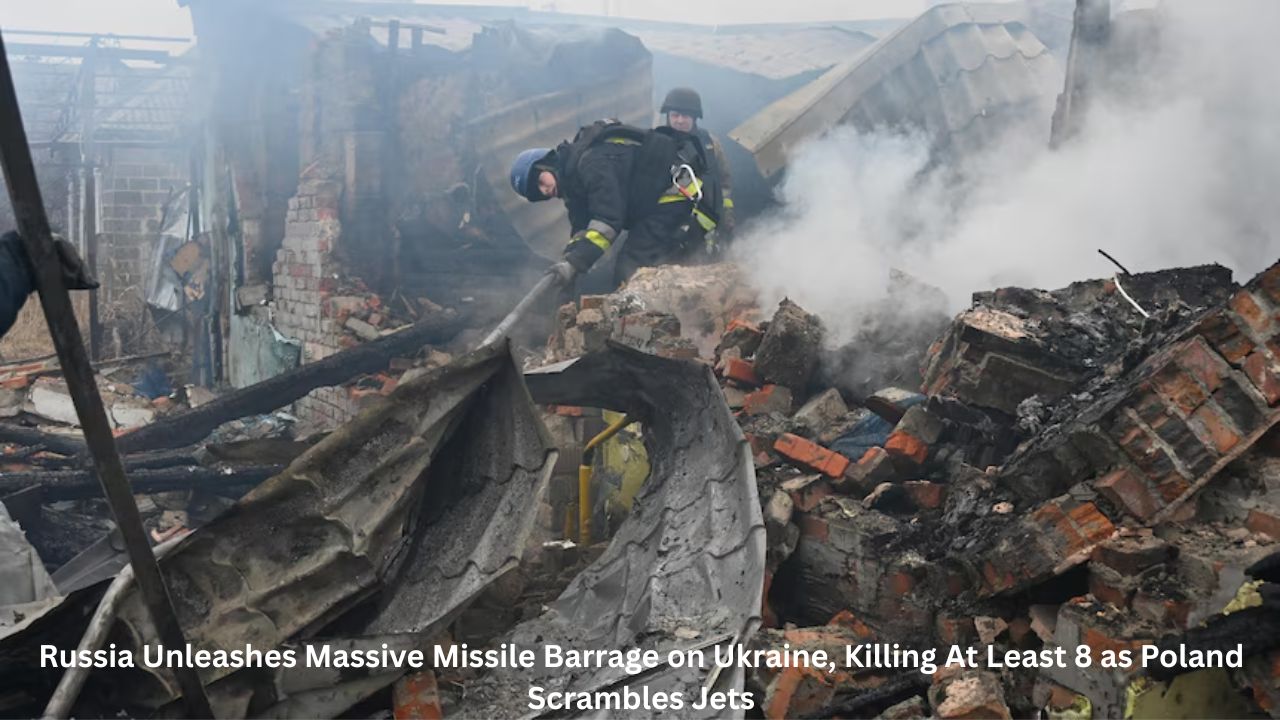
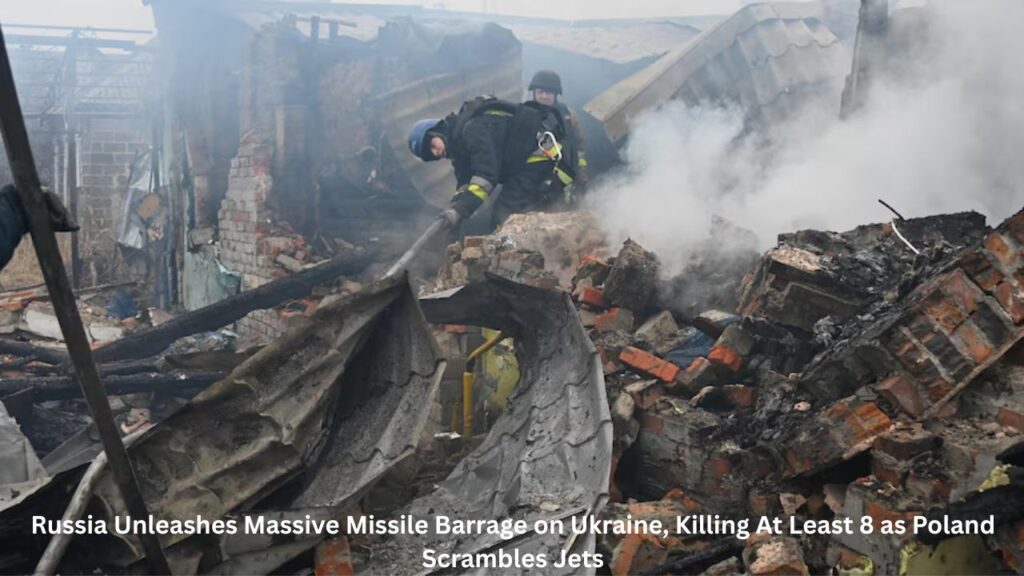
Russia Unleashes Massive Missile Barrage on Ukraine, Killing At Least 8 as Poland Scrambles Jets after Russian missile reportedly crosses its border. Ukraine woke up to one of its deadliest nights in months after Russia launched a massive combined missile and drone assault across the country, killing at least eight people, wounding dozens more, and forcing NATO member Poland to scramble fighter jets to protect its own airspace.
The overnight barrage struck the capital Kyiv, President Volodymyr Zelenskyy’s hometown of Kryvyi Rih, and the western city of Lviv near the Polish border — arriving just hours after Zelenskyy had publicly warned that a major Russian strike was likely.
For a global audience tracking the war’s next turn, here’s a full breakdown of what happened, why it happened now, and what it signals for the months ahead.
Russia Unleashes Massive Missile Barrage on Ukraine, Killing At Least 8 as Poland Scrambles Jets
A Night of Explosions Across Ukraine
Zelenskyy’s Warning Comes True
On Wednesday, Zelenskyy told Ukrainians that Russia appeared to be preparing a large-scale strike and urged citizens nationwide to take air raid alerts seriously.
Hours later, that warning proved accurate.
According to Zelenskyy’s own tally, Russia fired more than 70 missiles and roughly 280 drones at targets across the country, with Kyiv and the Lviv region bearing the brunt of the assault, Ukraine’s air force said.
Explosions rang out across Kyiv shortly after 1am local time, sending residents rushing into overcrowded metro stations for shelter.
Kyiv Mayor Vitali Klitschko reported that several non-residential sites caught fire in the capital, while air raid sirens sounded in nearly every region of the country through the night.
Rising Death Toll Across Multiple Cities
The human cost of the attack became clearer as the morning wore on.
Ukraine’s foreign minister said at least eight people had been killed nationwide, including children, in what officials described as the country’s heaviest single-night civilian toll in weeks.
In Kryvyi Rih, Zelenskyy’s hometown in central Ukraine, the losses were especially devastating.
A Russian Iskander-M ballistic missile, launched from Russia’s Voronezh region, struck the home of a large family, killing six people, including two young girls aged five and twelve.
Oleksandr Vilkul, head of the city’s defence council, called it a “dark night” on Telegram and cautioned that the death toll could still climb as rescue crews cleared the rubble.
In Kyiv itself, at least one person was killed and several others injured after missiles hit the capital.
Meanwhile in Lviv, close to the Polish border, Russian missiles tore into two apartment buildings, injuring more than a dozen residents and trapping others as rescue workers worked through the debris.
Poland Scrambles Jets as a Missile Crosses the Border
The scale of the attack rippled beyond Ukraine’s borders. Poland, a NATO and European Union member, scrambled fighter jets and placed ground-based air defence systems on alert as Russian missiles and drones flew close to its territory.
Ukraine’s foreign ministry said a Russian cruise missile actually crossed into Polish territory during the barrage, and Polish authorities later reported finding a crater and debris in a field following reports of an explosion.
It’s a scenario NATO has faced before — Polish jets have scrambled repeatedly during Russian strikes on western Ukraine — but the reported border crossing adds fresh urgency to long-running concerns in Warsaw and Brussels about the war spilling into NATO territory.
Why This Attack Came Right After a Trump-Zelenskyy Meeting
A Push for Patriot Missiles
The timing of the assault is hard to separate from events in Washington just a day earlier.
Zelenskyy had travelled to the United States and met President Donald Trump at the White House for just over an hour, in what the Ukrainian leader called a “good meeting.”
According to Zelenskyy, Trump agreed during that meeting to grant Ukraine licences to manufacture its own Patriot missile systems domestically — a significant shift, since Patriot batteries remain the only Western air defence system capable of reliably shooting down Russian ballistic missiles.
Trump had first signalled openness to this kind of arrangement earlier in the month, as Russia ramped up its ballistic missile campaign.
Following the Washington meeting, Trump posted photos on social media, noting simply that the talks had “went very well.”
An Interceptor Shortage Made Worse by Another War
Even with a Patriot manufacturing deal in principle, Ukraine’s more immediate problem is a shortage of PAC-3 interceptor missiles — the munitions Patriot batteries actually fire to bring down incoming warheads.
That shortage has grown more acute in recent months, a squeeze linked in part to global demand from the separate US-Israel war against Iran, which has consumed a share of the same limited interceptor stockpiles Ukraine depends on.
Zelenskyy used his return from Washington to press this point directly to Ukraine’s Western partners, arguing that the safety of Ukrainian civilians now depends largely on whether allied nations are willing to share more of their own missile defence supplies.
The Bigger Picture: A War Still Escalating on Both Sides
While Russia’s overnight barrage dominated headlines, it did not occur in a vacuum.
Ukraine has itself intensified long-range drone strikes deep into Russian territory in recent weeks, targeting oil refineries, military infrastructure, and industrial sites, with some strikes reportedly reaching as far as Moscow and St. Petersburg.
Trump himself suggested earlier this month that continued Ukrainian strikes inside Russia “could help” bring the broader war to a close — a notably permissive tone from a US president who has otherwise pushed for a negotiated settlement.
Zelenskyy, for his part, used his Washington visit to argue that Russian President Vladimir Putin has lost battlefield initiative due to mounting losses, even as Moscow continues to demonstrate the ability to launch devastating long-range strikes deep into Ukrainian territory almost at will.
What It Means for the Rest of the World
For audiences well beyond Ukraine and Russia, this attack matters for a few clear reasons.
First, a Russian missile reportedly crossing into Polish airspace is precisely the kind of incident that has, in the past, pushed NATO closer to direct involvement in the conflict — even if, as in this case, it does not appear to have caused casualties or triggered a wider response.
Second, the interceptor shortage underscores how thinly stretched Western air defence supply chains have become, especially with two major conflicts — Ukraine and Iran — now competing for the same limited stock of Patriot missiles.
And third, any Ukrainian move toward domestically producing its own air defence systems, if it materialises, would mark a meaningful long-term shift in how Kyiv sustains its defence without depending entirely on shipments from allies.
Ukraine’s Allies Face Renewed Pressure to Respond
The attack lands at a delicate moment for Ukraine’s Western backers.
European governments have spent months debating how to plug gaps in Kyiv’s air defence network without depleting their own stockpiles, and incidents like a Russian missile allegedly crossing into Poland tend to sharpen that debate rather than resolve it.
Diplomats and officials across the EU and NATO have repeatedly stressed they do not want the war to expand beyond Ukraine’s borders, even as Russia’s long-range strikes keep testing exactly where that border effectively lies.
Zelenskyy has been explicit that the response from allies, not just battlefield developments, will shape how many more nights like this one Ukrainian civilians have to endure.
Speaking after his return from Washington, he stressed that protecting people’s lives depends directly on partners’ willingness to share the air defence systems Ukraine still lacks.
With winter still months away but Russia already demonstrating the capacity for mass strikes involving hundreds of missiles and drones in a single night, that pressure on allies is unlikely to ease anytime soon.
Conclusion
Russia’s overnight assault on Ukraine — one of its most extensive in recent months — is a stark reminder that despite renewed diplomatic engagement between Kyiv and Washington, the war on the ground shows no sign of slowing down.
With civilian deaths mounting in Kyiv, Kryvyi Rih and Lviv, a missile reportedly crossing into NATO territory in Poland, and both sides trading long-range strikes deeper into each other’s territory, the conflict appears to be intensifying even as talk of ceasefires and peace negotiations continues in the background.
Whether the promised Patriot missile licences and renewed diplomatic momentum from the Trump-Zelenskyy meeting translate into real protection for Ukrainian civilians — or simply another chapter in a war still searching for an endpoint — is likely to become clearer in the days ahead.
Also Read: US Senate’s Massive 86-12 Vote Advances Russia Sanctions Bill, Threatens India with 100% Tariffs
Also Read: Russia launches missile barrage on Kyiv as Ukraine escalates strikes on Russian oil facilities