
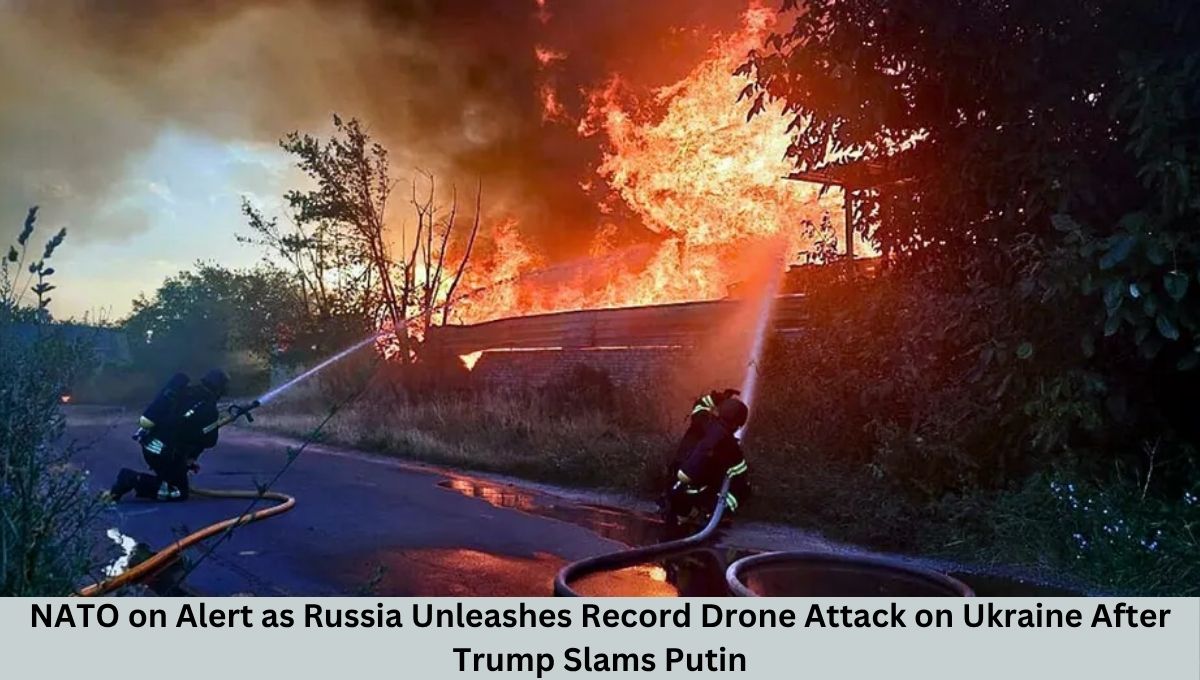
In a recent deadly Russia-Ukraine war, NATO on Alert as Russia Unleashes Record Drone Attack on Ukraine After Trump Slams Putin. In a dramatic and alarming escalation of the war in Eastern Europe, Russia launched its largest-ever drone and missile attack on Ukraine, triggering NATO to scramble fighter jets from Poland and other allied nations. The aerial assault, which occurred early Wednesday, followed U.S. President Donald Trump’s fiery criticism of Russian President Vladimir Putin and his announcement of renewed military aid to Kyiv.
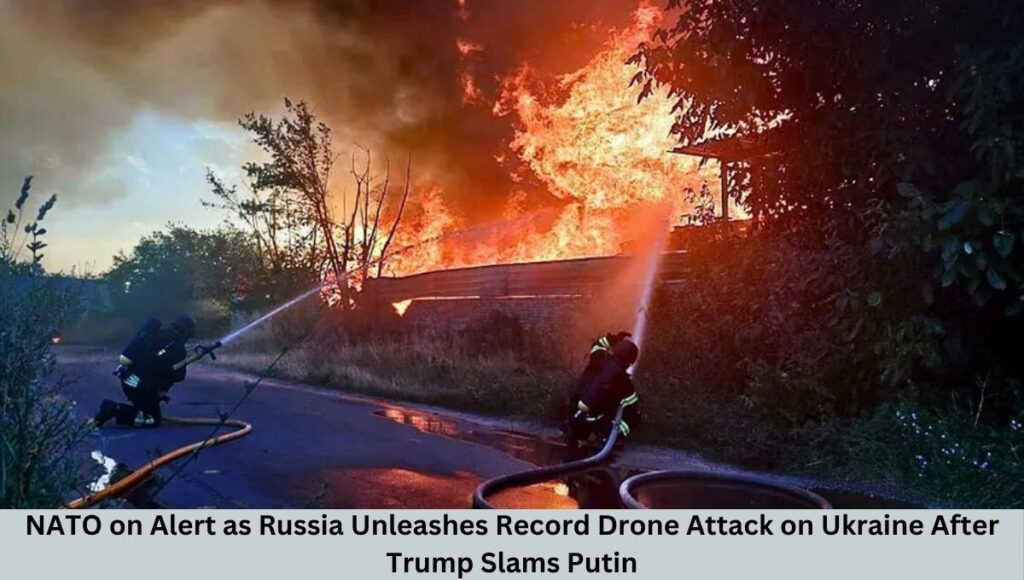
According to Ukraine’s Air Force, the unprecedented attack involved 728 drones and 13 missiles, including Iranian-designed Shahed drones, hypersonic Kinzhals, and Iskanders. Ukrainian officials confirmed that most of the drones were intercepted, but casualties and destruction were reported across multiple regions, including Kyiv, Lutsk, and Khmelnytskyi.
NATO on Alert as Russia Unleashes Record Drone Attack on Ukraine After Trump Slams Putin
A New Chapter in Russia’s War Strategy
Russia’s latest assault signals a significant escalation in aerial warfare tactics, blending sheer volume with high-tech drone and missile systems designed to overwhelm Ukrainian air defenses.
The Russian Defense Ministry confirmed the strike, stating that the targets were Ukrainian air bases and that “all designated targets have been hit.”
However, Ukraine’s air defense units, employing mobile fire groups, interceptor drones, and anti-aircraft systems, reportedly downed 718 drones and seven missiles.
Ukrainian President Volodymyr Zelenskyy condemned the attack as a deliberate act of war intended to undermine international peace efforts.
“This is a new massive Russian attack on our cities… at a time when so many efforts have been made to achieve peace,” Zelenskyy said. “Our partners must act to pressure Russia into ending this war.”
Why NATO Jets Were Scrambled
With Russian drones approaching Ukraine’s western regions bordering NATO countries, particularly Poland, the alliance responded quickly. The Polish Armed Forces deployed F-16 fighter jets and placed ground-based air defenses on high alert.
The cities of Lviv and Volyn, both close to the Polish border, experienced heavy bombardment. Though no Russian drones or missiles entered NATO airspace, the proximity raised fears of accidental or deliberate escalation.
“This kind of attack is unprecedented in scale and proximity,” a NATO official told reporters. “We have a responsibility to protect our borders and respond rapidly to any threat.”
Targeted Cities and Civilian Casualties
The city of Lutsk, located only 90 kilometers from Poland, was among the hardest hit. Known for its military airfields and strategic logistics role in receiving Western weapon supplies, Lutsk saw extensive damage.
Kyiv, the capital, faced its fourth consecutive night of strikes, with air raid sirens lasting over four hours. The Shevchenkivskyi district an area rich in culture, universities, and nightlife suffered massive damage.
Two civilians were killed and 13 injured, and a healthcare center was nearly destroyed. “Residential buildings, vehicles, warehouses, and office buildings are burning,” said Tymur Tkachenko, Kyiv’s military administration chief.
In the eastern town of Kostiantynivka, a Russian airstrike killed three civilians, including a child, and injured another, according to Ukraine’s emergency services.
Trump’s Harsh Words for Putin and Renewed U.S. Aid
Just hours before the Russian strike, President Trump publicly criticized Vladimir Putin, accusing him of sabotaging peace talks with deceitful diplomacy.
“We get a lot of bullsh*t thrown at us by Putin,” Trump said. “He’s very nice to us all the time, but it turns out to be meaningless.”
In a Cabinet meeting, Trump announced the resumption of military aid to Ukraine, including the delivery of 155 mm artillery shells and GMLRS precision rockets.
This came after a brief pause in arms shipments, which Trump reportedly did not authorize, prompting internal tension within the White House.
“They’re getting hit very hard,” Trump added. “We’re going to have to send more weapons. Defensive weapons, primarily, but they’re getting hit very, very hard.”
Russia’s Growing Drone Arsenal: The Shahed Factor
The sheer number of drones used in the latest attack was made possible by Russia’s 2022 deal with Iran to acquire and domestically produce Shahed drones.
According to U.S.-based analysts at C4ADS, Russia paid over $1.75 billion to Iran for Shahed technology, source code, and an estimated 6,000 drones.
Production now occurs in Alabuga, a special economic zone in Tatarstan, where over 5,000 drones and decoys are built monthly.
Many of these drones are decoys, designed to trigger Ukrainian defenses into wasting valuable interceptors. They closely mimic real drones in sound and appearance but carry no explosives.
Ukraine’s Multi-Layered Defense Strategy
To counter Russia’s evolving tactics, Ukraine has implemented a sophisticated aerial defense system that combines:
- Jet fighters and helicopters
- Mobile air defense teams
- Electronic jamming systems
- Drone-on-drone interception
Yuriy Ihnat, Ukraine’s Air Force spokesperson, warned that Russian drones are now faster, quieter, and have longer ranges some exceeding 2,500 kilometers.
He emphasized Ukraine’s use of electronic warfare to neutralize drone threats without expending costly interceptor missiles.
Ukrainian Drones Hit Back
In response, Ukraine launched 86 drones toward Russian territory overnight. The Russian Ministry of Defense reported that most were intercepted, but some penetrated deep into Russian airspace, forcing the temporary closure of Sheremetyevo and Kaluga airports in Moscow.
In Kursk, a drone struck a beach, killing three civilians, including a 5-year-old boy, and injuring seven more.
This back-and-forth in the skies highlights how the Russia-Ukraine war has evolved into a daily drone war, stretching beyond traditional battlefield zones.
Diplomatic Developments and Legal Milestones
Amid the military tension, diplomatic channels remain active but strained.
On Thursday, U.S. Secretary of State Marco Rubio is expected to meet Russian Foreign Minister Sergei Lavrov on the sidelines of the ASEAN summit in Kuala Lumpur.
The meeting will focus on potential ceasefire mechanisms, though expectations are low.
In a parallel development, the European Court of Human Rights ruled that Russia has engaged in systematic human rights violations in Ukraine since February 2022. The ruling came in response to inter-state cases filed by Ukraine and the Netherlands.
Espionage Tensions with China
In a surprising twist, Ukraine’s Secret Service (SBU) announced the arrest of two Chinese nationals accused of spying on Neptune missile production and attempting to smuggle sensitive military data back to China.
One suspect was reportedly caught red-handed with classified documents.This development adds another layer to the complex web of international players involved in the Ukraine war, from Iran’s drone exports to China’s growing intelligence interests.
Europe’s Response: “No Room for Compromise”
German Chancellor Friedrich Merz addressed the Bundestag with a stern message: diplomacy is exhausted, and Europe must continue supporting Ukraine to prevent a collapse of its democratic foundations.
“If a criminal regime openly seeks to destroy the democratic order of Europe, my government will do everything to prevent it,” said Merz.
Germany pledged to maintain and expand its support for Ukrainian defense and reconstruction efforts.
Conclusion: A Volatile New Normal for Europe
This week’s record-breaking drone and missile assault on Ukraine—unfolding alongside NATO’s military readiness, Trump’s shifting policies, and Russia’s technological escalation—marks a new, dangerous phase in the war.
As drones become cheaper, faster, and harder to detect, and defensive munitions become scarcer, both sides are investing heavily in aerial supremacy.
Meanwhile, millions of Ukrainian civilians live under constant threat, enduring sleepless nights, crumbling infrastructure, and the emotional toll of living through what increasingly feels like an endless war.
While Trump promises peace, Putin insists on victory, and Zelenskyy pleads for more help, the suffering continues with NATO standing watch, uncertain of when or if the conflict might cross its borders. “Everyone who wants peace must act,” Zelenskyy declared once more his words echoing across a continent now on edge.
Also Read: NATO Scrambles Jets as Russia Launches Record Drone and Missile Attack on Ukraine
Also Read: Rutte praises Trump in a NYT interview while warning of Russia’s rising threat to NATO
Related Posts:
- Can the EU and NATO Impose Tariffs on India and…

- 7 Powerful Measures: Trump Sanctions Russian Oil…

- Poland Invokes NATO Article 4 After Russian Drone…
- 5 Powerful Highlights as Trump Lands Second Nobel…

- Impacts of the Trump-Putin Call on Ukraine’s 2025 Strategy
- Dramatic Moments Behind Trump’s Gaza Peace Push and…
