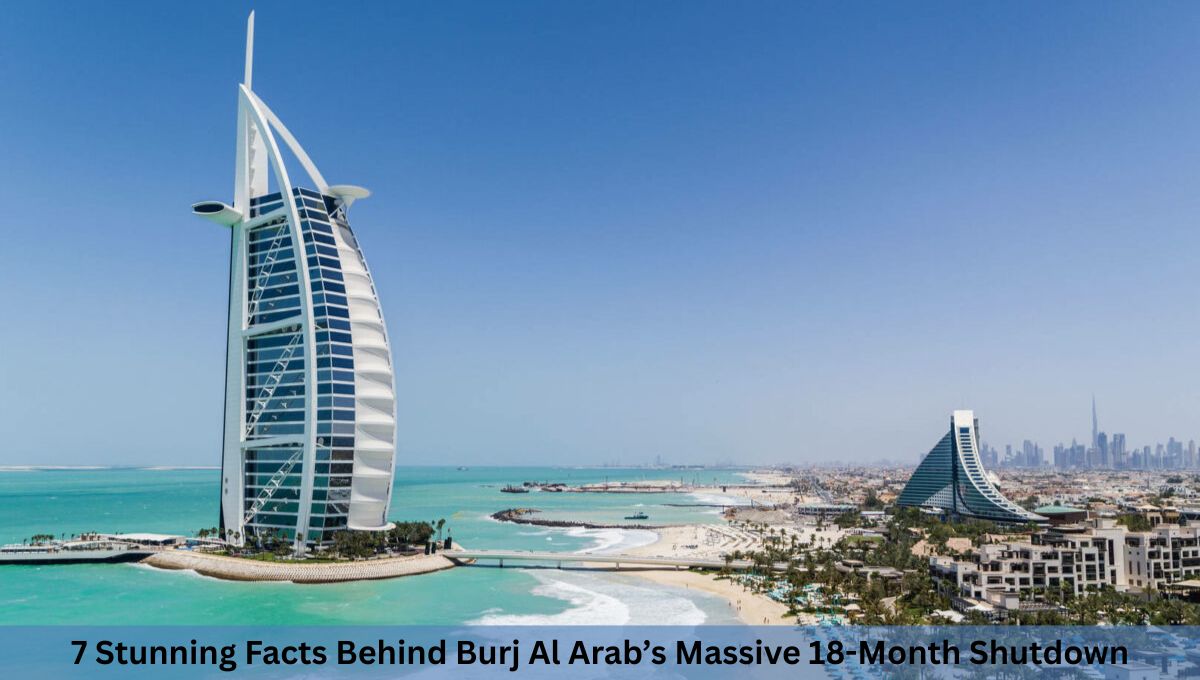
7 Stunning Facts Behind Burj Al Arab’s Massive 18-Month Shutdown for first major restoration in 27 years. Few buildings in the world are as instantly recognisable as the Burj Al Arab. Rising like a sail above the Arabian Gulf, it has symbolised Dubai’s ambition, luxury, and architectural daring for more than a quarter-century.
Now, in a rare and historic move, the iconic hotel is set to close its doors for approximately 18 months as it undergoes its first major restoration since opening in 1999.
Announced by Jumeirah Group, the ambitious project marks a turning point not only for the hotel but also for the global luxury hospitality industry.
The restoration is designed to preserve the building’s legacy while adapting it to the expectations of modern travellers.
This is not just a renovation—it’s a strategic reset for one of the world’s most famous hotels.
7 Stunning Facts Behind Burj Al Arab’s Massive 18-Month Shutdown
Why Burj Al Arab Is Shutting Down Now
After 27 years of continuous operation, the decision to pause operations reflects both necessity and foresight.
A Landmark That Defined an Era
When the Burj Al Arab opened in 1999, Dubai was still emerging as a global tourism destination. The hotel changed that trajectory almost overnight.
Designed to resemble a traditional Arabian dhow sail, it became a global symbol—much like the Eiffel Tower in Paris or the Sydney Opera House in Australia.
Its impact went beyond architecture. It redefined luxury hospitality.
The Need for Preservation
Over time, even the most iconic structures require maintenance and modernization. According to Jumeirah, the goal is not reinvention but preservation.
The restoration aims to:
- Protect architectural integrity
- Upgrade infrastructure and systems
- Enhance guest experience
- Maintain global competitiveness
This approach ensures the hotel remains relevant without losing its identity.
Timeline: What We Know About the 18-Month Restoration
Phased Restoration Plan
The project will be carried out in carefully planned phases over approximately 18 months.
While the exact reopening date may vary, estimates suggest operations could resume around late 2027.
During this period:
- All suites will be unavailable
- Restaurants and spa facilities will close
- Guests will be redirected to other Jumeirah properties
This controlled shutdown allows for deeper structural and aesthetic upgrades.
Who Is Leading the Transformation?
The restoration will be spearheaded by renowned French interior architect Tristan Auer.
Why Tristan Auer?
Auer is known for balancing heritage with modern design. His portfolio includes prestigious projects such as the restoration of the Hôtel de Crillon.
His design philosophy focuses on:
- Respecting original architecture
- Enhancing rather than replacing
- Introducing subtle contemporary elements
For Burj Al Arab, this approach is critical. The challenge is not to redesign—but to refine.
What Will Change Inside the Burj Al Arab?
While full details remain under wraps, several key upgrades are expected.
Interior Enhancements
The hotel’s lavish interiors—featuring:
- 24-carat gold leaf
- Rare marble varieties
- Swarovski crystal detailing
—will be carefully restored and refreshed.
Rather than removing these elements, designers will:
- Improve durability
- Enhance lighting and ambiance
- Update materials where necessary
Technological Upgrades
Modern luxury travellers expect seamless technology.
Likely upgrades include:
- Smart room systems
- Enhanced digital concierge services
- Improved sustainability features
Structural and Engineering Updates
Given the building’s unique offshore location, infrastructure improvements will likely include:
- Reinforced structural systems
- Upgraded climate control
- Improved energy efficiency
The Legacy of the “Seven-Star Hotel”
Though unofficial, the Burj Al Arab is often called the world’s only “seven-star hotel.” This reputation stems from its unmatched opulence.
What Made It Legendary?
- 198 duplex suites (no standard rooms)
- Private butler service for every guest
- Gold-plated interiors
- Helicopter access via rooftop helipad
The hotel also became famous for global publicity stunts involving icons like Roger Federer and Andre Agassi, who famously played tennis atop the helipad.
Engineering Marvel: Built on the Sea
One of the most remarkable aspects of the Burj Al Arab is its foundation.
A Man-Made Island
The hotel stands on an artificial island located about 280 meters offshore. Constructing this base took longer than building the tower itself.
Engineers used:
- Deep concrete piling
- Wave-resistant structures
- Advanced marine engineering techniques
The result is a structure that has withstood decades of harsh coastal conditions.
Recent Incidents and Increased Attention
In March 2026, the Burj Al Arab briefly made headlines after debris from an intercepted drone caused a minor fire on its exterior.
Authorities confirmed:
- No injuries
- Damage was limited
- Fire was quickly contained
While unrelated to the restoration, the incident highlighted the importance of maintaining resilience in high-profile structures.
Impact on Dubai’s Tourism Industry
The temporary closure raises important questions about Dubai’s tourism landscape.
Short-Term Impact
- Reduced availability of ultra-luxury accommodation
- Shift in bookings to alternative hotels
- Potential dip in high-end tourism experiences
Long-Term Benefits
However, the long-term outlook is positive:
- Renewed global attention
- Enhanced guest experience post-restoration
- Reinforced brand value
Dubai’s tourism ecosystem, already supported by landmarks like the Burj Khalifa and Museum of the Future, is expected to absorb the temporary gap.
Why This Restoration Matters Globally
The Burj Al Arab is more than a hotel—it is a benchmark.
A Signal to the Luxury Industry
This restoration reflects a broader trend:
- Iconic properties must evolve
- Heritage and innovation must coexist
- Sustainability is becoming essential
Luxury travellers increasingly value:
- Authenticity
- Experience
- Environmental responsibility
The Challenge: Modernizing Without Losing Identity
One of the biggest risks in restoring a landmark is over-modernization.
What Must Be Preserved
- The sail-shaped silhouette
- The dramatic atrium
- Signature luxury elements
- Cultural symbolism
What Must Be Updated
- Technology
- Sustainability features
- Guest personalization systems
Balancing these priorities will determine the project’s success.
Inside the Burj Al Arab Experience
Even today, few hotels match the immersive luxury experience offered here.
Unique Features
- Duplex suites with ocean views
- Personalized butler service
- Extensive pillow menu
- Luxury transport options
Dining Experiences
The hotel is home to world-class restaurants, including:
- Fine dining venues with panoramic views
- Aquarium-themed dining experiences
These will likely be refreshed but not fundamentally changed.
Dubai’s Vision and the Burj Al Arab
The hotel was originally conceived under the vision of Mohammed bin Rashid Al Maktoum, who wanted a structure that would define Dubai globally.
That vision succeeded.
Now, the restoration ensures the building continues to represent:
- Innovation
- Luxury
- Global ambition
What Travelers Should Expect After Reopening
When the Burj Al Arab reopens, expectations will be high.
Likely Enhancements
- More immersive luxury experiences
- Advanced in-room technology
- Greater sustainability focus
- Refined design aesthetics
What Will Stay the Same
- Iconic architecture
- Signature opulence
- World-class service
A Strategic Pause, Not a Decline
The closure is not a sign of decline—it is a calculated move.
Luxury brands must evolve to remain relevant. The Burj Al Arab’s restoration is a proactive step to maintain its leadership in a highly competitive market.
Conclusion: Preserving a Global Icon for the Future
The temporary closure of the Burj Al Arab marks the end of one chapter and the beginning of another.
For nearly three decades, it has defined luxury, shaped Dubai’s identity, and captured the imagination of travellers worldwide.
Now, as it undergoes its first major restoration, the focus is clear:
preserve the past, refine the present, and prepare for the future.
When it reopens, the Burj Al Arab will not just return—it will set a new standard once again.
Also Read: 9 Explosive Blows: How Iran Shattered Dubai’s Safe-Haven Image
Also Read: Burj Al Arab shuts for 18 months: Where to go instead in Dubai