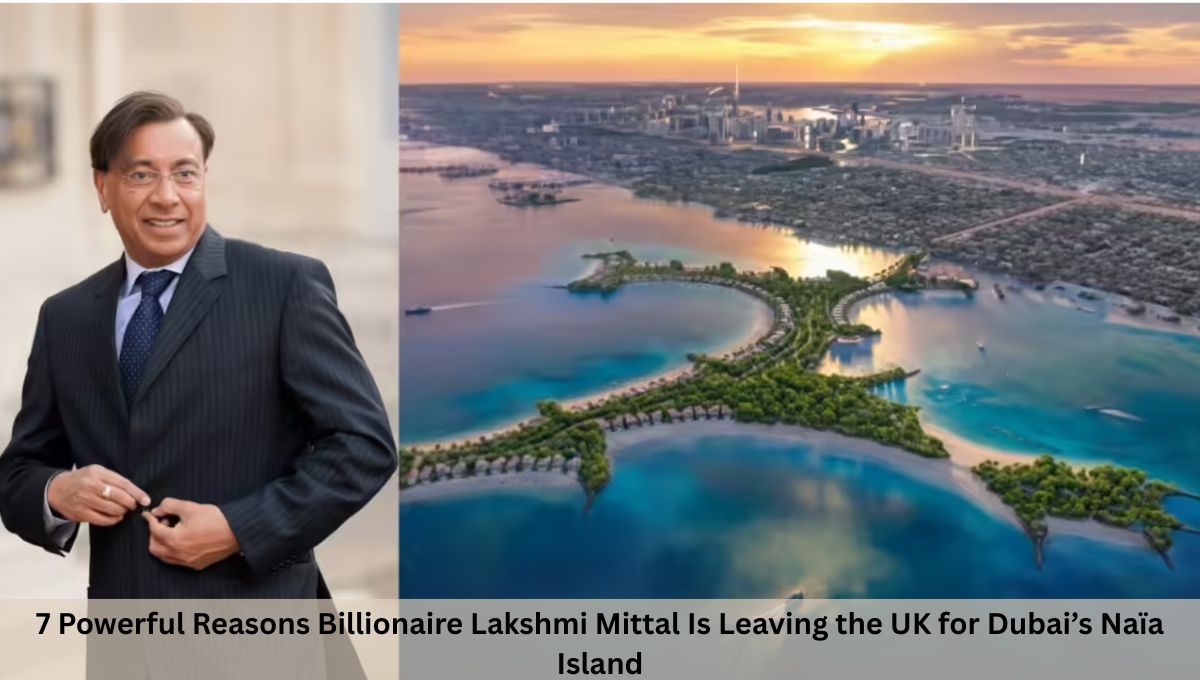
7 Powerful Reasons Billionaire Lakshmi Mittal Is Leaving the UK for Dubai’s Naïa Island under labour’s ultra-rich tax reforms. Indian-origin billionaire Lakshmi Niwas Mittal—one of the most recognisable faces in Britain’s business elite for nearly 30 years—is preparing to leave the United Kingdom. His move comes at a decisive moment in British politics, as the newly elected Labour government under Prime Minister Keir Starmer and Chancellor Rachel Reeves advances an aggressive tax reform agenda targeting the ultra-wealthy.
For years, London has been a magnet for global billionaires, offering stability, international connectivity, and lenient tax structures such as the non-dom regime. But with sweeping tax reforms taking shape—including major changes to inheritance tax, capital gains tax, entrepreneurs’ relief, and debates over an “exit tax”—the landscape is shifting dramatically.
Lakshmi Mittal, founder of ArcelorMittal, the world’s second-largest steelmaker, is now among the most high-profile billionaires signalling their departure. According to The Sunday Times, he has become a resident taxpayer of Switzerland and is preparing to base himself primarily in Dubai, where he has recently expanded his property portfolio—including a major purchase on the new Naïa Island, a man-made luxury island being developed off the Jumeirah coastline.
This article breaks down everything you need to know: why Lakshmi Mittal is moving, what Naïa Island is, how the UK’s tax environment is changing, and why several wealthy British Indians and international entrepreneurs are fleeing the country at record levels.
7 Powerful Reasons Billionaire Lakshmi Mittal Is Leaving the UK for Dubai’s Naïa Island
Who Is Lakshmi Mittal? A Brief Profile of the ‘King of Steel’
Lakshmi Mittal’s story is one of the most remarkable business journeys in modern global industry. Born in Rajasthan in 1950 and raised in Kolkata in a family of steelmakers, he entered the metals industry early, setting up his first plant in Indonesia in 1976. Over the next decades, he built a massive global steel empire that culminated in the landmark 2006 merger of Mittal Steel and Arcelor, creating ArcelorMittal.
Today the company:
- Earns $62.4 billion in annual revenue
- Employs over 125,000 people worldwide
- Reported $1.3 billion net income in 2024
- Has manufacturing operations across Europe, North America, South America, Asia, and Africa
Mittal’s personal wealth stands at:
- £15.4 billion (The Sunday Times Rich List 2025)
- $22.1 billion (Forbes Real Time Billionaires)
His influence extended far beyond industry. Since moving to London in 1995, he has:
- Donated over £5 million to the Labour Party
- Purchased multiple mansions on Kensington Palace Gardens, known as “Billionaires’ Row”
- Supported philanthropic ventures in education, medicine and sports
- Played a prominent role in the London Olympics, including funding the Orbit Tower
For years, he symbolised Britain’s ability to attract global wealth. But now that era appears to be ending.
Why Lakshmi Mittal Is Leaving the UK: A Deep Dive Into the Tax Turmoil
According to The Sunday Times, Mittal’s decision is rooted firmly in the Labour government’s tax overhaul.
Here are the 7 powerful reasons driving his exit.
1. The Abolition of the Non-Dom Regime
The UK’s long-standing non-dom (non-domiciled) tax system allowed wealthy residents born overseas to avoid paying tax on foreign income. It was one of the biggest attractions for global billionaires settling in London.
Labour is eliminating this regime.
This means:
- Foreign income will become taxable
- Global assets will fall under UK inheritance tax
- Wealthy residents lose decades of built-in tax protection
For someone like Lakshmi Mittal, whose family wealth and assets span continents, this change is significant and costly.
2. Inheritance Tax Became the Breaking Point
The defining factor behind Mittal’s move is not income tax or capital gains tax—but inheritance tax (IHT).
The UK imposes a 40% inheritance tax on estates above £325,000, and under the proposed reforms, global assets could become taxable.
An adviser quoted by The Sunday Times said:
“It wasn’t the tax on income that was the issue. It was inheritance tax. Many wealthy people from overseas cannot understand why all their global assets should be subject to UK inheritance tax.”
For billionaires with multinational holdings, the risk becomes massive.
In contrast:
- Dubai has 0% inheritance tax
- Switzerland offers multiple tax-friendly cantons
- UAE provides full clarity on asset protection for global families
In a world where wealth is internationally mobile, inheritance tax has become the most feared liability.
3. Fears of an Exit Tax Sent Shockwaves Through the Elite
During early Budget discussions, there were strong indications that Chancellor Rachel Reeves might impose an “exit tax” on high-net-worth individuals leaving the UK.
The proposal included:
- A 20% charge on unrealised capital gains
- Tax on key global assets
- Restrictions on moving family wealth abroad
Even though the government eventually stepped back, the damage was done.
Tech entrepreneur Herman Narula, also considering leaving for Dubai, called the idea:
“Completely insane… It has forced a lot of people to leave.”
For billionaires like Mittal, unpredictability can be more unsettling than the tax burden itself.
4. Rising Capital Gains Tax & Reduced Entrepreneurial Relief
Reeves’ first Budget already included several measures affecting wealthy individuals:
- Increased Capital Gains Tax
- Reduced entrepreneurs’ relief
- New rules on family business transfers
- Higher employer national insurance contributions
These decisions have especially affected global business families and those operating international corporations from the UK.
5. Loss of Confidence in UK’s Policy Stability
Multiple wealthy residents have expressed concerns over:
- Sudden tax changes
- Uncertainty about the next five Budgets
- Perception that the ultra-rich are being politically targeted
Mittal is known for long-term planning. Policy volatility is incompatible with the scale of his global empire.
6. Declining Public Services Despite Rising Taxes
Some wealthy British Indians say that high taxes are no longer justified.
The Times of India quoted IT consultant Ganapati Bhat, who said:
“I am not seeing any return on the high taxes I pay. No improvements in NHS, growth or infrastructure.”
While this is a broader sentiment, it reflects a widespread belief that the UK is losing competitiveness.
7. Dubai Offers a Clear, Attractive Alternative
Dubai has become the world’s fastest-growing destination for millionaires.
Its appeal includes:
- Zero income tax
- Zero inheritance tax
- Zero capital gains tax
- Transparent legal and asset-ownership framework
- Political stability
- Ultra-luxury living standards
- A fast-growing financial district
For global families like the Mittals, the UAE—and especially Dubai—ticks every box.
What Is Naïa Island? The Ultra-Luxury Dubai Island Mittal Is Moving To
One of the most buzzworthy parts of Mittal’s move is his investment in Naïa Island, a new super-exclusive, man-made island off the coast of Jumeirah.
Here’s everything we know.
Naïa Island: Dubai’s New Billionaire Enclave
The island is being developed by Shamal Holding, the investment group behind major UAE real-estate projects.
Key features of Naïa Island:
- A private, low-density luxury island
- Located in the water between Umm Suqeim and Jumeirah 3
- Ultra-premium villas and branded residences
- The Middle East’s first Cheval Blanc maison (by LVMH)
- Private beaches for residents
- Estate plots priced at $25 million for land alone
The project is expected to open in 2029.
Mittal reportedly bought:
- Multiple premium land plots
- Large stretches of the development, according to The Sunday Times
- In addition to his $200 million Emirates Hills mansion
This indicates he intends to spend a significant part of his future life in Dubai.
Lakshmi Mittal’s Life in London: The End of an Era
Even as Mittal prepares to shift his base, he reportedly has no plans to sell his London homes.
His Kensington Palace Gardens estate—nicknamed “Taj Mittal”—is one of London’s most iconic billionaire residences.
Features include:
- 55,000 sq ft
- Marble from the same quarry as the Taj Mahal
- A ballroom
- Turkish baths
- A jewel-encrusted swimming pool
- Parking for 20 cars
He has been a major donor, employer, landlord, and public figure in Britain for nearly three decades. His exit marks the end of a defining chapter in the story of London’s global elite.
A Bigger Trend: Why the Super-Rich Are Fleeing the UK
Mittal is not alone.
A record 691 millionaires left the UK in April 2024, a 79% increase from the previous year (The National).
Others leaving include:
- Nik Storonsky (Revolut co-founder)
- Rio Ferdinand (former England footballer)
- Nassef Sawiris (Egyptian billionaire)
- John Fredriksen (shipping magnate)
- Shravin Mittal (Bharti Airtel heir)
Many British Indians are also reassessing life in the UK due to:
- High taxes
- Declining public services
- Sluggish economic growth
- Uncertainty about future tax rules
- Potential exit charges
A group of wealthy entrepreneurs—including Surinder Arora and Ajaz Ahmed—wrote an open letter to Rachel Reeves warning that:
“There is alarming evidence that entrepreneurs are leaving the UK.”
Is Britain Losing Its Super-Rich?
A central concern is whether London may lose its global financial magnetism.
For decades, Britain promoted itself as:
- A stable business hub
- A low-risk political environment
- A friendly destination for international wealth
But as policies shift, Dubai, Switzerland, Singapore, and even Italy and Greece are becoming more competitive.
The UK risks losing:
- High-grade investors
- Large taxpayers
- Philanthropists
- Company headquarters
- Wealth creators
- Global corporate families
The departure of someone as prominent as Lakshmi Mittal may accelerate this trend.
Conclusion: Lakshmi Mittal’s Move Is a Turning Point for Britain
Lakshmi Mittal leaving the UK is not just a personal relocation—it is a symbolic moment that reflects the changing global flows of wealth. The billionaire who once represented the promise of London as a global capital is now building a future in Dubai and Switzerland, signalling a deep shift in the world’s financial geography.
Naïa Island, with its ultra-luxury private residences and tax-friendly environment, offers exactly what the UK can no longer provide: long-term certainty for global wealth. As Britain prepares for more tax reforms in the coming years, the exodus of billionaires is expected to grow—and Lakshmi Mittal’s departure may be remembered as the moment the tide truly turned.
Also Read: Trump vs Musk: The Billionaire Feud That’s Shaking Politics and Business
Also Read: Why Steel Tycoon Lakshmi Mittal Is Leaving UK — The ‘Rich Tax’ Issue Explained
Related Posts:
- 12 Explosive Days That Left Keir Starmer Fighting to…

- 7 Critical Signals Behind Starmer’s Bold China Reset…

- Keir Starmer Vows Britain Will Never Surrender to…

- 9 Powerful Moments That Made Dubai’s New Year Truly…

- 7 Powerful Reasons China Sees UK’s Starmer Visit as…

- 7th Prime Minister in a Decade: Andy Burnham's…