7 Powerful Reasons China Sees UK’s Starmer Visit as a Strategic Reset and the end of the golden era. Beijing is not always the most welcoming city in winter. Frigid winds sweep down from northern China, freezing lakes into solid glass and forcing residents to wrap themselves in layers of wool and down. It is a city where survival, not ceremony, often feels like the priority in January.
And yet, despite the cold, Beijing has been unusually busy.
Over the past two months, the Chinese capital has welcomed a steady procession of world leaders:
from France, South Korea, Ireland, Canada, and Finland.
Germany’s chancellor is due next. And now, stepping into this diplomatic queue, is Sir Keir Starmer — the first British prime minister to visit China in eight years.
To Beijing, this is not coincidence. It is choreography. China does not see Starmer’s visit as an isolated bilateral engagement. Instead, it views it as one piece of a much larger geopolitical recalibration, unfolding quietly but decisively as Western nations reassess their alliances in an era of US unpredictability.
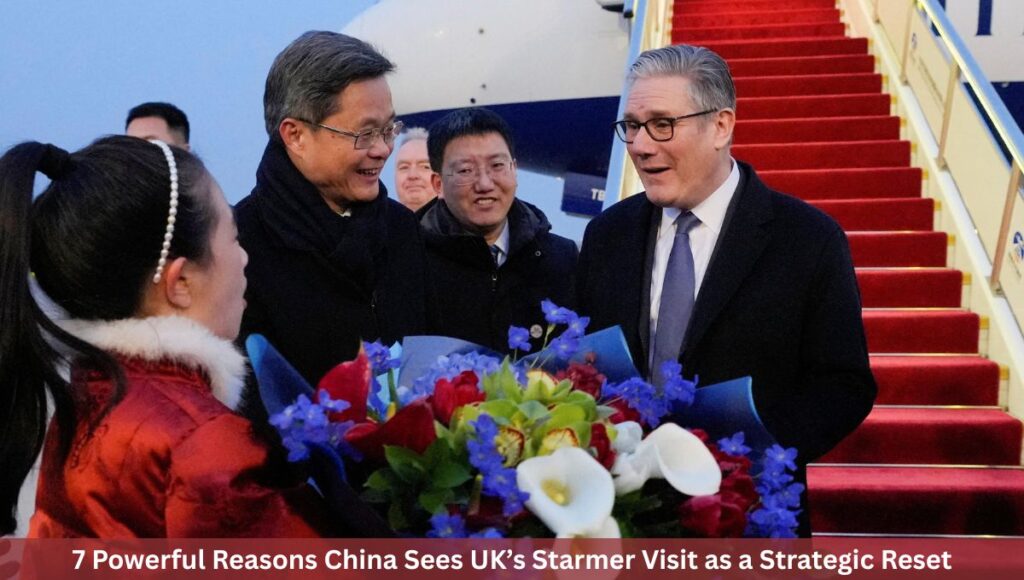
7 Powerful Reasons China Sees UK’s Starmer Visit as a Strategic Reset
A Winter of Diplomacy in Beijing
From Beijing’s perspective, the sudden rush of Western leaders through its gates sends a powerful signal.
For much of the past decade, China has been treated by many Western capitals as a strategic risk rather than a partner — criticised over human rights, sanctioned over technology, and increasingly isolated in global forums dominated by US influence.
Now, the mood is shifting.
Trade wars, tariff threats, and geopolitical shocks emanating from Washington have forced America’s allies to hedge their bets.
China, ever attentive to strategic openings, sees this moment as an opportunity to reposition itself as something it has long claimed to be:
a stable, predictable alternative to US volatility.
Starmer’s arrival fits neatly into this narrative.
Why the UK Visit Matters More Than It Appears
On paper, the UK is no longer the economic heavyweight it once was. Brexit has reduced its influence inside Europe, and London’s global clout is increasingly constrained by domestic political turbulence.
Yet for Beijing, Britain still matters — symbolically, strategically, and economically.
The UK is:
- A permanent member of the UN Security Council
- A core US ally with deep intelligence ties
- A major financial hub
- A country wrestling openly with how dependent it should be on Washington
If China can stabilise relations with Britain — even modestly — it sends a message far beyond London.
It tells other Western capitals that engagement with Beijing is possible without total rupture with the US.
The Embassy Signal: A Diplomatic Green Light
One detail stands out in Beijing’s calculations:
the UK’s approval of plans for a sprawling new Chinese “mega-embassy” in London.
The decision had been delayed for months amid security concerns, particularly because the site lies close to sensitive fibre-optic cables serving financial institutions.
Chinese officials made it clear privately that Starmer’s visit would not be announced until this issue was resolved.
Once approval came through, the visit followed swiftly. To Beijing, this was more than a bureaucratic step.
It was proof that London was willing to compartmentalise security concerns and diplomacy — a crucial prerequisite for any meaningful engagement.
China’s Charm Offensive: Learning From the Carney Precedent
Starmer’s visit comes directly after a breakthrough moment for Beijing:
Canadian Prime Minister Mark Carney’s trip to China.
Carney went further than any Western leader in recent years, announcing a “new strategic partnership” and openly declaring that the global order was at a “point of rupture.”
For Beijing, this was gold.
Relations with Canada had been frozen for nearly a decade. Suddenly, the ice cracked — and Carney’s willingness to say publicly what many leaders only whisper privately was interpreted in China as validation of its long-term strategy.
Washington’s response was swift and brutal:
President Donald Trump threatened 100% tariffs on Canada if it deepened trade ties with China.
The lesson for Beijing was clear — and instructive.
The Binary World Order Problem
China believes the US is forcing its allies into an increasingly binary choice:
with us or against us.
Beijing’s counter-strategy is to undermine that framing. Starmer has already played his part by explicitly rejecting the idea that Britain must choose between the US and China.
In Beijing, those words are carefully logged. But Chinese officials are not naïve. As Dr Yu Jie of Chatham House notes, Beijing is “clear-eyed” about the limits of what it can achieve.
It does not expect to pull Britain out of Washington’s orbit. What it wants instead is space — diplomatic, economic, and psychological.
From ‘Golden Age’ to ‘Ice Age’
The shadow hanging over this visit is the memory of the so-called “golden era” of UK–China relations.
In 2015, then Prime Minister David Cameron hosted President Xi Jinping at a countryside pub, where the two shared fish and chips and pints of beer.
Britain opened its doors to Chinese investment, from nuclear power to real estate.
That era ended badly.
Concerns over espionage, intellectual property theft, Hong Kong, and Huawei shattered trust. By 2020, Huawei was banned from Britain’s 5G network.
Chinese funding was withdrawn from nuclear projects. Political rhetoric hardened.
Starmer himself has called this period an “ice age.”
China does not expect — or want — a return to the old model.
Why a New Golden Era Is Unlikely
Chinese analysts understand that the economic balance has shifted dramatically.
In 2015, Britain believed it could attract Chinese capital on favourable terms. In 2026, China knows it holds far more leverage.
Today, China:
- Produces one-third of all global goods
- Processes over 90% of rare earth minerals
- Manufactures 60–80% of solar panels, wind turbines, and electric vehicles
This dominance gives Beijing real power — and it has shown repeatedly that it is willing to use it.
Countries including South Korea, Australia, Japan, and Canada have all experienced economic retaliation when relations soured.
A Relationship Built on Caution, Not Romance
For Britain, China remains officially classified as a national security threat. MI5 has warned repeatedly of Chinese state espionage.
Parliament has accused Beijing-linked entities of interference in academia, business, and politics. Human rights concerns remain unresolved.
At the same time, China is Britain’s third-largest trading partner, with UK exports worth around £45 billion annually. This contradiction defines Starmer’s approach.
Starmer’s ‘Mature’ Strategy
In Beijing, Starmer has deliberately avoided grand declarations.
Instead, he has emphasised:
- A “mature” relationship
- Engagement without naivety
- Cooperation without sacrificing security
He has been explicit that Britain will not trade national security for economic gain.
To Chinese ears, this language is acceptable — even reassuring. Beijing prefers predictability over passion.
Business First: The Delegation Tells the Story
Perhaps the clearest signal of Britain’s priorities is who travelled with Starmer.
More than 50 senior executives joined the trip, including leaders from:
- HSBC
- Airbus
- British Airways
- AstraZeneca
- GSK
The message is unmistakable: this visit is about economic stabilisation, not ideological confrontation.
Deals are expected in financial services, life sciences, creative industries, and climate-linked technologies.
China’s View of Britain’s Domestic Fragility
Despite the warm rhetoric, Chinese analysts remain sceptical.
Some openly question whether Starmer will remain in office long enough to deliver on promises.
Others view Britain’s domestic politics as chaotic and fragile — a far cry from the confidence Beijing projects under Xi Jinping.
From China’s standpoint, this limits how far the relationship can realistically go.
The Visa Question and Soft Power
Beyond trade, Beijing sees cultural and people-to-people ties as a long-term investment.
China has already lifted visa requirements for citizens of 70 countries — but not the UK.
British officials hope this visit will change that.
In Beijing’s hutongs, British-run tour companies, pubs, and cultural spaces offer a glimpse of what soft power engagement once looked like — and what it could become again, cautiously.
The US Factor Looms Large
None of this happens in a vacuum.
President Trump’s tariff threats, Greenland ambitions, and transactional diplomacy have shaken Western confidence in US leadership.
Polling shows British trust in Washington declining sharply — almost matching concern levels about China.
Beijing sees this moment as structural, not temporary.
Why China Thinks This Moment Is Different
For Beijing, the significance of Starmer’s visit lies in timing, not tone.
This is happening:
- After a bruising US–China trade war
- Amid Western economic anxiety
- As allies openly hedge against Washington
- During China’s peak industrial dominance
Xi Jinping is more confident than at any point in his leadership.
Not a Reset — A Recalibration
China does not believe Britain is returning to Beijing’s embrace.
What it sees instead is something subtler and, arguably, more valuable:
a recalibration of Western thinking, where China is no longer treated solely as a problem to be contained, but as a reality to be managed.
That alone makes Starmer’s visit significant.
Conclusion: A Risk Worth Taking — For Both Sides
For Britain, the risk is obvious:
engagement with China invites political backlash, security concerns, and pressure from Washington.
For China, the risk is different:
overplaying its hand could reinforce fears and drive allies back toward the US.
For now, both sides appear willing to walk the narrow path between confrontation and cooperation. No one in Beijing expects a new golden era.
But in the frozen depths of winter diplomacy, even a slow, cautious thaw can reshape the global landscape. And that is why China believes this visit is part of something much bigger.
Also Read: 7 Critical Signals Behind Starmer’s Bold China Reset Amid US Turmoil
Also Read: UK’s Starmer tells Xi he wants ‘sophisticated’ ties with China
Related Posts:
- 5 Major Takeaways from the US Supreme Court's…

- 7 Big Takeaways: Macron’s High-Stakes China Visit…

- 7 Heartbreaking Facts About Venezuela's Earthquake Disaster

- In 8 Moves, EU Targets China-Linked Refineries and…

- 7 Powerful Truths: UAE Golden Visa vs Saudi Premium…

- 7 Powerful Facts About Ayatollah Ali Khamenei’s…