

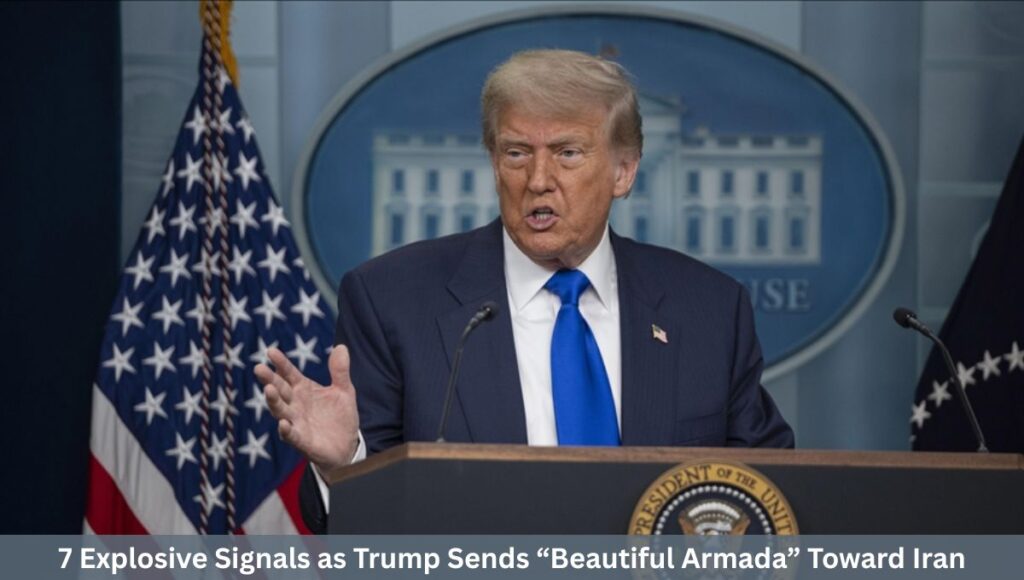
7 Explosive Signals as Trump Sends “Beautiful Armada” Toward Iran, Gulf states on edge. US President Donald Trump has once again escalated rhetoric around Iran, announcing that another American “armada” is moving toward the country even as he says he hopes Tehran will choose diplomacy over confrontation.
Speaking at a public event in Iowa, Trump struck a familiar balance between threat and negotiation—boasting of US military power while insisting that Iran wants to make a deal.
“By the way, there’s another beautiful armada floating toward Iran right now,” Trump said. “So we’ll see. I hope they make a deal. I hope they make a deal.”
The remarks come amid heightened military activity across the Middle East, growing warnings from Iranian officials, and deep unease among US allies who fear being dragged into a wider regional conflict.
7 Explosive Signals as Trump Sends “Beautiful Armada” Toward Iran
Trump’s ‘Beautiful Armada’ Comment Raises Stakes
Trump’s statement immediately drew attention because it follows confirmation that the USS Abraham Lincoln aircraft carrier strike group has already arrived in the region, significantly boosting US naval firepower near Iran.
It remains unclear whether Trump was referring specifically to the Abraham Lincoln group or to an additional deployment.
US officials have not publicly clarified whether a second carrier group or another naval task force is en route.
What is clear is the message Trump intended to send.
The president has repeatedly used the word “armada” in recent weeks to underscore America’s military presence, describing US naval movements as a warning rather than an act of war.
“We have a big armada next to Iran. Bigger than Venezuela,” Trump told Axios in a recent interview.
At the same time, Trump insists the pressure is designed to bring Iran to the negotiating table—not to spark open conflict.
US Military Buildup in the Middle East
USS Abraham Lincoln Arrives
According to US Central Command (CENTCOM), the USS Abraham Lincoln carrier strike group has arrived in West Asia, accompanied by guided-missile destroyers and support vessels.
The carrier’s arrival dramatically expands US options, from defensive operations to potential strikes, should the White House decide to escalate.
CENTCOM has framed the deployment as a move to:
- Defend US forces in the region
- Promote regional stability
- Deter Iranian aggression
Historically, such surges have often been defensive. However, similar buildups preceded last year’s US strikes on Iran’s nuclear facilities, raising concern that history could repeat itself.
Major US Air Exercises Announced
Alongside naval deployments, the US has announced multi-day air force exercises in the Middle East.
Lt. Gen. Derek France, commander of US Air Forces Central Command, said the drills are designed to ensure American forces can:
- Disperse under pressure
- Operate in contested airspace
- Generate combat sorties alongside regional partners
The Pentagon did not disclose exact locations or timelines, citing operational security.
Trump Says Iran ‘Wants to Make a Deal’
Despite the heavy military posture, Trump has consistently argued that Iran is seeking negotiations.
“They want to make a deal. I know so. They called on numerous occasions,” Trump told Axios.
US officials have echoed this view, saying Washington remains open to talks—provided Tehran understands the terms.
“We’re open for business if Iran wants to reach out,” a US official said, adding that Iran “knows what the terms are.”
Trump has portrayed the current strategy as one of maximum pressure paired with an open diplomatic door, a hallmark of his approach since withdrawing from the 2015 nuclear deal during his first term.
Iran Responds With Sharp Warnings
Iranian officials have responded angrily to the US military buildup, warning that any attack would trigger a powerful and destabilizing response.
IRGC Threatens Regional Fallout
Mohammad Akbarzadeh, political deputy of Iran’s Islamic Revolutionary Guard Corps (IRGC) naval forces, issued a blunt warning:
“Neighbouring countries are our friends, but if their soil, sky, or waters are used against Iran, they will be considered hostile.”
The statement underscores Iran’s intention to broaden any conflict beyond bilateral US-Iran confrontation if regional states cooperate with Washington.
Iranian military officials have also sought to project confidence, dismissing the arrival of US warships as exaggerated.
“The arrival of one or several warships does not impact Iran’s defensive determination,” said Foreign Ministry spokesperson Esmaeil Baghaei.
Iran claims its armed forces are monitoring every development and continuously upgrading readiness.
Iran’s Internal Crisis Fuels External Tensions
The standoff is unfolding against the backdrop of Iran’s deadly crackdown on nationwide protests, which erupted in late December and evolved into the most serious challenge to the Islamic Republic in years.
US-based human rights groups estimate:
- Over 6,000 protesters killed
- More than 17,000 additional deaths under investigation
Iran has acknowledged thousands of deaths but disputes the higher figures.
Trump has repeatedly warned Tehran against killing protesters, hinting at possible intervention if violence continues—though he has also suggested that executions and mass killings may now be slowing.
Regional Allies Refuse to Support Military Action
Saudi Arabia and UAE Say No
Key US allies in the Gulf have made it clear they do not want to be drawn into a conflict.
- Saudi Arabia has said it will not allow its airspace or territory to be used for attacks on Iran.
- United Arab Emirates, which hosts thousands of US troops at Al Dhafra Air Base, has similarly ruled out logistical support for any strike.
These refusals significantly complicate US military planning and underscore regional fears of escalation.
Gulf States Fear Blowback
Gulf governments worry that a war with Iran would:
- Disrupt energy markets
- Invite missile or drone retaliation
- Trigger attacks by Iran-backed militias
Their stance reflects growing regional fatigue with prolonged conflicts and proxy wars.
Iran-Backed Militias Signal Readiness
Several Iran-aligned groups across the Middle East have issued warnings following Trump’s remarks.
- Yemen’s Houthis have hinted at renewed attacks on Red Sea shipping.
- Iraq’s Kataib Hezbollah warned that any strike on Iran would lead to “total war.”
Meanwhile, Lebanon’s Hezbollah stopped short of committing to intervention but said it is preparing for “possible aggression.”
“These details will be determined by the battle,” Hezbollah leader Sheikh Naim Kassem said.
Psychological Warfare on the Streets of Tehran
In Iran’s capital, the tension is visible.
CNN journalists reported large government posters in Tehran depicting:
- A US aircraft carrier destroyed
- American sailors lying dead on its deck
- English and Farsi warnings reading: “If you sow the wind, you will reap the whirlwind.”
Another poster shows the 2016 capture of a US Navy patrol boat and its crew kneeling in surrender—an unmistakable message aimed at deterrence.
Trump’s Strategy: Pressure Without War?
Trump’s approach mirrors his earlier “maximum pressure” campaign:
- Severe sanctions
- Military deployments
- Public threats paired with negotiation offers
He has repeatedly said he prefers a deal to war.
“I’d rather not see anything happen,” Trump said. “But we’re watching them very closely.”
Yet critics argue that the scale of the military buildup risks miscalculation—especially in a region already on edge.
Economic Pressure Mounts Inside Iran
As tensions rise, Iran’s economy continues to deteriorate.
- The Iranian rial has plunged to a record 1.5 million to the US dollar
- Inflation and unemployment remain severe
- Sanctions continue to choke oil revenues
Analysts say economic pressure may be driving Tehran’s reported interest in talks, even as it projects defiance publicly.
What Comes Next?
Three Possible Scenarios
- Negotiations Resume
Iran engages the US quietly to ease sanctions and avoid confrontation. - Limited Military Clash
A misstep or proxy attack triggers targeted strikes without full-scale war. - Regional Escalation
A broader conflict erupts involving militias, shipping lanes, and Gulf states.
For now, Trump insists the door remains open.
“They should have made a deal the first time,” he said. “They’d have a country.”
Conclusion: A Fragile Standoff
Trump’s declaration that another “beautiful armada” is sailing toward Iran highlights a moment of extreme volatility in the Middle East.
The United States is signaling overwhelming force. Iran is warning of devastating retaliation. Regional allies are stepping back. Militias are on alert. And diplomacy hangs by a thread.
Whether this ends in a renewed deal—or a dangerous confrontation—may depend on decisions made in the coming days, both in Washington and Tehran. For now, the armadas are moving, the rhetoric is rising, and the world is watching.
Also Read: 9 Explosive Signals as Trump Sends “Massive Armada” Toward Iran
Also Read: Top Turkish diplomat says Iran ready to negotiate, warns against US attack
Related Posts:
- 11 Explosive Warnings as Trump Vows to ‘Knock the…

- Trump Reveals Private Nickname for Melania During…

- 12 Explosive Claims as Donald Trump Says Iran War…
- 10 Explosive Warnings as Donald Trump Calls Iran…
- 9 Explosive Signals as Trump Sends “Massive Armada”…
- Trump’s 2025 Gaza Peace Plan Signing and Historic…
