9 Explosive Signals as Trump Sends “Massive Armada” Toward Iran, fueling fears of escalation in the Middle East. United States President Donald Trump has confirmed that a “massive fleet” of American warships is heading toward Iran, reigniting fears of a fresh escalation in Middle East tensions even as the White House insists it hopes military force will not be used.
Speaking to reporters aboard Air Force One while returning from the World Economic Forum in Davos, Switzerland, Trump described the deployment as a precautionary move, while repeatedly emphasizing that Washington is “watching Iran very closely.”
“We have a big force going toward Iran,” Trump said. “I’d rather not see anything happen, but we’re watching them very closely.”
The comments come after weeks of heightened rhetoric, mixed signals from the White House, and growing concern among allies and analysts over whether the United States is once again positioning itself for potential military confrontation with Tehran.
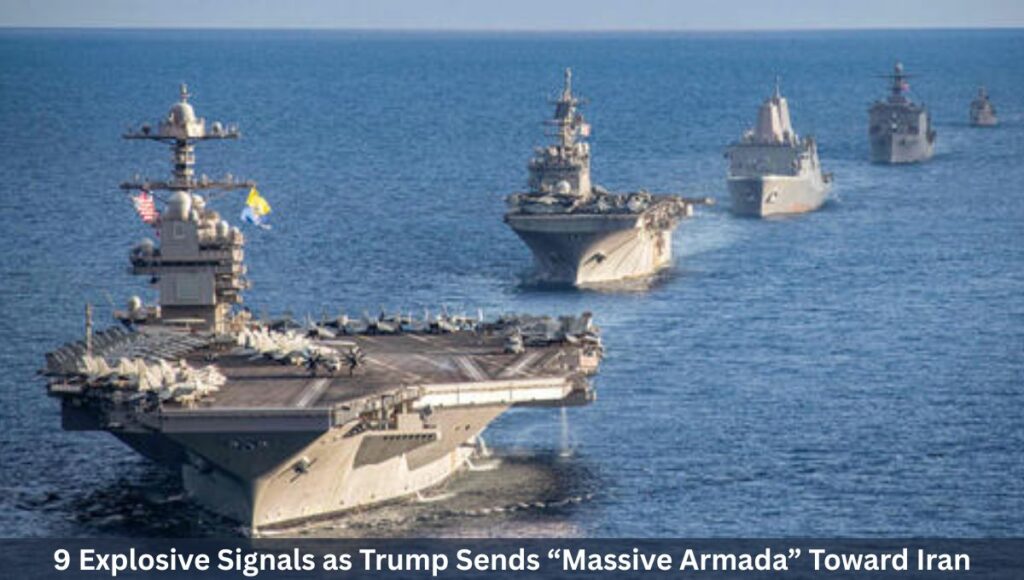
9 Explosive Signals as Trump Sends “Massive Armada” Toward Iran
Trump’s Words: ‘An Armada’ and a ‘Massive Fleet’
Trump used unusually stark language to describe the US military movement, referring to it as both an “armada” and a “massive fleet.”
“We have a lot of ships going in that direction, just in case,” he said.
“Maybe we won’t have to use it. We’ll see what happens.”
Despite the repeated emphasis on restraint, the scale and visibility of the deployment have drawn global attention.
US officials have confirmed that an aircraft carrier strike group, along with several guided-missile destroyers and other assets, is moving toward the Middle East.
The centerpiece of that deployment is the USS Abraham Lincoln, which was reportedly diverted from maneuvers in the South China Sea to the Gulf region.
Why Now? Protests, Executions, and Nuclear Fears
Iran’s Protest Crackdown
The immediate backdrop to Trump’s warning is Iran’s violent crackdown on months-long anti-government protests that began in late December and spread nationwide.
Iranian authorities have acknowledged that 3,117 people were killed, including civilians and security forces. Independent rights groups, including the US-based Human Rights Activists News Agency (HRANA), say the actual death toll may exceed 5,000, with thousands more cases still under review.
The scale of the violence has drawn international condemnation and intensified pressure on Tehran.
Trump’s Claim: ‘I Stopped 837 Hangings’
One of Trump’s most dramatic assertions is that his threats against Iran directly led to the cancellation of planned executions of protesters.
“I stopped 837 hangings,” Trump said.
“They would have been dead. Every one of them would have been hung.”
According to Trump, Iranian authorities were preparing to carry out mass executions when he issued a warning that any such action would trigger devastating US retaliation.
“I said, if you hang those people, you’re going to be hit harder than you’ve ever been hit,” he said.
“It’ll make what we did to your nuclear program look like peanuts.”
Trump claims the executions were cancelled an hour before they were due to take place, describing the reversal as “a good sign.”
Iranian officials, however, have denied that any such execution plans existed, setting up a sharp dispute over facts that remains unresolved.
From Threats to Hesitation — and Back Again
Trump’s Shifting Tone
Only days earlier, Trump appeared to back away from the prospect of immediate military action after the White House said Tehran had halted executions.
His tone softened, with the president saying he hoped force would not be necessary and that he remained open to talks with Iran.
Yet his latest comments — combined with confirmed military deployments — suggest that Washington is keeping all options firmly on the table.
“We’re watching Iran,” Trump said.
“I’d rather not see anything happen.”
US Military Build-Up: What Is Actually Moving?
Carrier Strike Group and Warships
US officials say the following assets are moving toward the Middle East:
- USS Abraham Lincoln aircraft carrier
- Multiple guided-missile destroyers
- Additional naval escorts
- Fighter aircraft and support elements
Some officials also confirmed that additional air-defense systems, including Patriot and THAAD batteries, are under consideration to protect US bases and allies from potential Iranian retaliation.
The deployments began last week from the Asia-Pacific region, mirroring US military movements that preceded American strikes on Iran’s nuclear facilities in June 2025.
Satellite Images Raise Questions
Despite Trump’s description of a “massive fleet,” satellite imagery reviewed by defense analysts has so far shown no major influx of US airpower at key regional hubs such as Diego Garcia, a strategic Indian Ocean base often used for bomber deployments.
Analysts caution that:
- Some movements may not be visible via open-source imagery
- Naval deployments can be harder to track than air operations
- The build-up may be incremental rather than overwhelming
Still, experts note that the current posture falls short of preparations for a full-scale war, suggesting deterrence rather than imminent attack.
Iran Responds: ‘Finger on the Trigger’
Tehran’s response has been defiant.
The commander of Iran’s Islamic Revolutionary Guard Corps (IRGC) warned that Iran’s forces have their “finger on the trigger” and are ready to respond to any US or Israeli action.
“Our powerful armed forces have no qualms about firing back with everything we have,” Iranian officials said.
Iranian commanders also warned that US bases, interests, and allies across the region would be considered legitimate targets if Iran is attacked.
A Warning From Tehran’s Top Diplomat
Iranian Foreign Minister Abbas Araghchi, writing in a US newspaper, warned that another confrontation would spiral far beyond what Washington might expect.
“An all-out confrontation will certainly be ferocious,” Araghchi wrote.
“It will drag on far, far longer than fantasy timelines being peddled to the White House.”
He stressed that Iran does not seek war but insisted that Tehran would respond decisively if attacked.
The Nuclear Question Looms Large
‘They Can’t Do the Nuclear’
Trump has repeatedly said that Iran must not resume its nuclear program following US strikes on key sites last year.
“They can’t do the nuclear,” Trump said.
“If they do it, it’s going to happen again.”
According to the International Atomic Energy Agency (IAEA):
- Iran possesses approximately 440.9 kg of uranium enriched up to 60% purity
- If enriched further, that stockpile could be sufficient for up to 10 nuclear bombs
- The IAEA has not verified Iran’s stockpile for at least seven months, despite guidelines calling for monthly inspections
The lack of verification has added to uncertainty and mistrust.
June 2025: A Recent Precedent
The current tension cannot be separated from events in June 2025, when the US joined Israel’s 12-day war against Iran, targeting nuclear enrichment and ballistic missile facilities.
US officials later acknowledged that a significant military buildup had preceded those strikes — a fact now fueling speculation that history could repeat itself.
Is This About Deterrence or Escalation?
Military analysts say the deployment serves multiple purposes:
- Deterrence: Signaling strength to discourage Iranian actions
- Defense: Protecting US forces and allies
- Flexibility: Giving Trump military options if diplomacy fails
US officials insist such buildups are often defensive and not necessarily precursors to attack.
However, critics argue that visible military pressure increases the risk of miscalculation.
Global Reactions: Allies Watch Nervously
Europe and the Gulf
European allies have expressed quiet concern, particularly given the fragile state of global energy markets and shipping routes in the Gulf.
Gulf states, meanwhile, are reinforcing air defenses and monitoring developments closely, wary of becoming collateral targets in any confrontation.
The UK has already announced that Royal Air Force Typhoon jets are deploying to the region for defensive purposes under its security agreements with Qatar.
Trump’s Broader Foreign Policy Context
The Iran standoff comes as Trump pursues an aggressive, unconventional foreign policy agenda that includes:
- Creation of the Board of Peace, with himself as chairman
- Pressure on allies to increase financial contributions
- Willingness to use or threaten force as leverage
- A record of sudden shifts from confrontation to negotiation
Asked whether he plans to remain chairman of the Board of Peace indefinitely, Trump said the charter allows it “in theory for life,” though he added he was unsure he wanted that.
Domestic Politics and Messaging
Trump’s statements on Iran also resonate strongly with his domestic political base, which views his approach as tough and decisive.
Supporters argue that:
- Trump is preventing executions and nuclear escalation
- Military pressure avoids prolonged wars
- Strength deters adversaries
Critics counter that:
- Claims about executions are unverified
- Military brinkmanship raises global risks
- Diplomacy is being sidelined
Protests Inside Iran: A Nation Under Strain
While protests in Iran appear to have ebbed in recent days, underlying grievances remain unresolved.
The unrest began as demonstrations over economic hardship and rapidly evolved into nationwide protests challenging the political system.
Rights groups continue to warn that renewed violence is possible.
What Happens Next?
Several key developments will shape the coming weeks:
- Arrival of US naval assets in the Gulf
- Iran’s response to increased US presence
- Any movement on nuclear inspections
- Potential diplomatic outreach behind the scenes
Trump has repeatedly said he is open to talks, even as he warns of overwhelming force.
A High-Stakes Standoff With No Easy Exit
The sight of a US “massive armada” moving toward Iran underscores just how volatile the situation remains.
Trump insists he hopes force will not be used. Iran insists it will respond if attacked. Between those positions lies a narrow and dangerous path — one where miscalculation could have consequences far beyond the region.
For now, the world watches as warships move, warnings fly, and two longtime adversaries edge closer once again to the brink — hoping, as Trump put it, that “maybe we won’t have to use it.”
Also Read: 7 Explosive Signals: Netanyahu’s Stark Iran Warning as US Forces Mass
Also Read: Trump warns US ‘armada’ is approaching as Iran death toll hits 5,000