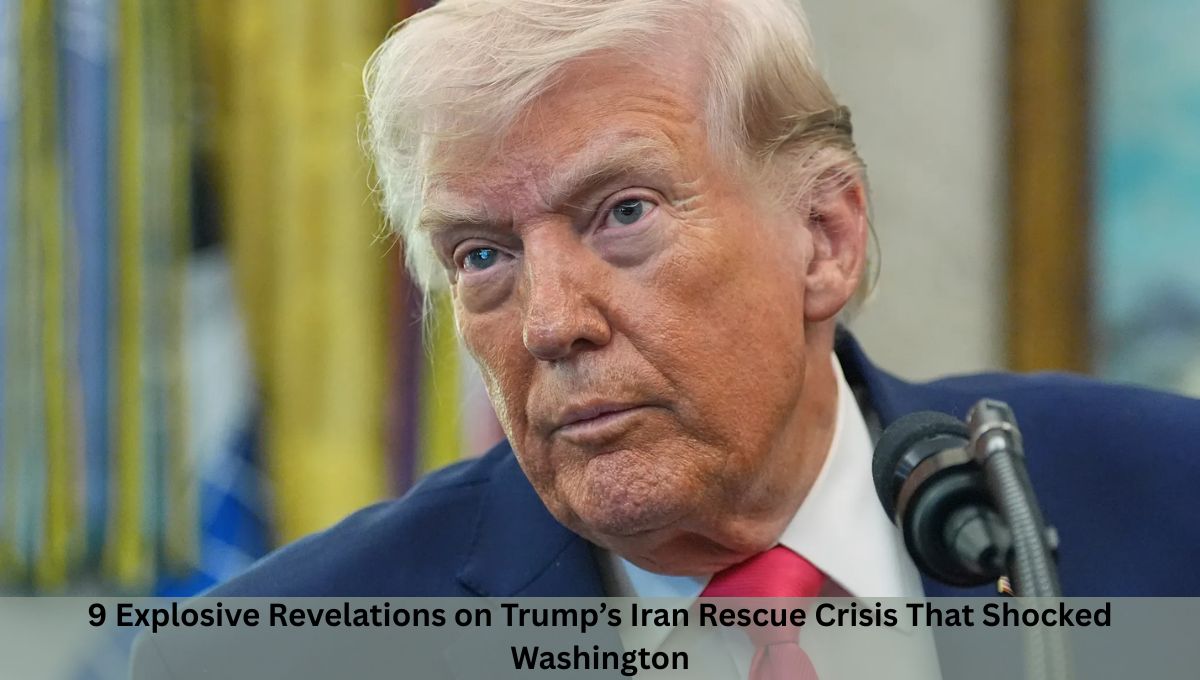
9 Explosive Revelations on Trump’s Iran Rescue Crisis That Shocked Washington — A deep analysis. A high-stakes U.S. military rescue mission deep inside Iran has exposed dramatic tensions within the White House, raising serious questions about leadership dynamics, military decision-making, and the broader trajectory of the ongoing U.S.–Iran confrontation.
According to a detailed report by The Wall Street Journal, U.S. President Donald Trump was deliberately kept out of real-time operational discussions after reportedly “screaming at aides for hours” following the downing of a U.S. fighter jet over Iranian territory.
The episode, which unfolded over a tense 24-hour period, highlights the complexity of modern warfare, the fragility of command structures under pressure, and the geopolitical risks tied to escalating tensions around the Strait of Hormuz.
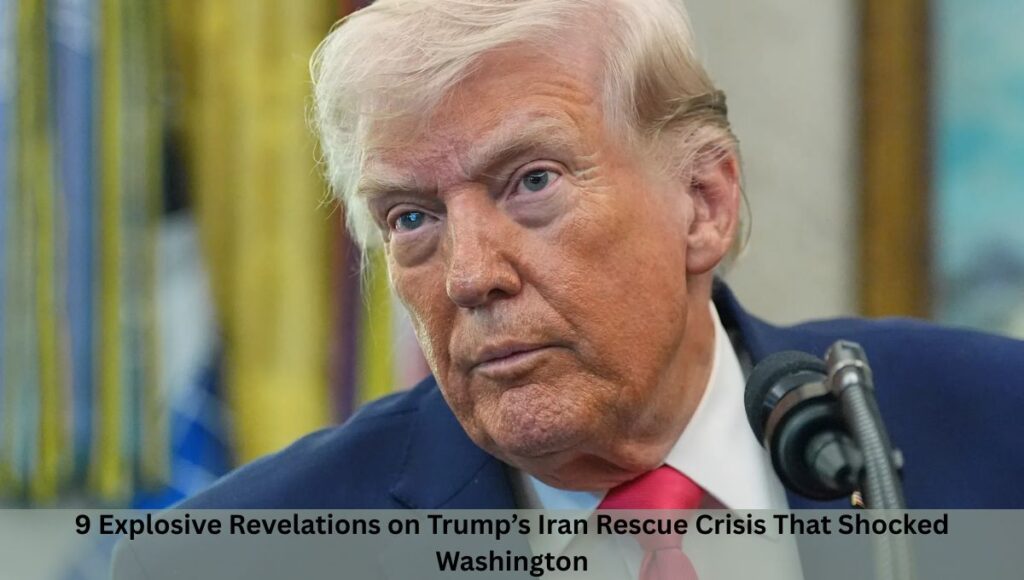
9 Explosive Revelations on Trump’s Iran Rescue Crisis That Shocked Washington
A Crisis Ignited: US Jet Shot Down Over Iran
The crisis began when a U.S. F-15 fighter jet was shot down over Iran during heightened hostilities.
Two American airmen onboard were forced to eject into hostile territory, triggering immediate alarm in Washington.
The situation quickly escalated into a race against time. One airman was recovered relatively quickly.
However, the second remained stranded behind enemy lines for more than 24 hours, evading Iranian forces in rugged terrain while U.S. military planners scrambled to mount a rescue operation.
Operating inside Iran posed a unique challenge.
The U.S. military has not conducted ground operations in the country for decades, meaning planners had to navigate unfamiliar terrain, avoid detection, and minimize the risk of triggering a broader conflict.
Inside the White House: Chaos and Control
Back in Washington, the mood was anything but calm.
Reports indicate that President Trump reacted with intense anger upon learning of the downed aircraft and missing personnel.
He allegedly demanded immediate action, repeatedly instructing officials to “go get them” despite the operational complexities involved.
This urgency clashed with the careful, methodical planning required for such a mission.
Senior officials grew concerned that the president’s impatience could interfere with sensitive decision-making. As a result, they made the unusual decision to limit his involvement.
Kept Out of the Situation Room
In a striking development, aides reportedly kept Trump out of the Situation Room during critical phases of the operation.
Instead of receiving continuous updates, he was briefed only at what officials described as “meaningful moments.”
This approach reflects a significant deviation from traditional wartime protocol, where the president typically maintains close oversight of military operations.
Officials involved in the mission justified the move by citing concerns that real-time presidential reactions could disrupt the operation or increase risks for personnel on the ground.
The Shadow of 1979: Hostage Crisis Fears
A key factor influencing Trump’s reaction was his long-standing concern over a repeat of the Iran hostage crisis.
During that crisis, 52 American diplomats were held hostage for 444 days, severely damaging the presidency of Jimmy Carter.
Trump has frequently referenced the episode as a political and strategic failure. According to reports, images of that crisis were “looming large” in his mind during the Iran rescue mission.
The fear of a similar scenario—where American personnel are captured and held—appears to have shaped both his urgency and his anxiety.
The High-Risk Rescue Operation
The rescue mission itself was a complex, multi-layered operation involving coordination between the Pentagon, intelligence agencies, and special operations forces.
Key Challenges Faced:
- Navigating hostile Iranian terrain
- Avoiding detection by Iranian military units
- Managing real-time intelligence updates
- Preventing escalation into full-scale conflict
At one point, complications arose when an extraction aircraft became stuck in desert terrain, increasing the risk of exposure.
To counter this, U.S. forces reportedly used deception tactics, including decoy movements and misinformation campaigns, to divert attention away from the rescue zone.
A Race Against Time
The second airman’s survival depended on stealth, endurance, and precision timing.
For over 24 hours, the stranded crew member evaded Iranian forces, hiding in mountainous terrain while U.S. teams worked to locate and extract him.
Finally, in a night-time operation, U.S. commandos successfully rescued the airman, bringing the mission to a close and avoiding what could have become a major geopolitical crisis.
Trump’s Leadership Style Under Scrutiny
The incident has reignited debate about Trump’s leadership style during high-pressure situations.
Critics argue that his impulsive behavior and aggressive rhetoric risk undermining strategic coherence.
Some analysts suggest that battlefield successes alone are insufficient without a clear long-term strategy.
Among those raising concerns is policy expert Kori Schake, who noted that military gains have not translated into a defined path to victory.
A Dual Approach: Aggression and Negotiation
Interestingly, Trump’s actions reflect a dual strategy:
- Publicly aggressive rhetoric toward Iran
- Behind-the-scenes efforts to push for negotiations
At times, he has reportedly used provocative language intentionally, believing it could pressure Iran into talks.
This approach, however, has drawn mixed reactions globally, with some viewing it as strategic brinkmanship and others as destabilizing.
The Strait of Hormuz: A Global Flashpoint
The crisis unfolded against the backdrop of rising tensions in the Strait of Hormuz, a critical maritime route through which a significant portion of the world’s oil supply passes.
Any disruption in this region has immediate global consequences, affecting:
- Oil prices
- Shipping routes
- Energy security
Following the rescue mission, Trump issued a strongly worded warning to Iran regarding the strait, drawing attention for its tone and intensity.
White House Response: Defending the President
Despite the controversy, the White House has strongly defended Trump’s handling of the crisis.
Press Secretary Karoline Leavitt described the president as a “steady leader,” emphasizing that his decisions ultimately contributed to the successful rescue of American personnel.
Officials also highlighted the complexity of the operation and the need for flexible decision-making under extreme conditions.
Strategic Decisions: Avoiding Escalation
Another critical aspect of the crisis was Trump’s reported reluctance to escalate the conflict further.
According to reports, he rejected a proposal to seize Iran’s Kharg Island—a key oil export hub—due to concerns over potential U.S. casualties.
This decision underscores a broader pattern:
- Willingness to apply pressure
- Reluctance to commit ground troops in high-risk scenarios
Trump reportedly feared that deploying troops could lead to significant losses, echoing concerns faced by previous U.S. presidents during wartime.
A War Without Clear Direction?
The broader question emerging from this episode is whether the U.S. strategy toward Iran has a clearly defined objective.
While tactical successes—such as the rescue mission—demonstrate military capability, critics argue that they do not necessarily translate into strategic clarity.
Key concerns include:
- Lack of a defined endgame
- Risk of prolonged conflict
- Potential for unintended escalation
At the same time, ongoing diplomatic efforts suggest that both sides may still be seeking a negotiated resolution.
Global Implications
The implications of this crisis extend far beyond Washington and Tehran.
For global audiences, the key takeaways include:
- Rising geopolitical instability in the Middle East
- Increased risks to global energy markets
- The evolving nature of U.S. military engagement
Countries dependent on oil imports are particularly sensitive to developments in the Strait of Hormuz, making this crisis a matter of global concern.
Conclusion: A Defining Moment in a Volatile Conflict
The Iran rescue mission represents more than just a military success—it is a window into the complexities of modern leadership during wartime.
From internal White House tensions to high-risk battlefield decisions, the episode highlights the delicate balance between urgency and strategy.
For Donald Trump, the incident may prove to be a defining moment—one that shapes both his leadership legacy and the future direction of U.S.–Iran relations.
As tensions remain high and the possibility of further escalation looms, the world will be watching closely to see what comes next.
Also Read: 7 Daring Moments in US Pilot Rescue Inside Iran That Shocked the World
Also Read: Trump ‘talked’ into Iran war but can’t find an exit? Here’s how crisis is unfolding
Related Posts:
- 11 Explosive Warnings as Trump Vows to ‘Knock the…

- 12 Explosive Claims as Donald Trump Says Iran War…
- 10 Explosive Warnings as Donald Trump Calls Iran…
- 9 Explosive Revelations as Trump Declares His Health…

- Murdoch vs. Trump: A Media Feud with Press Freedom…

- 10 Explosive Signals Trump Says Iran War Could End…