
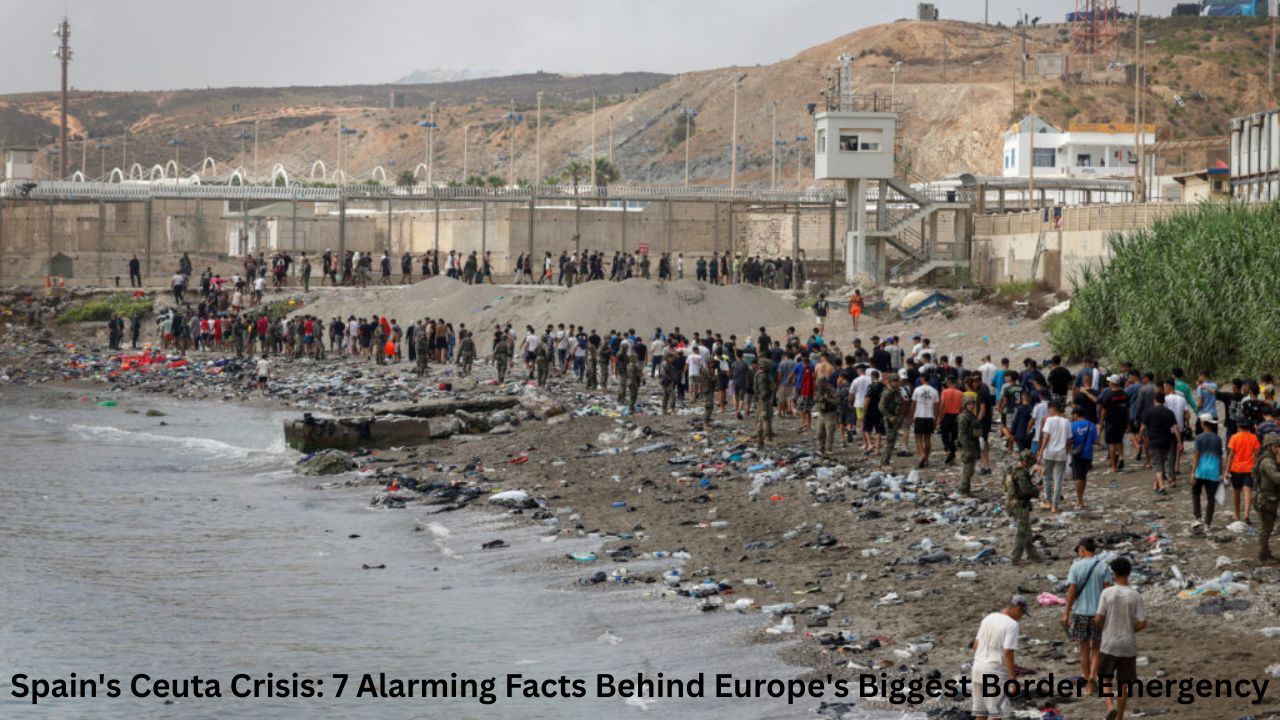
Spain’s Ceuta Crisis: 7 Alarming Facts Behind Europe’s Biggest Border Emergency shaking Spain, Italy, and the European Union. In the space of roughly 24 hours, tens of thousands of people swam, climbed, and pushed their way into a tiny patch of Spanish territory on the coast of North Africa — and by the time the dust settled, they had triggered what may be the largest single-day irregular border crossing the European Union has ever recorded.
Thank you for reading this post, don't forget to subscribe!The scenes from Ceuta, Spain’s small autonomous city bordering Morocco, have dominated headlines since Thursday, July 30, 2026. Beaches littered with abandoned swimming gear. Spanish troops mobilizing.
A death toll that kept climbing through the weekend. And within 48 hours, the crisis had spilled well beyond Spain’s borders — drawing in Italy’s government, the European Commission, and even the White House.
Here’s what actually happened, why it matters, and where things stand now.
Spain’s Ceuta Crisis: 7 Alarming Facts Behind Europe’s Biggest Border Emergency
What Happened in Ceuta?
Ceuta is a small Spanish-controlled enclave on Africa’s northern coast, separated from mainland Spain by the Strait of Gibraltar and bordered entirely by Morocco.
Along with the nearby city of Melilla, it forms the European Union’s only land border with Africa — which has made it a recurring flashpoint for migration for decades.
Starting Thursday, thousands of mostly Moroccan migrants began entering the sea near the border town of Fnideq and swimming around the breakwater barriers that mark Ceuta’s maritime boundary.
By Friday, Spanish officials put the number at close to 60,000 — though Madrid’s own count was closer to 49,000, while Ceuta’s regional government cited the higher figure.
Either way, it stands as one of the most dramatic single-day migration surges Europe has ever witnessed.
7 Key Facts About the Ceuta Migrant Crisis
1. It May Be the Largest Single-Day Border Crossing in EU History
Analysts and news agencies covering the crisis have described it as potentially the biggest irregular crossing attempt recorded on EU territory in such a short window.
For comparison, the last major surge into Ceuta — in May 2021 — saw around 8,000 to 10,000 people cross over two full days. This time, comparable numbers arrived in a matter of hours.
2. A Deadly Journey Across the Water
The human cost has been severe and is still being tallied.
Early reports on Thursday night put the death toll at 18, mostly from drowning and a stampede near the breakwater fences at Tarajal beach.
By the weekend, that figure had climbed past 50 as search-and-recovery efforts continued.
Many of those who died were swept away attempting to swim around the maritime barrier separating Morocco from Ceuta.
3. A Court Ruling May Have Opened the Door
Part of the puzzle lies in a Spanish Supreme Court decision issued on July 8, 2026.
The ruling found that migrants intercepted while swimming toward Ceuta or Melilla cannot be summarily returned to Morocco the way those who scale the physical border fences can — they must instead go through Spain’s ordinary immigration process, which can include the right to seek asylum or legal representation.
Spain’s Interior Ministry has accused human-smuggling networks of exploiting that ruling to encourage sea crossings, though some migrant-rights activists doubt most migrants were even aware of the legal change.
4. Spain Responds With Troops, Police, and a Political Fight
Prime Minister Pedro Sánchez ordered the armed forces to reinforce Spain’s Civil Guard in Ceuta, alongside additional police, naval patrols, air support, and military diving teams.
Visiting the enclave Friday, Sánchez called the mass crossing “a violation of Spain’s territorial integrity” and squarely blamed trafficking networks for luring migrants into a deadly journey.
Ceuta’s regional president, Juan Jesús Vivas, described the situation as an “absolute humanitarian and social emergency” and asked Madrid to formally declare a national emergency — a request the central government rejected, arguing migration isn’t covered under Spain’s civil-protection framework.
Reception centers for unaccompanied minors, meanwhile, were reported to be operating at roughly 24 times their intended capacity.
5. The EU Draws a Hard Line: No Onward Travel
Brussels moved quickly to reassure other member states that the crisis wouldn’t spill across the continent.
The European Commission confirmed that migrants who entered Ceuta irregularly cannot travel onward to mainland Spain or the rest of the EU without undergoing identity checks first, since Ceuta and Melilla are treated as the bloc’s external border for movement purposes.
Morocco is also classified as a “safe country of origin” under EU asylum rules, meaning Moroccan nationals have historically had a very low recognition rate for protection claims — around 6%, according to EU asylum data.
Spanish authorities said that by Friday evening, nearly half of those who had entered had already returned voluntarily to Morocco.
6. Italy Breaks Ranks — and Suspends Schengen
The diplomatic fallout escalated fast. Italian Prime Minister Giorgia Meloni said the images from Ceuta showed a “concrete threat to the security of Europe’s borders,” and her government went on to formally suspend the Schengen open-border agreement with Spain — closing air and sea travel routes and reintroducing border checks.
Finland and Denmark also criticized Spain’s handling of the situation.
Spain’s Foreign Minister, José Manuel Albares, pushed back hard, accusing Italy’s government of “partisan demagoguery” rather than the European solidarity Madrid says it expected from a fellow EU member.
France, for its part, tightened checks and reinforced police along its own border with Spain, stopping short of a full Schengen suspension.
7. The Crisis Became a Political Flashpoint Far Beyond Europe
Even U.S. President Donald Trump weighed in.
Speaking at a Cabinet meeting at Camp David on July 31, Trump described the scenes from Ceuta as looking “like an invasion of a country by hundreds of thousands of people,” and warned that a similar crisis could hit the United States “if the wrong side gets in” during the upcoming midterm elections.
The comments echoed rhetoric he used during the 2018 midterm cycle around migrant caravans headed for the U.S. southern border, turning a European regional crisis into fodder for American domestic politics within 24 hours of it unfolding.
Why Ceuta Keeps Becoming a Flashpoint
This isn’t the first time Ceuta has found itself at the center of a migration emergency, and geography is a big part of why.
The enclave covers barely 18 square kilometers, is home to around 85,000 people, and sits entirely surrounded by Moroccan territory except for its coastline — making it one of only two land borders the EU shares with Africa.
Morocco disputes Spain’s sovereignty over both Ceuta and Melilla, viewing them as remnants of European colonial rule, while Madrid insists they carry the same constitutional status as any other Spanish territory.
That unresolved dispute has repeatedly spilled into migration politics.
The 2021 surge was widely linked to a diplomatic row after Spain allowed a Western Sahara independence leader to receive medical treatment on Spanish soil.
What triggered this latest wave is less clear-cut — a mix of the court ruling, ongoing smuggling activity, and broader migratory pressure — but the pattern of sudden, large-scale crossings tied to Ceuta’s unique legal and geographic position is a familiar one for Spanish and EU officials.
What Happens to the Migrants Now?
For most of those who crossed, the outlook is fairly clear under current EU rules.
Since irregular arrivals in Ceuta are legally barred from onward travel until they’re processed, the majority face likely return orders to Morocco, given the low asylum recognition rate for Moroccan nationals.
Spain says coordination with Rabat has already resulted in a substantial share of migrants returning voluntarily.
Those who file asylum claims will go through an accelerated procedure introduced under the EU’s new migration and asylum reforms, which took effect in June 2026 — with detention measures possible while their cases are reviewed.
Global Reactions and What Comes Next
The Ceuta crisis has exposed familiar fault lines in European politics:
solidarity versus border-control obligations, humanitarian response versus deterrence, and long-simmering tension between Spain’s center-left government and opposition parties like Vox, which has framed the crossing as an “invasion” tied to Sánchez’s broader migration policies, including plans to regularize some undocumented migrants already living in Spain.
The Sánchez government rejects that framing, pointing to its rapid deployment of troops and police as proof it’s taking border security seriously.
Whether Italy’s Schengen suspension proves temporary or hardens into a longer-term rift will likely depend on how quickly Spain restores order in Ceuta — and on whether new arrivals continue.
For now, EU officials are trying to contain both the physical crisis on the ground and the political one spreading across the continent’s capitals.
Conclusion
The Ceuta migrant crisis has become one of 2026’s defining moments for European migration policy — a single, chaotic 24-hour window that reignited debates over border security, EU solidarity, and the human cost of irregular migration routes.
With dozens confirmed dead, a Schengen suspension between two EU members, and international leaders as far away as Washington weighing in, the fallout from Ceuta is likely to shape migration policy discussions in Brussels for months to come.
Whether this proves to be an isolated surge or the start of a longer, harder confrontation between Spain, Morocco, and the rest of the EU remains to be seen — but for now, the world is watching one of Europe’s smallest territories carry an outsized weight.
Also Read: Wildfire Inferno: 5 Alarming Facts on the France-Spain Blazes
Also Read: Ceuta Border Crisis: 67 Dead As Spain Installs 500-Metre Sea Barrier
Related Posts:
- Arizona Haboob Dust Storm Grounds 62 Flights, Cuts…

- 7 Heartbreaking Facts About Venezuela's Earthquake Disaster
- 5 Major Takeaways from the US Supreme Court's…

- Afghanistan–Pakistan War 2025: Inside the 48-Hour Ceasefire

- 7 Powerful Facts About Ayatollah Ali Khamenei’s…

- 7 Powerful Measures: Trump Sanctions Russian Oil…
