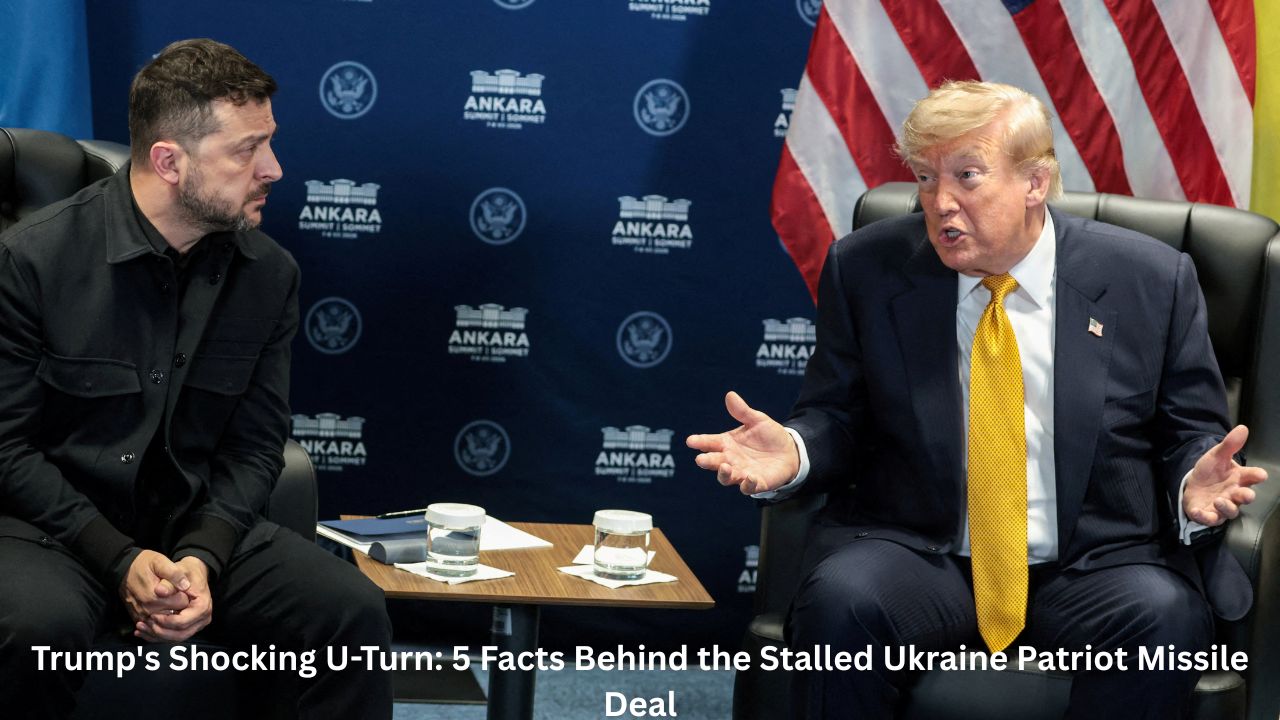
Trump’s Shocking U-Turn: 5 Facts Behind the Stalled Ukraine Patriot Missile Deal after promising Zelensky a license. Just days after Ukrainian President Volodymyr Zelensky walked out of the White House believing he had secured a green light to build Patriot missiles on Ukrainian soil, US President Donald Trump has pulled back from that promise — and the reversal is now sending shockwaves through Washington, Kyiv, and European capitals alike.
Speaking to reporters and Cabinet members at his Camp David retreat on July 31, Trump delivered a blunt correction to weeks of optimistic signals coming out of Kyiv.
“We have not agreed to that,” he said, when asked directly about licensing Ukraine to manufacture the advanced Patriot interceptor missiles domestically. It was a stunning contradiction of what Zelensky had told the world just three days earlier.
For a global audience watching the war in Ukraine enter its fifth year, the Patriot missile question isn’t a minor policy footnote — it’s about whether millions of Ukrainian civilians will have working air defenses this coming winter.
Here’s a full breakdown of what happened, why Trump changed his tone, and what it means going forward.
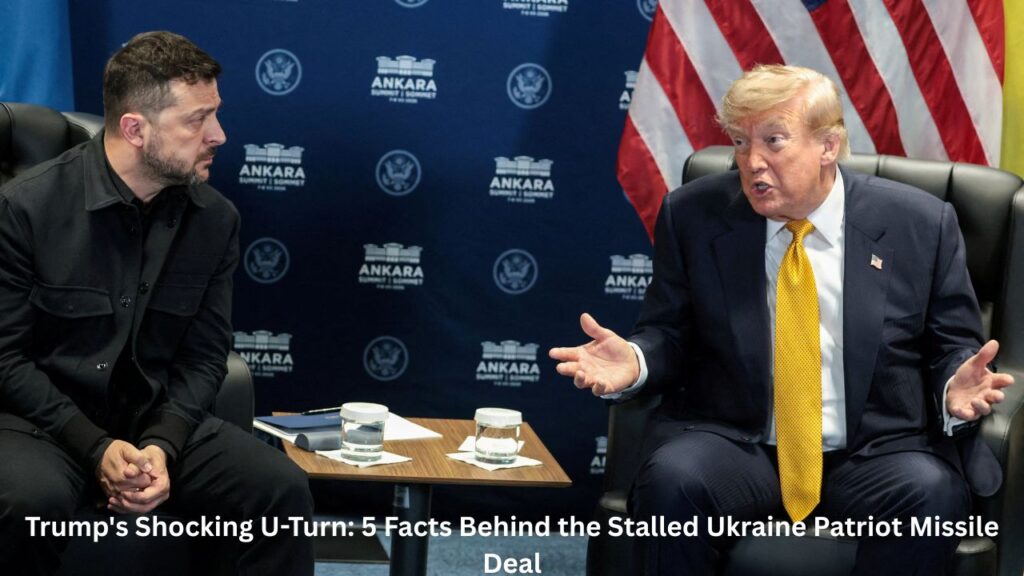
Trump’s Shocking U-Turn: 5 Facts Behind the Stalled Ukraine Patriot Missile Deal
1. The Promise That Started It All — Ankara, NATO Summit
The story begins earlier this month at a NATO summit in Ankara, Turkey. Standing alongside Zelensky, Trump appeared to make a landmark commitment: the United States would allow Ukraine to produce its own Patriot interceptors under license, rather than relying solely on shipments from American stockpiles.
At the time, it was framed as a major turning point — a way for Kyiv to finally build a sustainable, domestic supply of the one weapons system capable of reliably shooting down Russian ballistic missiles.
Until now, only two countries outside the US have held licenses to build Patriot systems: Japan and Germany.
Adding Ukraine to that short list would have marked one of the most significant defense-industrial concessions of the entire war.
2. Zelensky’s White House Visit — And the Confusion That Followed
On July 28, Zelensky traveled to Washington for an hour-long, closed-door meeting with Trump.
Afterward, the Ukrainian leader told reporters that Trump had “accepted” the idea of granting Ukraine Patriot production licenses.
He also revealed he had met separately with representatives from Lockheed Martin and Raytheon — the US defense giants behind the Patriot system — to discuss what he described as concrete steps toward joint production.
In a follow-up interview with Axios published just days later, Zelensky went further, saying Ukraine needed an emergency “winter package” of at least 300 Patriot interceptors to prevent a humanitarian catastrophe.
He said Ukraine’s existing stockpiles were nearly depleted and warned that Russia routinely fires 30 to 40 ballistic missiles in a single large-scale strike, with three to five such attacks happening every month.
“We needed the Patriots yesterday,” he told the outlet, underlining just how urgent Kyiv considers the shortage to be.
3. Camp David: Trump Hits the Brakes
That sense of momentum evaporated on July 31.
At a Cabinet meeting held at Camp David, Trump described handing over Patriot production technology as “a hard thing to give away,” and voiced concern that any country given access to such advanced weapons systems could theoretically “turn on you” someday.
He also referenced past US military support for Ukraine, including 2017-era Javelin missile shipments, and touted the Patriot system’s performance intercepting missiles fired at US forces in the Middle East during recent regional conflicts involving Iran.
Trump’s remarks echoed comments he reportedly made in a separate interview with the Financial Times, where he said he was “not sure” whether the US would ultimately license Ukraine to build the missiles.
Rather than committing to a firm answer, Trump repeatedly steered the conversation back toward his broader goal of ending the war altogether, suggesting that both Zelensky and Russian President Vladimir Putin would eventually need to make concessions for peace talks to succeed.
4. Why Patriot Interceptors Matter So Much Right Now
To understand why this reversal has triggered such a strong reaction, it helps to understand what’s at stake.
Patriot systems are currently the only reliable Western defense against the ballistic missiles Russia has increasingly relied on to strike Ukrainian cities and energy infrastructure.
Without them, Ukraine has limited ability to intercept Russia’s most destructive long-range weapons before they hit populated areas or critical power stations.
Complicating matters further, global demand for Patriot interceptors has spiked well beyond Ukraine’s needs.
The system has also played a central role in defending US and allied forces during the broader conflict involving Iran, and some analyses suggest the Pentagon has already used up roughly two-thirds of its total Patriot inventory.
That shortage helps explain why the Trump administration has been reluctant to commit large numbers of interceptors to Ukraine even as it weighs the separate question of licensing local production.
Zelensky has said Ukraine is even exploring ways to convert its own domestically produced ballistic missiles into Patriot-style interceptors, working directly with US defense contractors — a sign of just how urgently Kyiv is searching for alternatives while the license question remains unresolved.
5. Political Fallout: Republicans Push Back, Senate Moves Separately
Trump’s about-face has not gone unnoticed within his own party.
Nebraska Congressman Dan Bacon, a senior Republican on the House Armed Services Committee, was among the sharpest critics, arguing that mixed signals from the White House were undercutting broad public support for Ukraine at a moment when the country faces an intensifying missile campaign and a critical shortage of interceptors.
Separately, US officials speaking anonymously pushed back on the idea that Trump had scrapped the plan entirely, insisting that negotiations with Kyiv were simply still ongoing and that no formal decision had been finalized either way.
Meanwhile, the US Senate is charting its own course.
A bipartisan group of eight senators — led by Democrat Tim Kaine of Virginia and Republican John Cornyn of Texas — introduced legislation on July 31 called the Fast Tracking European Investment in Ukraine’s Defense Act.
The bill aims to streamline approvals for allied nations to transfer high-volume munitions, including artillery shells, HIMARS rockets, and GMLRS munitions, through 2030, while maintaining congressional oversight.
Ukraine’s Response: Diplomacy Continues Despite the Setback
Even as the Patriot license question remains unresolved, Kyiv has kept diplomatic channels open.
On the same day Trump made his Camp David remarks, Zelensky held a phone call with US Vice President JD Vance, which he described as “productive.”
The two discussed Ukraine’s air defense priorities and agreed that their teams would stay in close contact going forward.
There are also signs of continued high-level engagement ahead.
According to sources familiar with the planning, Trump envoys Steve Witkoff and Jared Kushner are expected to travel to Kyiv later in August, a trip reportedly arranged in the aftermath of Zelensky’s White House visit, aimed at reviving broader peace efforts between Ukraine and Russia.
What Happens Next
For now, the Patriot missile production license remains in limbo — neither confirmed nor formally rejected.
Trump’s Camp David comments suggest he wants to keep the issue tied to broader peace negotiations rather than treat it as a standalone military aid decision.
Ukrainian officials, meanwhile, continue to frame the interceptors as a matter of immediate survival rather than a long-term bargaining chip, especially with winter approaching and Russian strikes on energy infrastructure showing no signs of slowing down.
Whether Washington ultimately grants the license — and how quickly production could realistically begin even if it does — remains an open question.
Experts have previously cautioned that even with a signed agreement, meaningful domestic Patriot production in Ukraine could take anywhere from one to five years to scale up, meaning the immediate crisis will likely still hinge on direct US and allied shipments rather than local manufacturing.
The uncertainty is also being closely watched well beyond Washington and Kyiv.
European allies who have leaned on the US for Patriot supplies to reinforce their own eastern defenses are monitoring how this plays out, since any shift in US production policy could eventually affect allocation for the whole NATO bloc.
Analysts note that the back-and-forth also feeds into a wider narrative around Trump’s approach to the war:
publicly warm toward Zelensky and quick to make big pledges in the moment, but consistently cautious once it comes to signing off on anything that could be read as a long-term US commitment.
That pattern has left Kyiv in a familiar, frustrating position — celebrating verbal wins one week, only to see them qualified or walked back the next.
Conclusion
Trump’s sudden reversal on Patriot missile licensing has exposed just how fluid — and unpredictable — US policy toward Ukraine remains, even after high-profile meetings and public assurances.
What looked like a breakthrough moment in Ankara and again after Zelensky’s White House visit has instead become another example of the gap between diplomatic optimism and formal policy commitments.
With Russian ballistic missile attacks intensifying, Ukraine’s air defense stockpiles running low, and winter fast approaching, the coming weeks — including the expected Witkoff-Kushner visit to Kyiv — could prove decisive in determining whether this promise is ultimately revived, quietly shelved, or folded into a broader peace negotiation.
For a global audience watching the war’s trajectory, this episode is a reminder that in the current phase of the conflict, battlefield lines aren’t the only thing shifting — so is the political ground in Washington.
Also Read: Zelensky Meets Trump: 5 Explosive Flashpoints Rocking the Ukraine-Iran Crisis
Also Read: Zelensky hails ‘good meeting’ with Trump as Ukraine seeks Patriot missile deal
Related Posts:
- 5 Powerful Highlights as Trump Lands Second Nobel…

- Trump’s 2025 Gaza Peace Plan Signing and Historic…

- Impacts of the Trump-Putin Call on Ukraine’s 2025 Strategy

- 9 Explosive Revelations as Trump Declares His Health…

- Camp Mystic TikTok Turns Tragic: Texas Flash Flood…

- 11 Explosive Revelations From Ted Cruz’s Leaked…