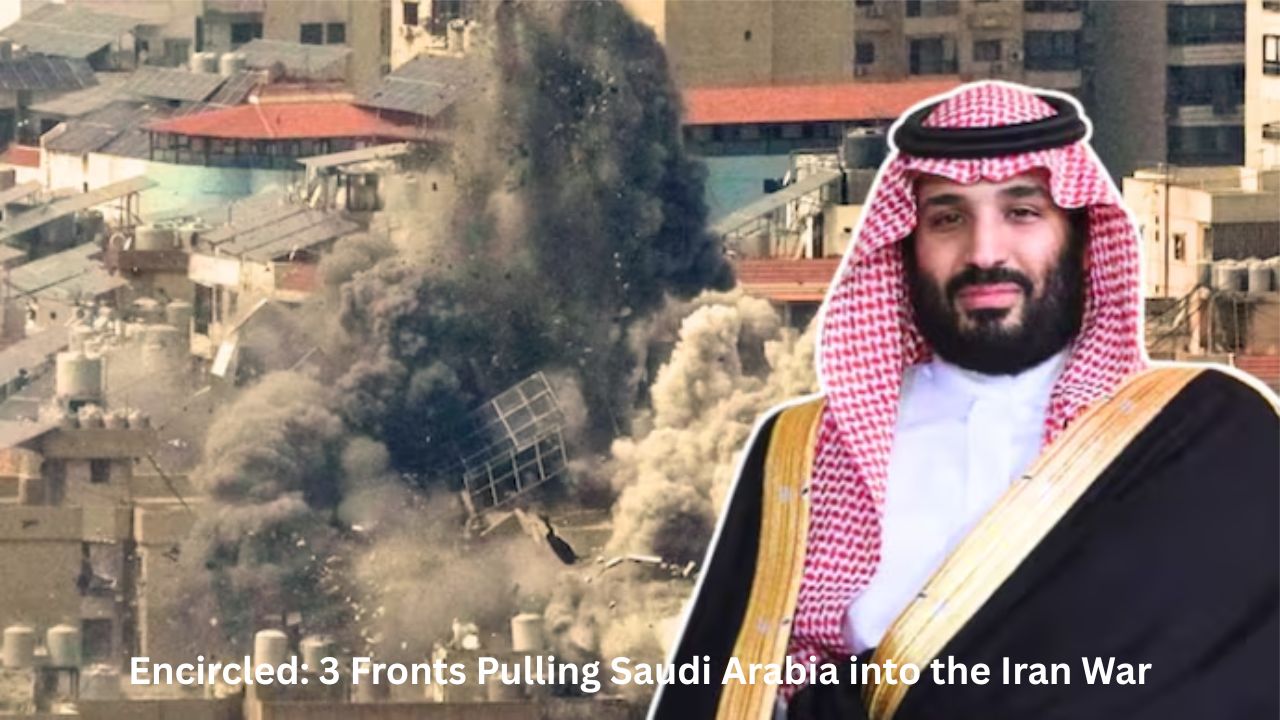
Encircled: 3 Fronts Pulling Saudi Arabia into the Iran War — Iraq, Yemen, and the Red Sea. For months, Saudi Arabia tried to stay out of it. As the United States and Israel fought a widening war against Iran, Riyadh kept diplomatic channels open with Tehran, urged Washington toward de-escalation, and worked hard to avoid becoming a target itself.
That careful balancing act is now under serious strain, as Saudi Arabia finds itself pressured from three directions at once — and forced, for the first time, into a much more active role in a conflict it spent months trying to avoid.
Here’s a clear look at what’s actually happening, why Riyadh’s strategy is shifting, and what experts and former officials say could come next.
Encircled: 3 Fronts Pulling Saudi Arabia into the Iran War
Why Saudi Arabia Held Back — Until Now
Since the US-Israel war against Iran began in February 2026, Saudi Arabia has pursued what analysts describe as a diplomacy-first approach:
maintaining lines of communication with Tehran, pressing Washington to pursue de-escalation, and avoiding the kind of overt support for the American war effort that countries like the UAE have provided.
That restraint reflected a clear-eyed calculation — Riyadh feared becoming a direct target of Iranian retaliation, and by keeping channels open, it largely succeeded in avoiding the kind of strikes Iran has directed at more openly pro-American Gulf states.
According to Michael Ratney, a former US ambassador to Saudi Arabia now at the Center for Strategic and International Studies, that strategy has always been about balance.
The Saudis, he told NPR, don’t want a full-scale resumption of conflict because they fear bearing the brunt of Iranian reprisal.
But Ratney said Saudi Arabia’s restraint has limits:
it couldn’t leave direct attacks on its own territory unanswered, especially given memories of 2019, when Iranian-linked strikes on Saudi oil infrastructure in the Eastern Province went unanswered.
Three Fronts, One Kingdom
That restraint is now being tested simultaneously from multiple directions.
The Iraq Strikes
Pro-Iran militias in Iraq have targeted Saudi energy infrastructure directly.
In response, joint US-Saudi strikes on Iran-backed groups in Iraq reportedly killed at least 20 people, according to the alliance of paramilitary factions whose bases were hit.
It marked a notable escalation — one of the clearest instances yet of Saudi Arabia taking direct military action alongside the United States rather than simply providing diplomatic or logistical support from the sidelines.
The Houthi Blockade in the Red Sea
At the same time, Yemen’s Iran-aligned Houthi movement has intensified its campaign against Saudi shipping, striking Saudi oil tankers and effectively imposing a blockade in the Red Sea.
The escalation followed a chain of events:
after Saudi-backed forces struck the runway at Sanaa’s airport to enforce a no-fly embargo aimed at blocking Iranian aircraft, the Houthis responded with ballistic missiles and drones targeting southern Saudi Arabia — ending a truce that had held for roughly four years.
Iran’s “Port Against Port” Doctrine
Perhaps most concerning for Riyadh, Iran has reportedly urged the Houthis to prepare to close the Bab al-Mandeb Strait entirely and has directly threatened Saudi Arabia’s East-West Pipeline under what’s been described as a “port against port” doctrine — a policy under which any Gulf infrastructure supporting American military operations becomes a legitimate target.
It’s widely seen as an attempt by Tehran to raise the global economic cost of the US campaign against it, spreading pressure well beyond its own borders.
The Oil Lifeline Under Threat
The stakes of this pressure campaign go far beyond symbolism.
With the Strait of Hormuz effectively shut since the war began — a route that normally carries a significant share of the world’s oil and gas exports — Saudi Arabia has relied on an alternative route:
the East-West Pipeline, which carries crude from the kingdom’s Eastern Province refineries to the Red Sea export terminal at Yanbu.
That workaround, while handling only a fraction of peacetime export volumes, has served as a genuine economic lifeline, helping preserve Saudi access to Asian markets, which account for the large majority of the kingdom’s crude exports.
That lifeline is now under direct threat. With Houthi attacks disrupting Red Sea shipping and Iran reportedly eyeing the pipeline itself as a target, Saudi Arabia’s one remaining major export route no longer looks as secure as it did just weeks ago.
What Experts Are Saying
A Former US Ambassador’s View
Ratney told NPR that Saudi Arabia has no real appetite for full-scale escalation, largely because it fears what a wider war could do to its own economy — from damage to energy infrastructure and desalination plants to disruption of civilian population centers.
In his assessment, the Saudis “hate the Iranian regime” but simply want the war behind them, provided their core interests are protected along the way.
He noted that Saudi Arabia’s capabilities are currently centered on a fairly potent air force, though effective operations still require close partnership with the US military, as seen in the recent Iraq strikes.
Diplomatically, he pointed to Riyadh’s success in building international support for a new maritime security coalition aimed at protecting shipping through the Bab al-Mandeb Strait — evidence, he said, of considerable regional influence Saudi Arabia can still bring to bear.
Analysts Warn of “Attrition by Proxy”
Other regional analysts frame Iran’s strategy in starker terms. Danny Citrinowicz, a senior Iran researcher at Israel’s Institute for National Security Studies, has described the campaign against Saudi Arabia as a deliberate outsourcing of risk — attacks carried out by Houthi drones or Iraqi militia rockets that give Tehran plausible deniability while Riyadh absorbs the actual damage.
He’s called it “attrition by proxy,” and argued it has proven highly effective so far, in part because Gulf economies depend so heavily on regional stability, investment, and uninterrupted energy flows to sustain their long-term growth plans.
Ali Shihabi, a political analyst close to the Saudi government, told AFP that the kingdom has so far exercised considerable restraint despite having the capacity to inflict severe punishment on both the Houthis and Iraqi militias — but warned that “restraint has limits and should not be mistaken for weakness.”
Meanwhile, H.A. Hellyer of the Royal United Services Institute in London has suggested that the Houthis’ demonstrated ability to disrupt one of the world’s most vital waterways is itself a warning sign of what other Iran-aligned actors along Saudi Arabia’s periphery could bring to bear if tensions continue to rise.
Riyadh’s Dilemma: Diplomacy or Escalation?
According to analysis from the European Council on Foreign Relations, Saudi Arabia now faces a genuinely difficult choice.
One path involves seeking a new understanding with the Houthis and Iran — removing Saudi tankers, ports, and infrastructure from target lists in exchange for concessions such as restrictions on refueling American aircraft or providing intelligence support for US operations.
The other path is far riskier:
moving closer to the American campaign against Iran while reviving Saudi Arabia’s own military campaign against the Houthis, potentially in coordination with the UAE, whose forces in southern Yemen have already begun targeting Houthi missile and drone sites.
Either path carries real risk. Analysts note that Iran has already demonstrated it can keep the Strait of Hormuz effectively closed despite repeated US strikes, using dispersed missile and drone systems that are difficult to fully neutralize — and the Houthis have shown they can do much the same in the Red Sea.
A renewed Saudi-Houthi ground war, meanwhile, risks reigniting Yemen’s broader civil war, a conflict that has already caused enormous humanitarian suffering over the past decade.
Why This Matters Beyond the Gulf
This isn’t just a regional story. A prolonged closure of the Bab al-Mandeb Strait would disrupt shipping through the Suez Canal, raise global energy and shipping costs, and add further strain to economies well beyond the Middle East.
That’s part of why the European Union is reportedly considering expanding its existing Aspides naval mission in the Red Sea to include minesweeping capabilities, amid concern that naval mines could be used to keep the strait closed even after a broader de-escalation is reached.
What Happens Next
For now, Saudi Arabia appears to be pursuing both tracks simultaneously — building international support for a defensive maritime coalition while also demonstrating, through the recent Iraq strikes, that its patience for unanswered attacks has limits.
Whether Riyadh ultimately leans toward renewed diplomacy or a broader military campaign against the Houthis may depend heavily on what happens in the coming weeks along its remaining oil export lifeline through Yanbu.
Conclusion
Saudi Arabia’s predicament captures just how difficult it has become for any regional power to stay on the sidelines of the widening conflict with Iran.
Pressured on three fronts — Iraq, Yemen, and the Red Sea — and facing direct threats to its last major oil export route, Riyadh’s long-standing strategy of quiet restraint is being tested like never before.
Whichever path Saudi Arabia chooses next, one thing is clear:
with roughly a fifth of the world’s oil trade running through waters now caught in the crossfire, the kingdom’s next moves will be watched closely far beyond the Gulf.
Also Read: Trump’s Saudi Nuclear Deal: 5 Explosive Fallout Points Rocking the Middle East
Also Read: Why Iran chose to restart the fight after the US stopped firing