
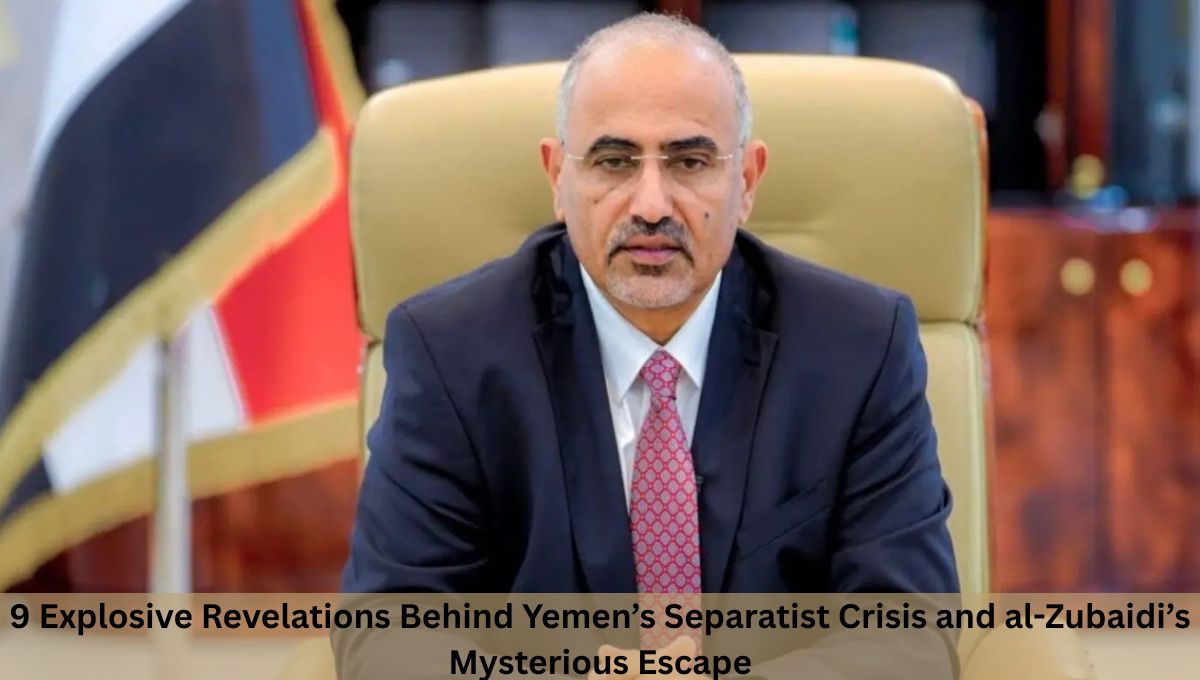
9 Explosive Revelations Behind Yemen’s Separatist Crisis and al-Zubaidi’s Mysterious Escape that shook the south. The sudden disappearance of Aidarous al-Zubaidi, the powerful leader of Yemen’s Southern Transitional Council (STC), has plunged southern Yemen into one of its most volatile moments in years.
Saudi Arabia now alleges that al-Zubaidi fled the country with the assistance of the United Arab Emirates, bypassing planned peace talks in Riyadh and triggering airstrikes, treason charges, and a dangerous escalation in a region already fractured by war. At the heart of this unfolding crisis lies more than the fate of one separatist leader.
Al-Zubaidi’s alleged escape has exposed deep fractures within the Saudi-UAE alliance, raised questions about the future of Yemen’s territorial unity, and reignited fears that the country’s long war is entering a new and even more complex phase.
9 Explosive Revelations Behind Yemen’s Separatist Crisis and al-Zubaidi’s Mysterious Escape
Who Is Aidarous al-Zubaidi?
From Southern Power Broker to Accused Traitor
Aidarous al-Zubaidi is not a marginal figure in Yemen’s conflict. As president of the Southern Transitional Council, he has been the most visible and influential advocate for the re-establishment of an independent South Yemen — a state that existed before unification in 1990.
Backed politically and militarily by the United Arab Emirates, the STC rose to prominence during the war against the Iran-aligned Houthi movement.
While initially aligned with Yemen’s internationally recognised government, the council gradually emerged as a rival power structure, controlling key southern cities and ports, including Aden.
Al-Zubaidi himself served on Yemen’s Presidential Leadership Council (PLC), giving him formal legitimacy even as his forces challenged government authority.
That balancing act collapsed dramatically in December when STC fighters launched a rapid offensive into the eastern provinces of Hadramout and al-Mahra — areas bordering Saudi Arabia and regarded by Riyadh as a red line.
The Missed Flight That Sparked a Firestorm
Riyadh Talks and a Sudden Absence
In an attempt to de-escalate tensions, Saudi Arabia invited al-Zubaidi and an STC delegation to Riyadh for crisis talks.
A Yemeni Airways flight was scheduled to carry the delegation from Aden to the Saudi capital. The plane departed hours late — without al-Zubaidi on board.
According to the Saudi-led coalition, intelligence gathered during the delay suggested that the separatist leader had mobilised armed forces and prepared to escalate fighting in Al-Dhale governorate.
Soon after, coalition aircraft launched what they described as “limited pre-emptive strikes” against STC positions.
Al-Zubaidi’s failure to appear instantly raised alarm bells. Within hours, the Saudi narrative hardened: the STC leader had fled Yemen altogether.
Saudi Claims: A Midnight Escape via Somaliland
A Route That Raised Eyebrows
In a detailed statement, the Saudi-led coalition alleged that al-Zubaidi “escaped in the dead of night” aboard a vessel that sailed from Aden to Berbera, a port city in Somaliland.
From Berbera, the coalition claimed, al-Zubaidi boarded a military aircraft accompanied by Emirati officers. The plane allegedly flew first to Mogadishu before heading toward Abu Dhabi.
Saudi officials further asserted that the aircraft temporarily switched off its identification systems over the Gulf of Oman, reactivating them shortly before landing at Al Reef military airport in the UAE capital.
If confirmed, the operation would represent one of the most extraordinary episodes in recent Gulf diplomacy — a covert extraction of a wanted Yemeni leader by a close Saudi ally.
Neither the STC nor the UAE immediately confirmed the account.
UAE Silence and STC Denials
Competing Narratives Take Shape
The STC categorically rejected claims that al-Zubaidi fled Yemen. Its officials insisted he remained in Aden, overseeing military and security operations and safeguarding the southern population amid Saudi airstrikes.
The UAE, for its part, issued no immediate response. The silence only fueled speculation, particularly as Saudi media outlets broadcast what they described as intercepted communications and flight tracking data to support the coalition’s claims.
The absence of independent verification has left observers grappling with two sharply different narratives — one portraying al-Zubaidi as a fugitive, the other as a leader under siege but still on the ground.
Saudi Airstrikes and the Battle for Al-Dhale
A “Pre-Emptive” Military Response
As the political dispute intensified, the situation on the ground deteriorated rapidly. Saudi-led coalition aircraft launched more than 15 airstrikes in Al-Dhale governorate, targeting camps and convoys linked to the STC.
Coalition spokesperson Major General Turki al-Malki said the strikes were necessary to prevent al-Zubaidi’s forces from expanding the conflict into new areas.
He accused the separatist leader of distributing weapons in Aden and mobilising armoured units toward government-held territory.
Local sources reported civilian casualties, including women and children, further inflaming anger among southern communities already exhausted by years of conflict.
Treason Charges and Political Fallout
Expulsion from the Presidential Council
The political consequences for al-Zubaidi were swift and severe.
Yemen’s Presidential Leadership Council announced his removal from the body and referred him to the public prosecutor on charges including:
- High treason
- Forming armed gangs
- Undermining Yemen’s unity
- Killing soldiers and security personnel
Council chairman Rashad al-Alimi accused al-Zubaidi of exploiting the southern cause for personal and political gain, damaging Yemen’s military and economic standing in the process.
The decision marked an extraordinary rupture, transforming a sitting member of Yemen’s top governing authority into an accused criminal overnight.
Saudi Arabia and the UAE: Allies at Odds
A Rift Years in the Making
The al-Zubaidi affair has brought long-simmering tensions between Saudi Arabia and the UAE into the open.
Although both countries intervened in Yemen in 2015 to counter the Houthis, their strategic priorities have increasingly diverged.
Saudi Arabia views Yemen’s unity as essential to its national security, fearing that fragmentation would empower hostile forces along its southern border.
The UAE, meanwhile, has focused on counterterrorism, maritime access, and influence over strategic ports — interests that aligned naturally with the STC.
When STC forces pushed into Hadramout and al-Mahra, Riyadh interpreted the move as a direct threat. The subsequent Saudi airstrikes on what it said were UAE-linked weapons shipments underscored how far relations had deteriorated.
Why Somaliland and Somalia Matter
The Geopolitical Significance of the Alleged Route
If Saudi claims about al-Zubaidi’s escape route are accurate, the choice of Somaliland and Somalia is telling.
Berbera has long been a strategic logistics hub in the Horn of Africa, while Mogadishu has served as a transit point for military flights linked to regional conflicts.
Saudi officials even named a senior Emirati officer allegedly involved in the operation and pointed to the aircraft type — an Ilyushin Il-76 — commonly associated with operations in conflict zones.
These details suggest Riyadh intends not merely to accuse, but to publicly document what it sees as Emirati interference.
Southern Yemen: Independence Dreams or Fragmentation Nightmare?
What the STC Represents
The STC commands genuine support among many southerners who feel marginalised since unification with the north. Polling and street protests have consistently shown strong backing for eventual independence.
Yet critics argue that the STC’s militarised approach and reliance on foreign backing risk turning southern Yemen into a patchwork of armed fiefdoms rather than a viable state.
Al-Zubaidi’s disappearance — whether real or alleged — has intensified fears that the southern movement could splinter without its central figure.
Humanitarian Costs Mount Again
Civilians Caught in the Crossfire
Airstrikes in Al-Dhale, Shabwah, and surrounding areas have once again placed civilians at risk. Hospitals reported deaths and injuries, while residents described explosions shaking neighbourhoods before dawn.
Yemen remains one of the world’s worst humanitarian crises. Renewed fighting in the south threatens to divert attention and resources away from already desperate civilian needs.
International Implications
A Coalition Under Strain
The crisis comes at a time when the Saudi-led coalition was already struggling with internal divisions. The United States and other Western partners have urged de-escalation, warning that further fragmentation will only strengthen the Houthis.
A prolonged Saudi-UAE rift could reshape alliances across the Middle East and Horn of Africa, with implications extending far beyond Yemen’s borders.
Where Is al-Zubaidi Now?
A Question Without an Answer
Despite detailed Saudi allegations and firm STC denials, the precise whereabouts of Aidarous al-Zubaidi remain unconfirmed.
Whether he is in Aden, Abu Dhabi, or elsewhere, his absence from public view has already altered the political landscape.
In Yemen’s fragile environment, perception can be as powerful as reality.
Conclusion: A Defining Moment for Yemen’s South
The saga of Aidarous al-Zubaidi is more than a personal drama. It is a defining moment for southern Yemen, for the Saudi-UAE partnership, and for a country struggling to hold itself together after nearly a decade of war.
Whether through diplomacy or further confrontation, the choices made in the coming weeks will determine whether Yemen edges toward renewed fragmentation — or finds a narrow path back to dialogue.
For now, uncertainty reigns, and the echoes of airstrikes over Al-Dhale signal that the crisis is far from over.
Also Read: 7 Explosive Developments Behind Saudi Arabia’s Yemen Bombing and UAE’s Shock Withdrawal
Also Read: Who is Aidarous al-Zubaidi? Yemen’s ‘traitor’ chief
Related Posts:
- 7 Explosive Developments Behind Saudi Arabia’s Yemen…
- 7 Heartbreaking Facts About Venezuela's Earthquake Disaster
- 5 Major Takeaways from the US Supreme Court's…

- 7 Powerful Ways the US–Saudi $1 Trillion Partnership…

- 7 Powerful Facts About Ayatollah Ali Khamenei’s…
- Trump’s 20-Point Gaza Peace Plan Gains Urgent Global…
