11 Powerful Shifts in New US Dietary Guidelines That Could Redefine How America Eats — A major reset.The United States has unveiled a dramatic overhaul of its federal dietary guidelines, marking what the Trump administration calls the most significant reset of national nutrition policy in decades.
Thank you for reading this post, don't forget to subscribe!Released jointly by the Department of Health and Human Services (HHS) and the Department of Agriculture (USDA), the new recommendations urge Americans to eat more protein, sharply reduce added sugar and ultra-processed foods, and embrace full-fat dairy — a clear departure from long-standing advice.
At the centre of the shift is Health and Human Services Secretary Robert F. Kennedy Jr., whose “Make America Healthy Again” (MAHA) agenda has placed diet, chronic disease, and food systems at the heart of national policy.
The updated guidelines, released on January 7, 2026, are shorter, more visual, and far more prescriptive in tone than their predecessors. Supporters hail the emphasis on “real food” as overdue and necessary. Critics warn the guidance risks reviving dietary patterns linked to heart disease and environmental harm.
Together, the recommendations have ignited a fierce debate over science, ideology, public health, and the future of American eating.
11 Powerful Shifts in New US Dietary Guidelines That Could Redefine How America Eats
What Are the US Dietary Guidelines and Why They Matter
A Blueprint That Shapes What America Eats
The Dietary Guidelines for Americans are updated every five years and serve as the foundation for federal nutrition policy.
They directly influence:
- School meal programmes
- Military and veteran food services
- The Supplemental Nutrition Assistance Program (SNAP)
- The Women, Infants and Children (WIC) programme
- Medical and public health advice nationwide
In effect, these guidelines shape not only what Americans are told to eat, but what millions of children, low-income families, and service members are served every day.
Previous editions, particularly the 2020 guidelines, ran nearly 150 pages and offered life-stage-specific advice.
The new version is far shorter — just a few pages — with additional scientific justification published separately.
Administration officials say the simplified format is intentional, designed to cut through confusion and make nutrition guidance accessible to ordinary Americans.
“Eat Real Food”: The Core Message
At a White House briefing announcing the guidelines, Kennedy delivered a blunt message.
“My message is clear: eat real food.”
The new guidance encourages Americans to prioritise whole and minimally processed foods — those that resemble how they looked when harvested, raised, or caught — while avoiding foods loaded with added sugars, refined carbohydrates, excess salt, and chemical additives.
Ultra-processed foods singled out for avoidance include packaged snacks such as chips, cookies, candy, sugary cereals, sodas, energy drinks, and many ready-to-eat meals.
Federal data shows these foods currently account for about 55% of calories in the average American diet, a figure widely cited by officials as evidence of a national health crisis.
A New Emphasis on Protein
Higher Targets Than Ever Before
One of the most controversial changes is the dramatic increase in recommended protein intake.
The new US dietary guidelines advise Americans to consume 1.2 to 1.6 grams of protein per kilogram of body weight per day, up from the previous recommendation of around 0.8 grams per kilogram.
For a 150-pound adult, that translates to roughly 82 to 109 grams of protein daily.
Officials argue higher protein intake:
- Improves satiety
- Helps preserve muscle mass
- Stabilises blood sugar
- Reduces overeating
Protein sources listed include:
- Red meat
- Poultry
- Eggs
- Seafood
- Dairy
- Plant-based options such as legumes and beans
However, critics note that animal protein, particularly red meat, appears prominently in both the text and the new food pyramid.
Red Meat Returns to the Center of the Plate
A Break From Decades of Caution
For decades, federal guidelines encouraged Americans to limit red meat consumption, favouring lean proteins and plant-based alternatives.
The new recommendations include red meat among acceptable and even encouraged protein sources. This has alarmed many nutrition experts.
Marion Nestle, professor emerita of nutrition at New York University, called the guidance “retro” and “ideological.”
“Americans already eat more than enough protein. Encouraging more meat and dairy takes us back to the 1950s, when heart disease was rampant,” she said.
Public health advocates also worry the shift reflects pressure from the meat and dairy industries rather than emerging science.
Full-Fat Dairy Makes a Comeback
From Skim Milk to Whole Milk
Another major departure from past guidance is the endorsement of full-fat dairy.
The new guidelines recommend:
- Three servings of full-fat dairy per day on a 2,000-calorie diet
- Products with no added sugars, such as whole milk, full-fat yogurt, and cheese
For decades, Americans were advised to choose low-fat or fat-free dairy to limit saturated fat intake. The Trump administration argues that evidence against full-fat dairy was overstated and that such products can be part of a healthy diet.
Some studies have found neutral or even protective effects of dairy consumption on cardiovascular health. Still, experts caution that full-fat dairy adds calories and saturated fat, increasing obesity risk if consumed in excess.
The Saturated Fat Debate
Ending the “War on Saturated Fats”?
Kennedy has long criticised what he calls the “war on saturated fats.” While the new guidelines retain the long-standing recommendation that no more than 10% of daily calories should come from saturated fat, critics say the practical advice undermines that limit.
The guidelines suggest cooking with:
- Olive oil
- Butter
- Beef tallow
While olive oil is widely recognised as heart-healthy, butter and beef tallow are high in saturated fat.
The American Heart Association warned that routinely consuming red meat and saturated fats could easily push people beyond safe thresholds, increasing the risk of heart disease and stroke.
Ultra-Processed Foods Declared the Primary Villain
A Rare Point of Consensus
If there is one area of near-universal agreement, it is the strong stance against ultra-processed foods.
The new guidelines urge Americans to:
- Avoid packaged, ready-to-eat foods high in sugar and salt
- Limit refined carbohydrates like white bread, crackers, and tortillas
- Choose home-prepared meals whenever possible
The American Medical Association applauded this shift, stating that ultra-processed foods “fuel heart disease, diabetes, obesity, and other chronic illnesses.”
Even critics of the meat and dairy recommendations describe the attack on ultra-processed food as the strongest and most evidence-backed aspect of the guidelines.
Sugar: A Declared Enemy
Children Told to Avoid Added Sugar Until Age 10
The updated guidance takes a firm stance on sugar:
- Added sugars should be avoided in infancy and early childhood
- Children should not consume added sugars until age 10
- Sugar-sweetened beverages are strongly discouraged
Officials cite sugar as a major driver of obesity, insulin resistance, and metabolic disease, particularly among children.
Kennedy described sugar as a national threat, arguing that addiction to sweetened foods has weakened public health and inflated healthcare costs.
Alcohol Limits Removed — and Questions Raised
“Less Is Better,” But How Much Less?
One of the most striking changes is the removal of specific daily alcohol limits.
Previous guidelines advised:
- No more than one drink per day for women
- No more than two drinks per day for men
The new guidance simply states:
“Drink less alcohol for better overall health.”
While pregnant women, people recovering from alcohol use disorder, and those on certain medications are advised to avoid alcohol entirely, the lack of numeric limits has unsettled many experts.
Critics argue vague guidance risks normalising higher consumption, particularly since alcohol is linked to cancer, liver disease, and cardiovascular problems.
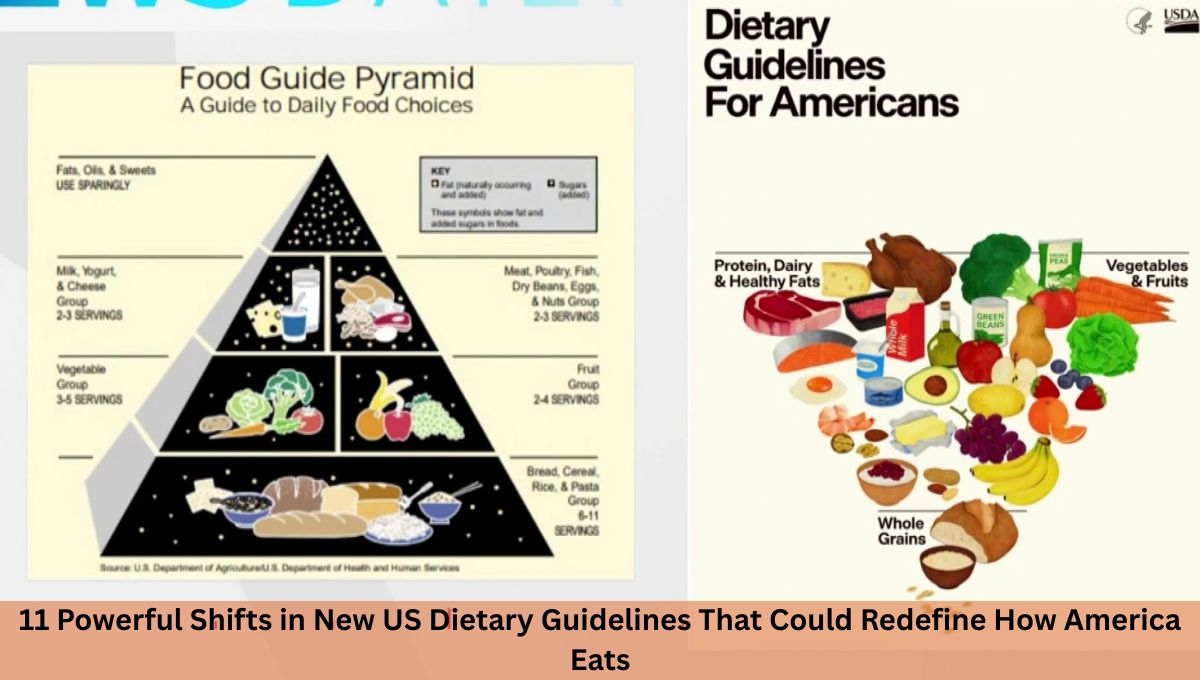
The Inverted Food Pyramid Explained
Flipping a Familiar Symbol
The Trump administration introduced a new visual framework: an inverted food pyramid.
At the broad top:
- Meat
- Dairy
- Healthy fats
- Vegetables and fruits
At the narrow bottom:
- Whole grains
- Refined grains
- Ultra-processed foods and sugar
Officials say the graphic emphasises nutrient density rather than calorie volume. Critics argue it is confusing and visually suggests grains should be minimised, despite guidance still recommending fibre-rich whole grains.
Impact on Schools and Federal Food Programs
Ambitious Goals, Practical Challenges
Because the dietary guidelines govern school meals, the changes could have far-reaching consequences for the 30 million children who rely on school food daily.
School nutrition officials warn:
- Scratch cooking requires more staff and training
- Fresh foods cost more than processed options
- Infrastructure is often inadequate
Nearly 80% of school meal directors report needing significantly more funding to reduce reliance on ultra-processed foods.
Congressional action will likely be required before schools can fully implement the new standards.
Mixed Reactions From the Medical Community
Praise and Alarm Side by Side
Medical organisations offered sharply divided responses:
Supporters say:
- Targeting ultra-processed foods is overdue
- Sugar reduction is critical
- Whole foods should anchor public health
Critics warn:
- Emphasis on red meat contradicts decades of evidence
- Full-fat dairy adds excess calories
- Saturated fat guidance is internally inconsistent
Some experts also raised concerns about climate change, noting that beef production is among the most environmentally damaging food sources.
A Political and Ideological Undercurrent
Nutrition Policy Meets Culture Wars
The dietary guidelines cannot be separated from the broader political context.
Kennedy has made sweeping changes to vaccine policy, criticised scientific advisory committees, and framed food policy as a matter of national security.
Some nutrition experts fear that science-based processes have been sidelined in favour of ideology, undermining trust in federal health institutions.
What This Means for Everyday Americans
For most people, the guidelines boil down to several clear messages:
- Eat fewer packaged foods
- Cut back on sugar and refined carbs
- Cook more at home
- Focus on whole, nutrient-dense foods
Where Americans may struggle is navigating the tension between eating more protein and limiting saturated fat — especially amid rising food prices.
Conclusion: A Defining Moment for American Nutrition
The new US dietary guidelines represent a bold, controversial attempt to confront America’s chronic disease crisis by reshaping how the nation eats.
By targeting ultra-processed foods and sugar, the administration has aligned with growing scientific consensus. By embracing red meat, full-fat dairy, and higher protein intake, it has reopened long-settled debates about heart health, sustainability, and the role of ideology in public health.
Whether these guidelines lead to healthier Americans or deeper confusion will depend not just on what is written on paper, but on how families, schools, doctors, and policymakers interpret and implement them.
One thing is certain:
the way America talks about food has changed — and the debate is only beginning.
Also Read: RFK Jr. Fires Entire CDC Vaccine Panel, Sparking Public Health Uproar
Also Read: Here’s what’s in new dietary guidelines from the Trump administration
Related Posts:
- 5 Major Takeaways from the US Supreme Court's…

- 7 Big Takeaways: Macron’s High-Stakes China Visit…

- 7 Heartbreaking Facts About Venezuela's Earthquake Disaster

- 7 Powerful Facts About Ayatollah Ali Khamenei’s…

- Afghanistan–Pakistan War 2025: Inside the 48-Hour Ceasefire

- 11 Explosive Revelations From Ted Cruz’s Leaked…