
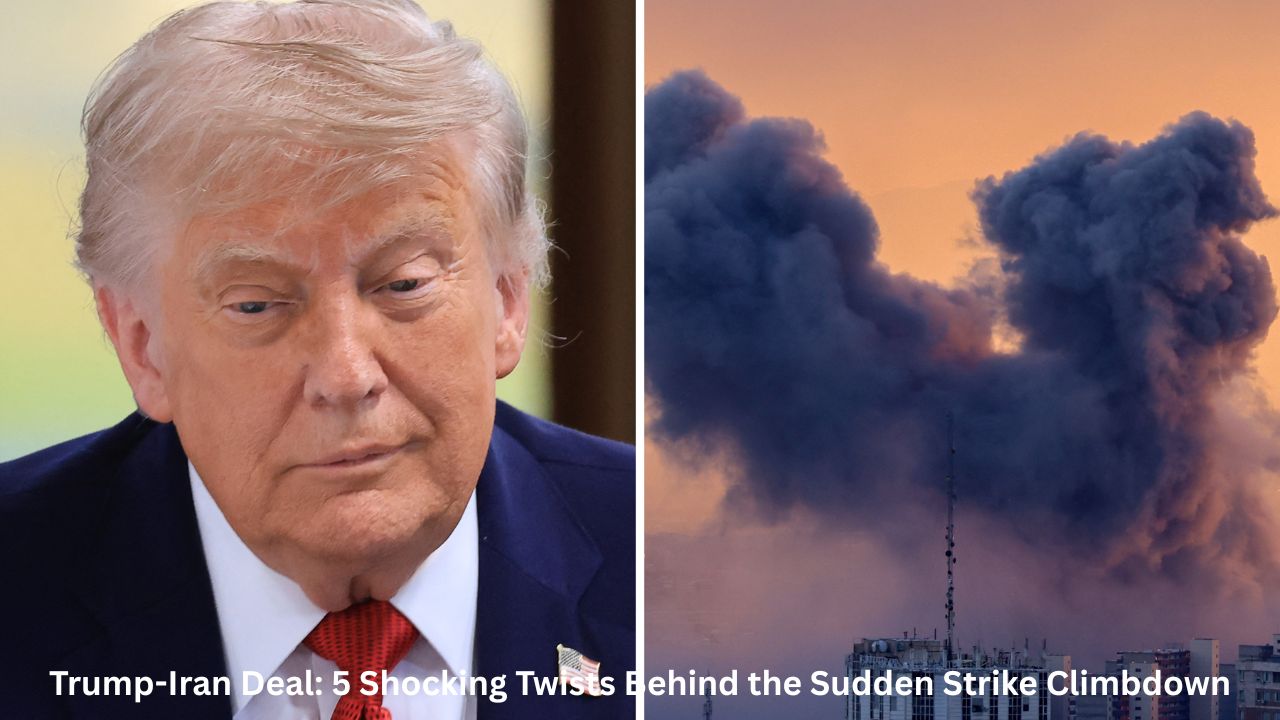
Trump-Iran Deal: 5 Shocking Twists Behind the Sudden Strike Climbdown that sent global oil markets reeling. A weekend that was supposed to end with American bombs falling on Iran instead ended with a phone call, a Truth Social post, and a promise of talks. President Donald Trump announced late Saturday that the United States would hold off on a planned massive assault against Iran, saying the “perimeters” of a deal to reopen the Strait of Hormuz had been agreed.
By Sunday, he confirmed that formal negotiations with Tehran would begin Monday afternoon.
For a world that has been bracing for a dangerous new phase of the five-month-old US-Iran war, the announcement offered a flicker of relief.
But it also raised a familiar question:
is this the moment the fighting finally winds down, or just the latest pause in a conflict that has repeatedly threatened to reignite?
Here’s what’s really going on — and why it matters far beyond the Gulf.
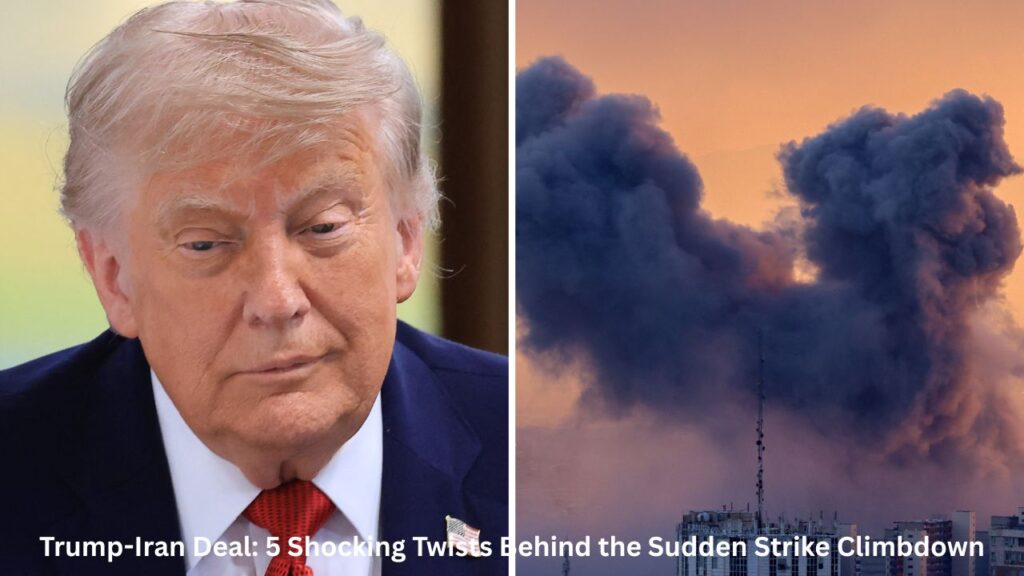
Trump-Iran Deal: 5 Shocking Twists Behind the Sudden Strike Climbdown
A Weekend U-Turn That Stunned the Region
Just days earlier, Trump had struck a very different tone, warning that the US military “will be hitting them very hard” and suggesting he was losing patience with diplomacy altogether.
Behind the scenes, US Central Command had reportedly drawn up plans for what one Israeli official described as the biggest American assault since World War II, targeting Iranian energy infrastructure. Israel was expected to take part.
Then, roughly 24 hours before the strikes were due to begin, everything changed.
Trump announced he was calling off the operation, crediting pressure from Gulf allies and, he claimed, from Iran itself.
It marked yet another reversal in a war that began on February 28, when a joint US-Israeli strike killed Iran’s supreme leader and plunged the region into open conflict.
Why Trump Blinked: The Saudi Phone Call
Mohammed bin Salman’s Warning
According to multiple reports, Saudi Crown Prince Mohammed bin Salman called Trump on Saturday and raised serious concerns about the scale of the planned strikes.
The crown prince reportedly pushed for de-escalation, worried that hitting Iran’s energy infrastructure could trigger retaliation against Gulf oil facilities and rattle the global economy.
Trump later told reporters he had asked bin Salman directly whether he preferred an attack or a deal, and the answer was clear:
the Saudis wanted an agreement, not another round of bombing.
Mixed Signals from Gulf Allies
Curiously, Trump named Saudi Arabia, the United Arab Emirates, and Qatar as the countries that asked him to stand down.
That account doesn’t fully match other reporting, which suggests the UAE had actually favored a tougher response against Tehran.
It’s a reminder that even among Washington’s closest Gulf partners, opinions on how to handle Iran are far from unified — a dynamic that could complicate any lasting settlement.
What’s Actually on the Table
Reopening the Strait of Hormuz
At the heart of the emerging deal is the Strait of Hormuz, the narrow waterway through which roughly a fifth of the world’s oil has historically passed.
Iran has spent weeks attacking and harassing tankers moving through the strait, part of its campaign to punish shipping tied to US military escorts.
A senior official involved in the mediation said the new proposal calls for Iran to reopen the strait and halt attacks by its allied militias across the region — including in Iraq, against Gulf states, and against Jordan — in exchange for the US lifting its naval blockade and allowing Tehran to resume oil exports.
This would essentially revive the memorandum of understanding both sides signed back in June, which gave negotiators 60 days to reach a broader nuclear agreement.
With less than a month left on that clock, the pressure to move quickly is real.
The Nuclear Question Gets Pushed Back
On Saturday, Trump suggested the new deal would tackle both the strait and Iran’s nuclear program at once.
By Sunday, his tone had shifted — he indicated that the nuclear file would likely be addressed in a follow-up agreement, once the Hormuz issue is settled first.
Speaking to reporters aboard Air Force One, Trump said he was hopeful about the process, adding that reaching an agreement would “save a lot of lives.”
Iran Pushes Back: “There Is No Agreement”
Not everyone in Tehran is on the same page as Washington’s version of events.
Iran’s semi-official Mehr and Fars news agencies flatly denied that the Islamic Republic had asked the US to stand down or agreed to any arrangement dividing control of the strait, with one outlet insisting the strait remains closed to any vessel not cleared by Iran’s Revolutionary Guard Corps.
Iran’s Foreign Ministry spokesperson separately said the waterway would not return to its pre-war status, while state media outlets mocked Trump’s reversal as yet another empty threat.
This isn’t just theater. Iran’s leadership appears genuinely split, with hardliners who reject any negotiation pitted against factions that see continued military pressure as a way to extract better terms at the table.
That internal tug-of-war helps explain the whiplash between Washington’s optimistic framing and Tehran’s public denials — and it’s a major reason analysts remain cautious about Monday’s talks producing a quick breakthrough.
Global Oil Markets Feel the Whiplash
Few markets have felt this conflict as directly as oil. Brent crude broke above $100 a barrel in late July amid fears of a full-scale escalation, before easing back toward $90 as talk of a truce spread — only to jump again after Iran fired ballistic missiles at a US base in Jordan.
By Monday, prices pulled back once more as investors trimmed the risk premium built into crude following news that Trump had called off the strike.
The uncertainty has had real-world consequences well beyond trading floors. US embassies across the Middle East have warned American citizens to prepare for flight cancellations and unpredictable airspace closures.
For businesses and consumers worldwide, every twist in this standoff continues to ripple through fuel costs, shipping insurance, and supply chains far from the Gulf itself.
What Happens Monday — and Why the World Is Watching
Trump has confirmed that negotiations with Iran begin Monday afternoon, though he has notably declined to set a deadline for reaching an agreement, despite mediators having worked on the framework for weeks already.
He has also dropped an earlier demand that ships pay a fee to transit the strait under US military protection, after the shipping industry pushed back hard against the idea.
What makes this moment different — or perhaps not so different — from previous attempts is the sheer number of times a pause has been announced only to collapse within days.
Since the war erupted in February, ceasefires and strike halts have been declared and broken repeatedly, each time reviving hopes that were then dashed by a fresh attack or diplomatic breakdown.
The Bigger Picture: A War That Keeps Almost Ending
To understand why this weekend’s announcement matters, it helps to step back.
The conflict has already reshaped the region:
it triggered a leadership vacuum inside Iran, drew in Gulf states and Israel, spread to the Red Sea through Houthi attacks on shipping, and repeatedly disrupted one of the world’s most critical energy corridors.
Every time diplomacy appears to gain ground, a new incident — a missile strike, a tanker attack, a denial from Tehran — threatens to unravel it.
That history is exactly why so many observers are treating Monday’s talks with cautious optimism rather than confidence.
A deal that genuinely reopens the Strait of Hormuz and halts the fighting would be a major turning point, not just for the Middle East but for global energy security and trade.
A deal that unravels within days would simply be the latest chapter in a war that has defied predictions since the day it began.
Conclusion
For now, the world is left watching two very different narratives unfold at once:
an American president insisting a breakthrough is within reach, and an Iranian government insisting nothing has actually been agreed.
Somewhere between those two accounts, Monday’s negotiations will either chart a genuine path out of this war — or become one more false dawn in a conflict that has tested the patience of the entire international community.
Either way, from oil traders in London to shipping companies in Singapore to ordinary families in the Gulf, the stakes of what happens next stretch far beyond the negotiating room.
Also Read: US-Iran War Escalates: 5 Critical Facts About Trump’s Threatened Strikes This Weekend
Also Read: Iran denies it asked Trump not to strike or agreed to deal to split control of Hormuz
Related Posts:
- 10 Explosive Signals Trump Says Iran War Could End…
- 10 Explosive Warnings as Donald Trump Calls Iran…
- 12 Explosive Claims as Donald Trump Says Iran War…
- 3 Explosive Conditions Iran Sets to End War with US…
- 11 Explosive Warnings as Trump Vows to ‘Knock the…

- 10 Explosive Strikes: Israel Bombs Tehran Oil Depots…
