
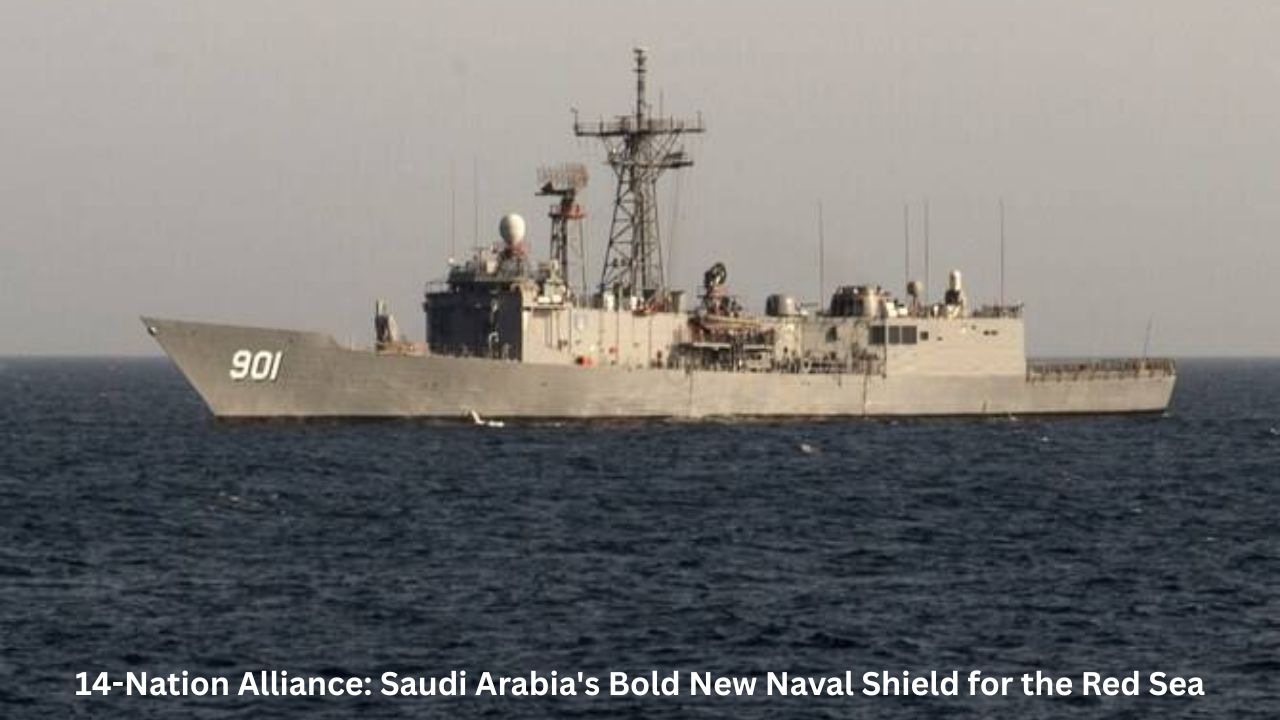
14-Nation Alliance: Saudi Arabia’s Bold New Naval Shield for the Red Sea, Bab al-Mandeb Strait, and Gulf of Aden against Houthi attacks. One of the world’s most vital shipping corridors just got a new line of defense. On July 30, 2026, Saudi Arabia announced the creation of a 14-nation naval coalition designed to protect the Red Sea, the Bab al-Mandeb Strait, and the Gulf of Aden — a stretch of water that carries a striking share of the planet’s oil and trade, and one that has come under repeated attack from Yemen’s Iran-aligned Houthi movement in recent months.
The announcement lands at a genuinely tense moment. With the Strait of Hormuz effectively shut down by the ongoing US-Iran conflict, Red Sea shipping routes have become even more critical — and even more exposed.
Here’s a complete look at what Saudi Arabia has actually announced, why the timing matters, and what it could mean for oil markets and global trade in the months ahead.
What Was Announced: Inside the Multinational Maritime Defense Alliance
According to a statement from Saudi Arabia’s Ministry of Defence, the new coalition — officially named the Multinational Maritime Defense Alliance — was created as a framework for closer cooperation on maritime security across the Bab al-Mandeb Strait, the Red Sea, and the Gulf of Aden.
Together, these waterways form a strategic corridor linking the Indian Ocean to the Mediterranean Sea.
Representatives from 43 countries, out of 51 that were invited, took part in the meeting that produced the alliance, and a European Union delegation was also present.
The EU already runs its own naval protection mission in the region, known as Aspides, and it isn’t yet clear how the new Saudi-led alliance will work alongside it.
The Saudi ministry’s statement did not specify exactly what ships, aircraft, or other military assets each member country would contribute.
Instead, it described the coalition’s activities as centered on intelligence sharing, coordinated operational planning, joint military exercises, and maritime security operations.
Saudi Arabia is recognized as the alliance’s founding member and will host its headquarters, although the exact location has not been disclosed.
Who Signed On — and Who Didn’t
Alongside Saudi Arabia, the alliance’s 13 other members are Turkiye, Kuwait, Bahrain, Qatar, Jordan, Egypt, Pakistan, Djibouti, Somalia, Bangladesh, Yemen, Sudan, and the Comoros.
Notably, two of Saudi Arabia’s closest Gulf neighbors — the United Arab Emirates and Oman — have not signed on, despite sharing similar security concerns amid the broader regional conflict tied to Iran.
The Saudi ministry’s statement left the door open for additional countries to join later, once they complete their own national approval procedures.
Riyadh has reportedly also invited the United States and several European countries, including Germany, France, the UK, and Italy, to take part.
Why Now: The Houthi Blockade and a Fragile Oil Route
The timing of the announcement is no coincidence.
Roughly a week before the coalition was unveiled, Yemen’s Houthi movement declared a maritime blockade against Saudi Arabia, disrupting oil shipments that had been rerouted through the Red Sea.
The Houthis, who control Yemen’s capital, Sanaa, and much of the country’s Red Sea coastline, have said the blockade applies specifically to Saudi-linked shipping and denied planning to impose tolls on vessels more broadly.
The group has framed the standoff as tied to Yemen’s own long-running blockade rather than a direct extension of the wider conflict with Iran, saying it will lift restrictions once Saudi Arabia eases its own blockade on Yemen.
Saudi officials dispute that characterization, pointing out that more than 300 commercial ships carrying food, fuel, and other goods reached Houthi-controlled ports during the first half of 2026 alone.
The stakes for Saudi Arabia are considerable.
Since the outbreak of the US-Israel conflict with Iran in late February, and the resulting near-total closure of the Strait of Hormuz — a route that normally handles roughly a fifth of global oil and gas exports — Riyadh has leaned heavily on an alternative path:
the East-West pipeline, which carries crude from refineries in eastern Saudi Arabia to the Red Sea export terminal at Yanbu.
But to reach international markets from there, tankers still have to pass through Bab al-Mandeb, giving the Houthis significant leverage over a critical piece of Saudi Arabia’s remaining export capacity.
Bab al-Mandeb: A Narrow Chokepoint With Global Stakes
It’s hard to overstate how much rides on this single stretch of water.
An estimated 10 to 12 percent of global maritime trade, including millions of barrels of oil daily, passes through Bab al-Mandeb, which sits between Eritrea, Djibouti, and Yemen.
It is one of only two entry and exit points to the Red Sea, the other being Egypt’s Suez Canal.
At its narrowest point, the strait is just 29 kilometers (about 18 miles) wide, limiting ship traffic to two navigable channels — a bottleneck that makes any disruption there capable of sending shockwaves through global energy markets almost instantly.
The Bigger Picture: A Possible Ground Offensive, Too
The naval coalition may be only part of Saudi Arabia’s response.
According to Yemeni sources cited by The Guardian, Riyadh is also preparing for a possible major offensive against the Houthis — potentially by both sea and land — aimed at breaking their grip on Saudi oil exports through the southern Red Sea.
Saudi forces have reportedly begun withdrawing from positions in eastern Yemen and regrouping, in what could be preparation for an advance into the Houthi-controlled al-Bayda governorate in the country’s center.
Saudi officials have not publicly confirmed any plans for a ground operation.
The reported military buildup comes shortly after Saudi and US strikes on Iran-backed groups in Iraq killed at least 20 people, and after Saudi Defense Minister Khalid bin Salman held urgent talks with US President Donald Trump and Vice President JD Vance.
For his part, Houthi leader Abdul Malik al-Houthi said this week there were signs Saudi Arabia was preparing a major escalation, and vowed that his movement would respond to any siege with a “siege” of its own.
Oil Markets React
Global oil markets moved quickly on the news.
Brent crude, the international benchmark, fell nearly 2 percent to close at $89.03 a barrel, while US West Texas Intermediate dropped about 1 percent to settle at $83.59 a barrel — both easing slightly as traders welcomed signs of a coordinated response to Red Sea disruptions.
That’s still a far cry from the extreme volatility seen earlier in the year, when Brent crude briefly surged past $100 a barrel amid the worst of the fighting around the Strait of Hormuz.
The relative calm in prices suggests markets see the new coalition as at least a modest stabilizing force, even if the underlying security situation remains fragile.
A “Purely Defensive” Alliance? Questions That Remain
In its official statement, the Saudi Defense Ministry described the new alliance as “purely defensive in nature” and stressed that it does not target any particular state.
The coalition, it said, reflects a shared conviction that maritime security is a collective responsibility, and that cooperation among states is essential to confronting shared, cross-border maritime threats.
Still, plenty of questions remain unanswered. It’s unclear exactly how this new alliance will coordinate with the EU’s existing Aspides mission, what specific military resources each member country will actually contribute, and whether major Gulf powers like the UAE and Oman might eventually join.
There’s also the broader question of how a “defensive” naval alliance squares with reports of a possible offensive military operation against the Houthis on land — two tracks that, if both materialize, would represent a significant escalation in an already volatile regional conflict.
What Happens Next
For now, the alliance exists mostly as a framework and a statement of intent rather than a fully operational military force.
The coming weeks are likely to reveal more about its actual capabilities — including whether the US and additional European nations formally join, how patrols and joint exercises will be organized, and whether the coalition can meaningfully deter further Houthi attacks on shipping.
Meanwhile, all eyes will remain on both the Red Sea and the Strait of Hormuz, the two chokepoints now sitting at the center of the world’s most consequential energy security story.
Conclusion
Saudi Arabia’s new 14-nation maritime alliance marks one of the most significant regional responses yet to the disruption threatening global shipping lanes in 2026.
It reflects both the scale of the threat posed by the Houthi blockade and the deep interconnection between Middle Eastern security and the global economy, where a narrow 18-mile strait can move oil prices and unsettle markets thousands of miles away.
Whether this alliance evolves into a robust, well-coordinated security force — or remains a largely symbolic diplomatic gesture — will depend on what happens in the weeks ahead, both on the water and, potentially, on the ground in Yemen.
Until then, the Red Sea remains one of the most closely watched flashpoints in a region already stretched thin by conflict.
Also Read: 7 Powerful Reasons Trump’s F-35 Deal with Saudi Arabia Is Rewriting Middle East Geopolitics
Also Read: Saudi Arabia Prepares Major Offensive Against Houthis in Yemen
Related Posts:
- 9 Explosive Revelations Behind Yemen’s Separatist…

- Yemen War 2025: Israeli Strike Kills Houthi Military…

- 5 Major Takeaways from the US Supreme Court's…

- 7 Heartbreaking Facts About Venezuela's Earthquake Disaster

- 7 Powerful Insights into Zohran Mamdani’s Historic…

- In 8 Moves, EU Targets China-Linked Refineries and…
