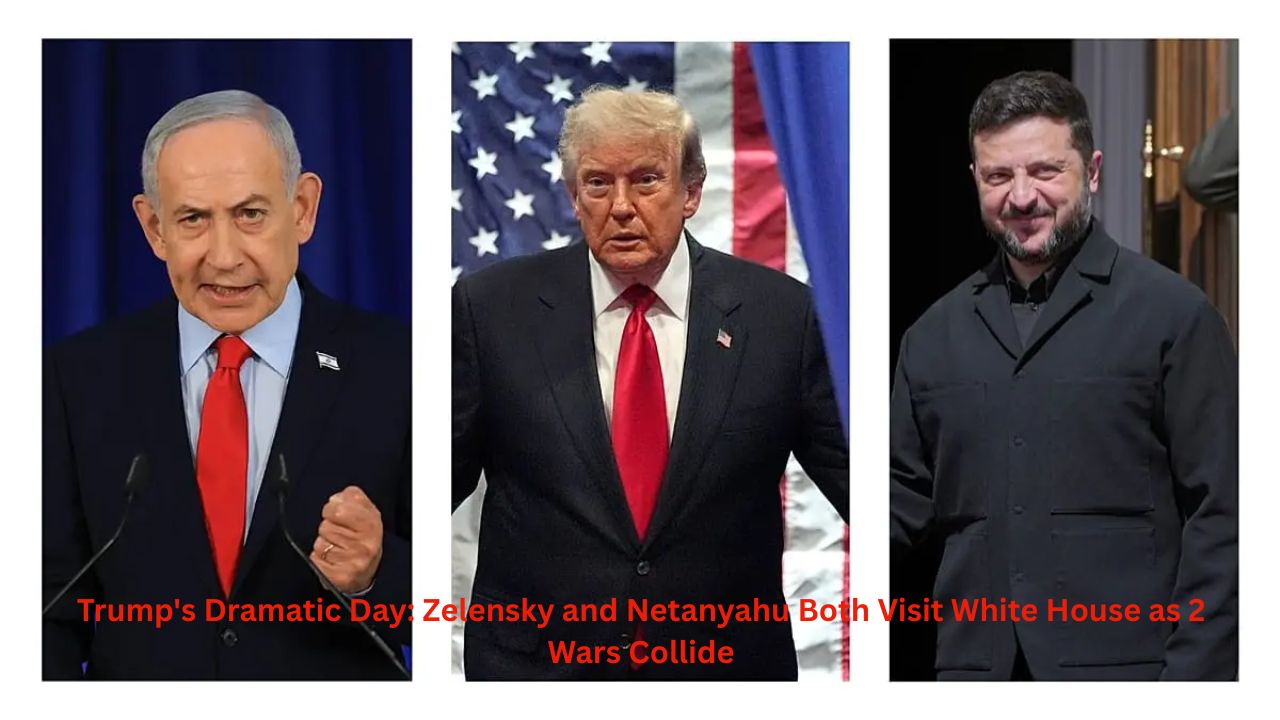
Trump’s Dramatic Day: Zelensky and Netanyahu Both Visit White House as 2 Wars Collide, hours before Lindsey Graham’s funeral in Washington.
Washington rarely sees a day quite like Tuesday, July 28, 2026. Within the span of a few hours, President Donald Trump sat down separately with two wartime allies, Ukrainian President Volodymyr Zelensky and Israeli Prime Minister Benjamin Netanyahu, while the Senate advanced one of the toughest Russia sanctions packages in years, and lawmakers from both parties gathered to bury one of Washington’s most influential foreign policy voices, Senator Lindsey Graham.
Taken together, the day offered a rare, compressed snapshot of just how tightly the wars in Ukraine and the Middle East have become intertwined in American politics, and how much influence a single senator’s legacy can still carry even after his death.
Trump’s Dramatic Day: Zelensky and Netanyahu Both Visit White House as 2 Wars Collide
Quick Facts: Trump’s White House Meetings
- Date: Tuesday, July 28, 2026
- Who met Trump: Ukrainian President Volodymyr Zelensky and Israeli Prime Minister Benjamin Netanyahu, in separate closed-door Oval Office meetings
- Occasion: Both leaders were also in Washington to attend the funeral of Senator Lindsey Graham
- Key Ukraine topic: Licensing Ukraine to produce US Patriot air-defense interceptor missiles domestically
- Key Israel topic: The war with Iran, Lebanon negotiations, and expanding the Abraham Accords
- Same-day development: The US Senate voted 86-12 to advance the Lindsey O. Graham Sanctioning Russia and Iran Act of 2026
- White House statement: Press Secretary Karoline Leavitt called both meetings “positive and productive”
A Day of Historic Diplomacy at the White House
The choreography of the day was striking in itself. Zelensky arrived at the White House at around 9:40 a.m., entering through a side entrance of the West Wing, for a meeting that lasted just over an hour.
Netanyahu followed later in the morning, departing shortly after 12:25 p.m. Both sessions took place behind closed doors in the Oval Office, with no press access granted to either.
Afterward, Leavitt confirmed that Trump had concluded both meetings and described them in nearly identical terms:
positive and productive.
It was a notable — and once unimaginable — turn of phrase given how fraught Trump’s relationship with Zelensky was for much of his presidency.
What Zelensky and Trump Discussed: Patriots, Peace, and Pressure on Russia
For Zelensky, the Oval Office conversation centered on strengthening Ukraine’s air defenses and reviving stalled diplomatic efforts to end the more than four-year war with Russia.
The Ukrainian leader said afterward that the two discussed licenses allowing Ukraine to manufacture Patriot interceptor missiles on its own soil, building on an agreement Trump made earlier this month at a NATO summit in Ankara.
That earlier announcement marked one of the most significant transfers of advanced American military technology to Ukraine since Russia’s full-scale invasion began, and if it moves forward, Ukraine would join only Japan, Germany, and Poland among nations licensed to build the system.
Trump has said he believes Ukrainian manufacturers could begin production within a few months, though independent experts caution the process is unlikely to move that quickly, given the complexity of Patriot’s guidance systems and strict US certification requirements.
Zelensky also used the Washington visit to press for progress on the Russia sanctions bill, a drone-production partnership with the US, and renewed momentum on peace talks.
He later described Graham as a true friend of Ukraine, a man he had met roughly ten times in Kyiv since the war began, and said the two had discussed producing Patriot missiles “and several other ideas that could help.”
Netanyahu’s Visit: Iran, Lebanon, and a Rare Moment of Friction
Netanyahu’s meeting covered different, but equally urgent, ground.
According to a White House official, the talks focused on the ongoing war with Iran, negotiations involving Lebanon, and efforts to expand the Abraham Accords, the framework normalizing relations between Israel and several Arab nations.
Netanyahu was also expected to share intelligence with Trump about alleged Iranian nuclear activity at a facility referred to as Pickaxe Mountain.
But the visit wasn’t entirely friction-free:
Trump appeared visibly irritated that Netanyahu had discussed the intelligence briefing publicly before their meeting, telling reporters he would have preferred to hear about it directly rather than through an announcement.
Despite the moment of tension, Trump acknowledged only a “little difference” between Washington and Israel’s approach, describing the two allies as “pretty close” overall.
Later that day, Trump repeated a warning to Iran that the United States could strike bridges and power plants if Tehran does not move toward an agreement, underscoring how unresolved the conflict remains even as diplomatic channels stay open.
Remembering Lindsey Graham: The Senator Who Bridged Two Wars
Both leaders’ visits were shaped by a somber occasion:
the funeral of Senator Lindsey Graham, the South Carolina Republican who died suddenly on July 11 at age 71 from an aortic dissection, just days after returning from a trip to Ukraine where he had met with Zelensky to discuss the Russia sanctions legislation that now bears his name.
Graham had spent more than three decades in Congress and became one of the most consistent Washington voices pushing for American involvement in both Ukraine’s defense and Israel’s security, making him an unusually direct conduit to the White House for both Zelensky and Netanyahu.
A Funeral Fit for World Leaders
Washington held two days of ceremonies to honor Graham. On Tuesday morning, his flag-draped casket was carried into the US Capitol rotunda by a military honor guard, where lawmakers and mourners paid their respects in silence.
That afternoon, a formal funeral service was held at Washington National Cathedral, attended by Vice President JD Vance, Treasury Secretary Scott Bessent, Secretary of State Marco Rubio, Defense Secretary Pete Hegseth, Finnish President Alexander Stubb, and members of Graham’s family.
Trump delivered a personal eulogy, calling Graham a true American original and a beloved friend.
Netanyahu, who had joined Graham’s family the previous evening for a private dinner in his honor, said Israel had lost one of its greatest friends and described Graham as someone who understood that the security of Israel and America were inseparable.
A second memorial service was scheduled for Wednesday in Graham’s home state of South Carolina.
How the Wars in Iran and Ukraine Are Converging
Beyond the diplomacy and the mourning, Tuesday’s events underscored something increasingly hard to ignore:
two conflicts fought roughly 2,500 kilometers apart are beginning to intersect in ways that shape US policy on both fronts.
The Caspian Sea Tanker Strike
Days before the White House meetings, Ukraine struck an Iranian tanker in the Caspian Sea that Kyiv’s ambassador to Israel said was carrying drones and military components bound for Russia. Iran has since vowed retaliation.
Analysts note that by targeting Iranian shipping, Ukraine is effectively striking at what Washington increasingly views as its own top adversary, a move likely to be welcomed in US policy circles even as Kyiv tries to avoid becoming too closely associated with America’s unpopular war against Tehran.
Zelensky has separately signaled support for folding Iran-related sanctions into the Russia bill, reportedly telling a Trump ally last week that he considered the move “a great idea.”
Why Trump’s Tone on Ukraine Has Shifted
Much of the goodwill on display Tuesday traces back to a broader, and fairly dramatic, shift in how the Trump administration views Ukraine’s usefulness as a partner. For much of the past year, Ukraine was often treated in Washington as a dependent seeking handouts.
That began changing as Iran’s war with Israel and the United States dragged on, and as Iranian-designed Shahed-type drones repeatedly overwhelmed American and allied air defenses across the Gulf.
Ukraine, by contrast, has built one of the world’s most battle-tested drone industries out of necessity, reportedly on track to produce six to seven million short-range attack drones this year alone.
That expertise has suddenly become far more valuable to Washington, prompting Trump to not only offer the Patriot production license but also express interest in purchasing Ukrainian-made drones directly, something his administration had shown little appetite for as recently as last year.
Not Everyone Is Convinced: Skepticism Remains
Despite the warmer atmosphere, foreign policy analysts remain cautious about how much has actually changed.
Commentators speaking on international broadcasts this week argued that Trump’s more supportive tone toward Ukraine will mean little unless it’s paired with genuine pressure on Russian President Vladimir Putin to negotiate seriously.
Diplomats and former officials have made similar points in recent months, noting that rhetorical shifts from the White House have, in the past, not always translated into lasting policy changes, and that Moscow has so far shown little willingness to make concessions at the negotiating table.
The Bigger Picture: Fighting Continues on Ukraine’s Front Lines
None of Tuesday’s diplomacy has slowed the fighting on the ground.
Russian strikes on eastern Ukraine on Monday killed seven people and injured more than twenty, according to Ukrainian officials, while a Ukrainian drone strike on a commercial building in Russia’s Belgorod region killed one person and injured two others.
The heaviest combat continues around Kostiantynivka and Pokrovsk in Ukraine’s Donetsk region, a grim reminder that even as leaders exchange warm words in Washington, the war itself shows no sign of slowing down.
Conclusion
Tuesday’s convergence of diplomacy, mourning, and legislative momentum captured a Washington navigating two wars at once, each shaping the other in ways that would have seemed unlikely just a year ago.
Whether the day’s warm meetings, the advancing sanctions bill, and Ukraine’s new standing as a valued defense partner add up to real progress toward peace remains an open question.
What is clear is that the legacy of Lindsey Graham, a senator who spent his career pushing America deeper into both of these fights, was very much alive in the room on the day Washington said goodbye to him.
Also Read: 7 Crucial Developments as Zelenskyy Says US Security Deal Is 100% Ready
Also Read: At Graham funeral, Netanyahu and Zelensky speak in person for first time in 3 years