

Trump’s Historic Gaza Ceasefire Deal 2025: Powerful Insights into regional politics and global diplomacy. When dawn broke over the war-ravaged skyline of Gaza City, thousands of Palestinians began the long journey home. Their city lay in ruins — no power, no running water, hospitals flattened, neighborhoods erased — yet they walked northward with determination and grief.
That same morning, in Washington, U.S. President Donald Trump stood before reporters calling it a “great deal.” The announcement marked what could be the most consequential diplomatic breakthrough in decades: the end of the two-year Israel–Hamas war, one of the bloodiest conflicts in modern Middle Eastern history.
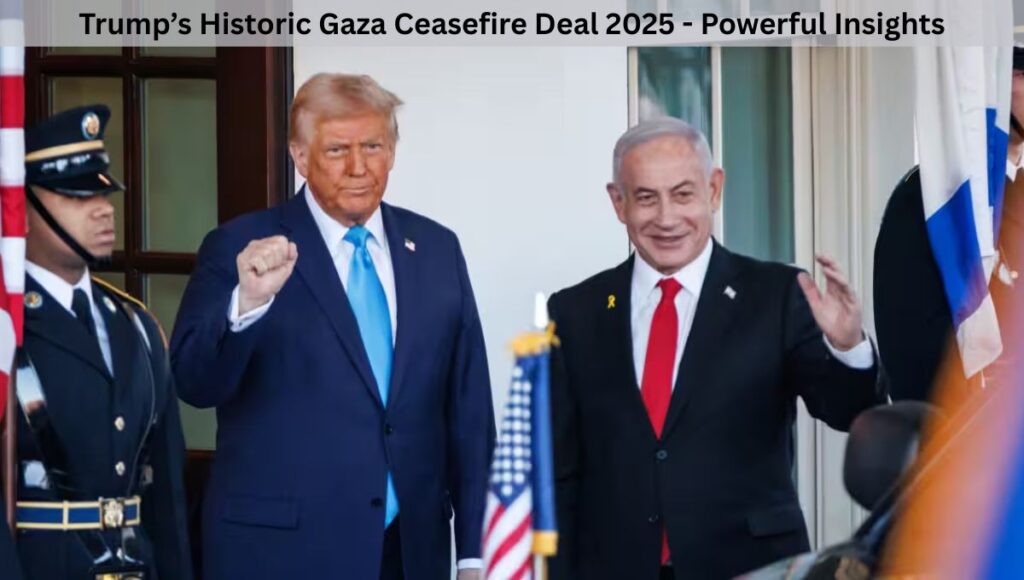
Trump’s Historic Gaza Ceasefire Deal 2025 – Powerful Insights
A Fragile Return to the North
For Palestinians like Ahmad Abu Watfa, the journey home was both spiritual and symbolic. “Even if the houses are destroyed, we will return,” he told CNN on his way to Sheikh Radwan in Gaza City.
His joy, though heavy with loss, echoed across the desolate streets of northern Gaza — a region that had been forcibly emptied since October 2023, when Hamas’ attacks triggered Israel’s devastating military campaign.
Aerial footage of the city paints a haunting picture — entire neighborhoods flattened, hospitals reduced to rubble, streets carpeted in dust and debris. Yet despite the destruction, tens of thousands of displaced Palestinians began walking north as the ceasefire took effect.
For many, it was the second attempt to return. Earlier ceasefires had collapsed, and Israel’s repeated evacuation orders forced civilians to flee south time and again. This time, they hoped, would be different.
The Turning Point: How the Deal Took Shape
Behind the scenes, the ceasefire was months in the making — a labyrinth of diplomacy, power politics, and backchannel negotiations.
At its core was Trump’s 20-point peace plan, a document designed to end hostilities, secure the release of hostages, and begin Gaza’s reconstruction. But what truly changed the equation was a shock event in September 2025: Israel’s airstrike on Qatar’s capital, Doha, aimed at killing Hamas leaders allegedly hiding there.
The strike killed six people, including a member of Qatar’s internal security force — and nearly derailed any chance of diplomacy. Yet paradoxically, it became the catalyst that forced Washington to act decisively.
“It was the moment Trump said, ‘Enough,’” recalled a former Israeli official. “This deal, almost identical, had been on the table for over a year. Netanyahu didn’t want to do it — but Trump left him no choice.”
Trump’s fury at the Israeli strike on a U.S. ally was public. “I was very unhappy about every aspect,” he said bluntly. But rather than collapsing negotiations, the crisis gave Trump leverage. For the first time, Washington threatened to withdraw support for Israel’s far-right ambitions, including plans to annex parts of the West Bank.
Building Leverage: The Doha Strikes and Trump’s Ultimatum
The Doha incident marked a rare moment when the U.S., Qatar, and Arab nations found common cause — pressuring Israel’s government to accept a ceasefire. For Trump, the moment demanded both confrontation and calculation.
According to Arab and Israeli officials, Trump privately warned Prime Minister Benjamin Netanyahu that further escalation would “isolate Israel diplomatically and morally.” Behind closed doors, he linked Israel’s cooperation to future U.S. defense and aid guarantees — a move seen as both a carrot and a stick.
Simultaneously, Jared Kushner, Trump’s son-in-law and Middle East envoy, worked the phones with leaders in Qatar, Egypt, and Saudi Arabia, rebuilding trust shattered by Israel’s attack. “Kushner was the architect,” said a former Israeli diplomat. “He had credibility on both sides — and Trump had the power to enforce it.”
Together, they revived a modified version of the Abraham Accords diplomacy, leveraging Trump’s personal relationships with Gulf leaders to keep negotiations alive.
The U.N. General Assembly: Quiet Talks, Big Shifts
The next key moment came weeks later at the U.N. General Assembly in New York. Trump, determined to announce a deal by October 7 — the second anniversary of the Hamas attacks — convened discreet meetings on the sidelines with Arab and Muslim-majority leaders.
There, in private rooms overlooking the East River, Trump pitched his “20-Point Path to Peace.” Secretary of State Marco Rubio later said it was “the moment the coalition came together.”
At Trump’s insistence, Netanyahu made a rare apology call to Qatari Prime Minister Sheikh Mohammed bin Abdulrahman Al-Thani for the Doha airstrikes — a diplomatic gesture that reopened Qatar’s role as mediator. “The apology was a way to move forward,” said former Qatari defense attaché Nawaf Al-Thani. “It kept Qatar in the game when others had written off peace.”
That apology set the stage for the ceasefire’s first phase:
- A 72-hour truce,
- Exchange of hostages and prisoners, and
- Withdrawal of Israeli troops from key northern zones.
The move was both symbolic and strategic — a temporary truce meant to evolve into what U.S. officials described as an “almost permanent ceasefire.”
Inside the Deal: What the Ceasefire Text Reveals
While the full text of the ceasefire hasn’t been released, portions published in Israeli media reveal key insights — and lingering ambiguities.
Titled “Implementation Steps for President Trump’s Proposal for a Comprehensive End to the Gaza War,” the document outlines an immediate cessation of hostilities, exchange of detainees, and mechanisms for humanitarian relief.
Notably, it declares that “the war is over” — language that Hamas has embraced, but Netanyahu has avoided repeating publicly. Instead, the Israeli leader has maintained that disarmament of Hamas remains non-negotiable, warning, “If it’s not achieved the easy way, it will be achieved the hard way.”
That ambiguity reflects both Trump’s pragmatism and the fragile nature of the peace. The agreement leaves space for enforcement flexibility — allowing Israel to re-enter areas if Hamas violates terms — but also signals that Washington and Arab mediators will act as guarantors to prevent a relapse into war.
Humanitarian provisions were also central. With famine spreading across Gaza and medical infrastructure obliterated, the deal prioritizes aid convoys, reconstruction frameworks, and oversight by an International Stabilization Force supported by up to 200 U.S. troops — though none will enter Gaza itself.
Trump’s Balancing Act: Pressure, Power, and Personal Diplomacy
What set Trump’s approach apart was not just his leverage but his personal style — the mix of pressure, unpredictability, and proximity that often unnerves diplomats but gets results.
He played both “bad cop” and “broker,” alternating between threats to cut support and grand promises of economic aid. Sources say Trump’s aides used “psychological diplomacy,” leaking optimism to the media before the deal was finalized to box Netanyahu into agreeing — a strategy one Israeli official called “brilliant statecraft.”
Even Trump critics admit the method worked. “He understands that sometimes you have to use force to set the structure for peace,” said former House Speaker Newt Gingrich.
Why Biden Failed Where Trump Succeeded
Many analysts have drawn contrasts between Joe Biden’s failed ceasefire attempts in 2024 and Trump’s success a year later.
Four major differences stand out:
1. The Netanyahu Factor
Trump’s personal relationship with Netanyahu proved pivotal. Despite moments of tension, their mutual trust allowed for direct, uncompromising dialogue. Biden, by contrast, was openly critical of Netanyahu’s Gaza campaign, calling it “over the top” — remarks that strained Washington–Jerusalem communication channels.
2. Arab Trust and Visits
Trump’s visits to Saudi Arabia, Qatar, and the UAE earlier in 2025 reestablished U.S. credibility in the Arab world. His prior achievement — the Abraham Accords — gave him a diplomatic bridge to moderate Muslim states, many of which had severed informal contact with Washington during the Biden years.
3. Unified Political Support at Home
With both the U.S. Senate and House of Representatives controlled by Republicans, Trump operated with unprecedented political backing. The absence of domestic opposition enabled swift executive actions — from military deployments to diplomatic overtures — that Biden’s divided administration could never achieve.
4. Global and European Pressure
Europe’s position shifted dramatically in 2025. Nations like France and the U.K. recognized the State of Palestine, aligning with Arab powers to pressure Israel toward compromise. The French–Saudi peace initiative reinforced Trump’s plan, creating rare transatlantic unity behind an American peace framework.
A Human Cost Beyond Politics
Even as diplomats hailed Trump’s breakthrough, Gaza’s humanitarian catastrophe loomed large. According to the Palestinian Health Ministry, over 67,000 people — mostly civilians, including 18,000 children — were killed during the war.
The U.N.-backed Integrated Food Security Phase Classification (IPC) reported that famine took hold of Gaza City by August 2025, later spreading across the Strip. Hospitals like Al-Rantisi and Al-Shifa were found in ruins, with medical teams returning to rubble and burned-out equipment.
In the heart of Tal al-Hawa, Majdi Fuad Mohammad Al-Khour, a 70-year-old man, stood over the debris of his home. Two of his children had died in the conflict. “Forty years of work to build this home,” he said. “Now I cannot work, and I am old and sick. Where should I go?”
These voices — weary, defiant, and heartbroken — form the human backdrop to a political victory that, for many Palestinians, came too late.
The Next Phase: Governing Gaza After War
Trump’s deal was designed in two stages:
- Ceasefire and exchange, now underway.
- Political restructuring, including who governs Gaza and how reconstruction is funded.
The second phase could be even harder. Israel insists on Hamas’ disarmament; Hamas demands guarantees of political inclusion; Arab states seek international oversight; and Washington wants to prevent Iranian influence.
The emerging idea of an “International Stabilization Force” — supported by U.S., Egyptian, and Jordanian coordination — could form the backbone of post-war security. Trump’s aides have hinted that Saudi Arabia may lead funding efforts for Gaza’s rebuilding, linking it to a broader normalization pact with Israel.
As one U.S. official put it: “The hard part isn’t stopping the war — it’s agreeing on what peace looks like.”
Trump’s Legacy and the Road Ahead
For Trump, the Gaza ceasefire marks a defining moment in his second presidency — one that echoes the Abraham Accords of his first term but carries even greater stakes.
By halting a war that killed tens of thousands and destabilized an entire region, he reinforced his doctrine of “peace through strength.” Yet the path ahead remains fraught: Gaza’s governance is unresolved, Israeli politics remain volatile, and Hamas’ compliance will be tested daily.
Still, in diplomatic terms, the breakthrough has reshaped perceptions of U.S. leadership. “He’s reasserted American influence where it had waned,” said Jon Alterman of the Center for Strategic and International Studies. “And he’s done it in a way few expected — by forcing everyone to act.”
Also Read: ‘Nobel Prize to Trump’: Crowds in Gaza, Tel Aviv hail ceasefire deal brokered by US President
A Ceasefire of Consequence
As night fell on Gaza City, the lights remained out — but for the first time in two years, the sky was silent. No jets, no bombs, no sirens. Only the faint hum of voices as families picked through the ruins of their past lives.
Whether the ceasefire endures or falters, the moment stands as a testament to the interplay of political power and human resilience — to a diplomacy born of both coercion and compassion.
In the end, perhaps the truest measure of Trump’s Gaza breakthrough lies not in speeches or signatures, but in the footsteps of those returning home — walking through ash and memory toward what they still dare to call peace.
Also Read: Rubio’s Urgent Note to Trump Before Gaza Peace Deal Announcement – Key Moments 2025
Related Posts:
- Trump’s 2025 Gaza Peace Plan Signing and Historic…

- Trump’s Breakthrough Gaza Ceasefire Deal 2025: Key Insights

- Trump’s Historic Gaza Ceasefire Deal 2025: A…

- Israel–Hamas Ceasefire Under Strain: 4 More Hostage…

- Trump’s Gaza Warning: ‘Kill Hamas’ Threat After…
- 5 Powerful Highlights as Trump Lands Second Nobel…
