

Washington, October 10, 2025 —
Trump’s 2025 Tariffs: Shocking Impacts on Global Peace and the curbing of global conflicts. President Donald Trump suggested that his controversial tariffs may have played a role in securing the Israel-Hamas peace deal, following the first phase of the agreement that includes hostage releases and partial troop withdrawals from Gaza.
During a Fox News interview with Sean Hannity, Trump said:
“I think we shocked everybody by a lot with the tariffs and all of that… having the ability to use tariffs to help me make a point… the tariffs have brought peace to the world.”
Trump claimed that these measures have saved millions of lives, despite legal challenges over the tariffs’ implementation.
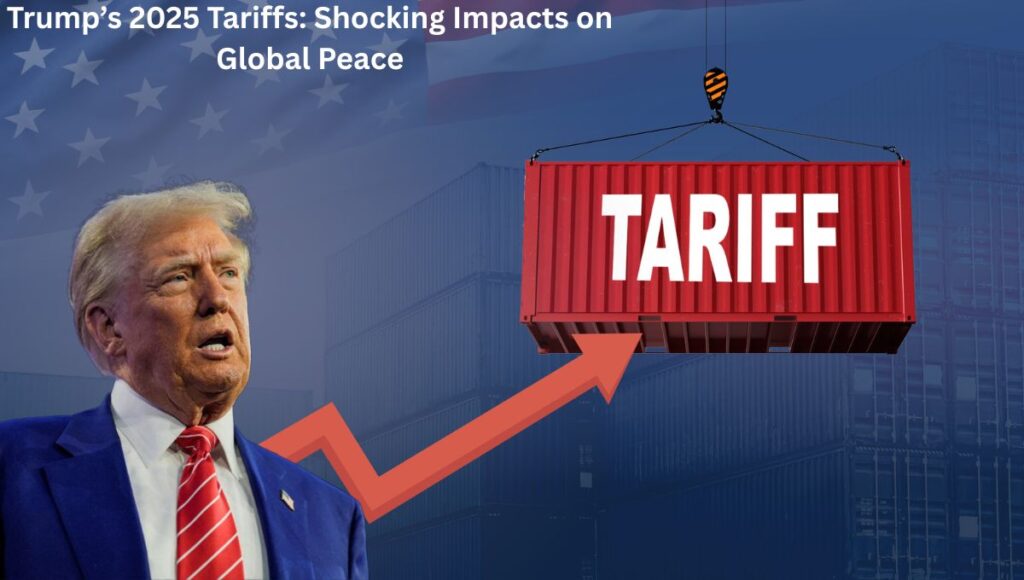
Trump’s 2025 Tariffs: Shocking Impacts on Global Peace
1. Trump’s Perspective on Tariffs as a Diplomatic Tool
Trump emphasized the strategic use of tariffs to influence global behavior:
- Tariffs were used as leverage in negotiations to encourage peace.
- According to Trump, they create economic pressure that motivates countries to resolve conflicts.
- He described tariffs as a tool for stopping wars and maintaining global stability.
“I’ve saved millions of lives using tariffs. So if for any reason the court ruled against… we should be absolutely entitled,” Trump said.
The legality of many 2025 tariffs has been challenged in court, with the US Supreme Court set to review them in November.
2. The Israel-Hamas Peace Deal: Trump’s Role
Trump announced the deal on Truth Social, highlighting its significance:
- Israel and Hamas signed the first phase of the peace plan.
- All hostages are expected to be released soon.
- Israeli forces will withdraw to agreed lines in Gaza.
- Mediators from Qatar, Egypt, and Turkey facilitated negotiations.
“BLESSED ARE THE PEACEMAKERS!” Trump wrote, calling it a “Historic and Unprecedented Event.”
A senior Hamas official, Zaher Jabarin, confirmed that lists of Palestinian prisoners for release are awaiting final agreement, per NBC News.
3. Trump’s Self-Assessment: “Eighth War Settled”
Trump celebrated the Gaza ceasefire during a White House Cabinet meeting, referring to it as “number eight” in a string of seven wars his administration settled.
He cited previous peace efforts, including:
- India-Pakistan truce
- Israel-Iran de-escalation
- Armenia-Azerbaijan peace efforts
- Ceasefires in Thailand-Cambodia, Congo-Rwanda, Egypt-Ethiopia
Trump attributed 60% of these outcomes to trade and tariff policies, claiming economic leverage encourages nations to negotiate rather than fight.
Also Read: Trump again claims he pushed India, Pakistan to peace through trade pressure, tariff threats
4. Critics Question Trump’s Claims
Many analysts and political opponents have called Trump’s self-assessment exaggerated:
- Ukrainian President Zelenskyy questioned rapid progress:
“I can’t tell you that President Trump will do everything that we want or need.”
- Turkish President Erdoğan noted that conflicts persist despite U.S. promises.
- California Governor Gavin Newsom mocked Trump’s statement about saving millions of lives using tariffs.
Newsom reposted a clip on X, responding simply, “hahahahahahahahaha.”
Critics argue that tariffs, while influential economically, cannot singlehandedly secure peace in multi-party conflicts.
5. The Legal Challenges of Trump’s 2025 Tariffs
Trump’s tariffs have faced intense legal scrutiny:
- Many were unilaterally imposed without congressional approval.
- Implemented under emergency authority typically reserved for crisis situations.
- The US Supreme Court is scheduled to hear a case in November regarding their legality.
Despite these challenges, Trump defended his actions as necessary for global stability.
6. Timeline of Key 2025 Tariff Actions
Trump’s 2025 tariffs were broad-reaching and aggressive:
| Date | Action | Impact |
| April 2 | Announced tariffs on 185+ countries; EU 20%, China 34% | Global trade tensions escalated |
| April 3 | 25% tariff on passenger cars | Automotive sector impacted |
| April 9 | China retaliation; US tariffs on Chinese imports raised to 125% | Trade war intensifies |
| July 12 | 30% tariffs on Mexico & EU | Political backlash in Europe |
| Sept 5 | Reduced Japanese car tariffs to 15% | Partial concession to allies |
| Sept 25 | 100% tariff on brand-name drugs not produced in US; heavy trucks & cabinets tariffs | Domestic industry incentivized |
| Oct 6 | 25% tariff on medium/large trucks | Set to take effect Nov 1 |
Analysts note that tariffs reshape global economic dynamics, but carry risks of inflation and supply chain disruption.
7. Trump’s Peace Strategy Beyond Gaza
Trump has linked economic policy to conflict resolution in multiple regions:
- Claims to have eased tensions between Israel and Iran.
- Mediation in India-Pakistan and Thailand-Cambodia conflicts.
- Supported Congo-Rwanda security plans, excluding M23 group.
He also asserts involvement in Serbia-Kosovo and Egypt-Ethiopia disputes, presenting himself as a global peace broker.
8. Response from World Leaders
The international response has been mixed:
- French President Macron convened supportive nations regarding Palestinian recognition.
- Turkish President Erdoğan expressed caution on U.S. promises.
- Ukrainian President Zelenskyy highlighted ongoing challenges in the Russia-Ukraine war.
While Trump emphasizes tariffs as peace tools, foreign leaders underscore the complexity of conflict resolution, where economic leverage alone may not suffice.
9. Public Reaction and Political Debate
Trump’s claim that tariffs have saved millions of lives sparked widespread discussion:
- Supporters hail economic diplomacy as a creative approach to peace.
- Critics, including Newsom and political analysts, see it as hyperbolic self-promotion.
- Media coverage emphasizes both legal controversies and geopolitical impact.
Social media amplified the debate, particularly on X (formerly Twitter) and political news outlets.
10. The Role of Trade in Global Diplomacy
Trump’s remarks highlight a broader trend of economic measures as diplomatic tools:
- Tariffs can pressure nations into negotiation.
- Trade restrictions can create incentives for peaceful cooperation.
- Critics caution that retaliatory tariffs may escalate conflicts economically.
Trump argues that strategic use of tariffs complements traditional diplomacy, framing them as life-saving interventions.
11. Gaza Ceasefire Implementation
The first phase of the Israel-Hamas ceasefire involves:
- Release of 20 Israeli hostages within days.
- Israel’s withdrawal to an agreed line of control in Gaza.
- Planned release of Palestinian prisoners, with names pending final approval.
- International mediation from Qatar, Egypt, and Turkey.
Trump described the deal as a model for “lasting, durable peace”, while analysts note that long-term stability remains uncertain.
12. Linking Tariffs to Geopolitical Outcomes
Trump argues that tariffs have indirect peacekeeping effects:
- They signal seriousness to adversaries.
- Economic constraints create incentives for negotiation.
- He cites past successes in India-Pakistan and Israel-Iran situations.
While unconventional, Trump frames tariffs as tools for conflict prevention in a globalized economy.
13. The Supreme Court and the Future of Trade Policy
Legal review is a critical factor for Trump’s tariff strategy:
- Pending Supreme Court decision may determine the legality of unilateral tariff powers.
- Future administrations may limit or expand executive trade authority.
- Trump emphasizes that legality should not override perceived humanitarian benefits.
The case has drawn attention from legal scholars, economists, and international trade experts.
14. Critics vs. Supporters: A Polarized Narrative
Trump’s narrative is polarizing:
- Supporters: See trade as an effective instrument for peace, calling Trump a master dealmaker.
- Critics: Question causality, describing his claims as grandiose and misleading.
- Neutral analysts: Emphasize that tariffs influence economic behavior, but do not guarantee political peace.
Public debate focuses on the intersection of trade, diplomacy, and global security.
15. Future Outlook for Trump’s Diplomacy and Tariffs
Looking forward, Trump plans to:
- Expand the concept of tariffs as diplomatic tools to other conflicts.
- Promote the Gaza ceasefire as a model for international peace efforts.
- Continue positioning himself as a global dealmaker ahead of 2028 elections.
Analysts remain skeptical about whether trade-based diplomacy can reliably achieve lasting peace, given complex political and military dynamics.
Conclusion: Tariffs, Diplomacy, and Global Debate
Trump’s assertion that tariffs brought peace to the world underscores the growing use of economic tools in diplomacy.
- He frames tariffs as life-saving measures, credited with the Gaza ceasefire.
- Legal challenges loom over executive authority for such measures.
- World leaders and critics remain cautious about long-term effectiveness.
- Public discourse emphasizes the balance between economic pressure and genuine conflict resolution.
As the first phase of the Gaza plan unfolds, Trump’s claims, critics, and ongoing tariff policies are poised to shape discussions on trade, diplomacy, and global peace strategy well into 2025 and beyond.
Also Read: Trump’s 25% Truck Tariff 2025 Shakes Global Trade
Related Posts:
- Trump’s 2025 Gaza Peace Plan Signing and Historic…

- Dramatic Moments Behind Trump’s Gaza Peace Push and…

- Trump’s 20-Point Gaza Peace Plan Gains Urgent Global…

- 5 Powerful Highlights as Trump Lands Second Nobel…

- Trump’s Breakthrough Gaza Ceasefire Deal 2025: Key Insights

- Gaza Peace Deal First Phase Achieved: Trump’s Israel…
