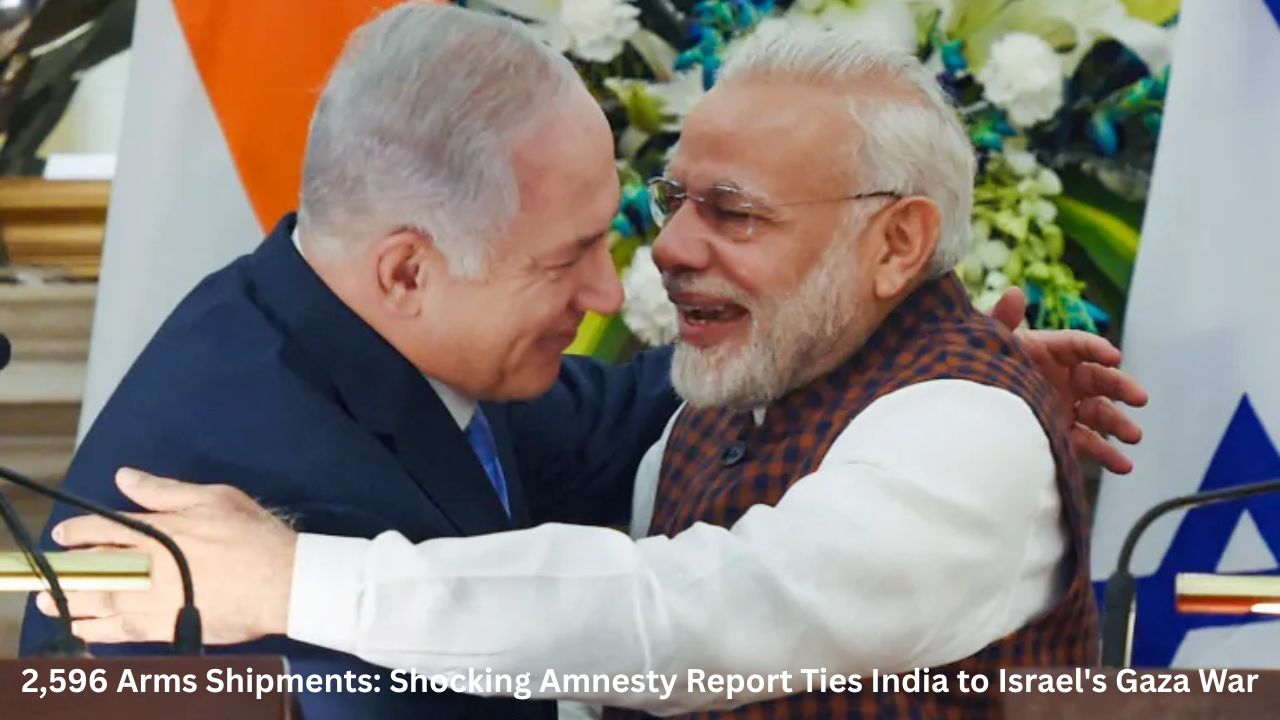
2,596 Arms Shipments: Shocking Amnesty Report Ties India to Israel’s Gaza War, warning of complicity risk. A hard-hitting new investigation from Amnesty International has placed India squarely at the centre of one of the most sensitive questions in global human rights law right now:
who bears responsibility when weapons made or shipped by one country end up fuelling a war widely condemned by international bodies as genocidal.
The London-based rights group says Indian state-owned and private companies sent at least 2,596 shipments of weapons, ammunition and military components to Israel between October 7, 2023, and November 30, 2025 — and argues that continuing these exports carries a “substantial risk” that India could be complicit in violations of international law in Gaza.
For readers around the world trying to understand how deep India’s role in this conflict actually runs, here’s a full breakdown of what the report says, how India has responded, and why the findings matter well beyond South Asia.
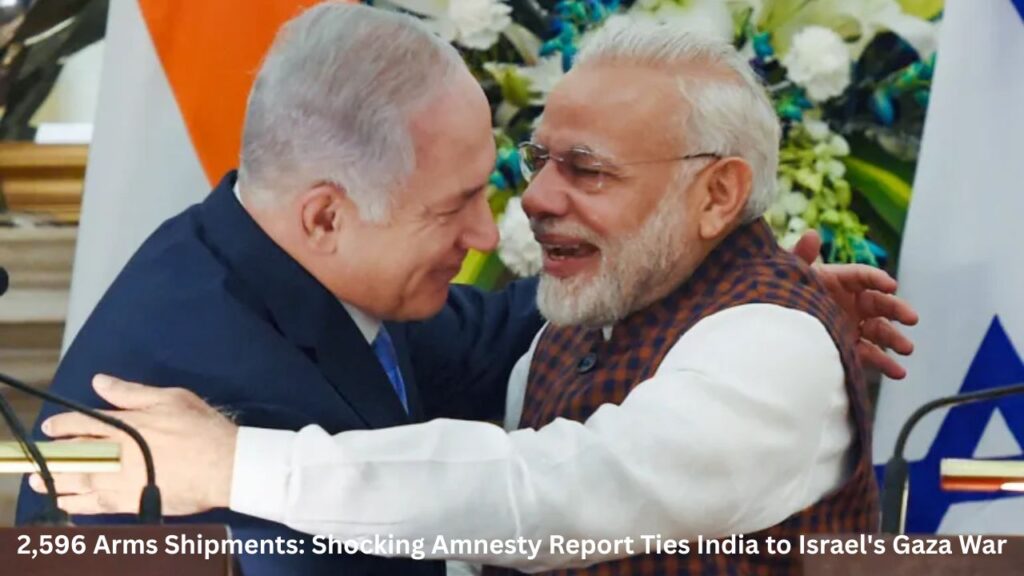
2,596 Arms Shipments: Shocking Amnesty Report Ties India to Israel’s Gaza War
What the Amnesty Report Actually Found
2,596 Shipments, Hundreds of Thousands of Parts
The report, titled “Made in India: The Supply of Weapons and Ammunition to Israel,” is built on shipment-level trade data rather than anecdotal claims.
Amnesty’s investigators tracked exports classified under internationally recognised Harmonised System customs codes covering weapons, ammunition, and armoured vehicle parts.
According to the findings, Indian firms supplied at least 390,516 small-arms parts for military-grade weapons, 564,970 components for explosive ordnance — including drone warheads and artillery shell casings — and 298 armoured vehicle components to Israeli companies that directly supply the country’s armed forces.
Amnesty describes its own methodology as “deliberately conservative,” meaning the true scale of India’s contribution to Israel’s military supply chain is likely even larger than what the report captures.
State-Owned Companies Named Directly
Perhaps the most striking detail is that some of the exporters aren’t private arms dealers chasing profit on the margins — they’re owned outright by the Indian government.
Amnesty names three defence public sector undertakings wholly owned by New Delhi — Munitions India Limited, India Optel Limited, and Advanced Weapons and Equipment India Limited — among the suppliers identified in the shipment data.
Private industry also features prominently.
The report points to PLR Systems, a joint venture between the Adani Group and Israel Weapon Industries, which alone exported over 10,000 parts for IWI Negev machine guns.
Other shipments reportedly included 155mm high-explosive artillery shells linked to Israeli defence giant Elbit Systems and explosive warheads for “Skystriker” loitering munitions, a type of drone described by rights investigators as resembling weapons found amid the wreckage in Gaza.
Why Amnesty Says This Amounts to “Complicity”
Under international humanitarian law, states are barred from transferring weapons — or allowing companies within their borders to do so — when there is a clear risk those weapons could be used to commit serious violations of international law.
Amnesty’s argument hinges on this principle, pointing to the International Court of Justice’s 2024 provisional measures order, which required Israel to take steps to prevent acts of genocide in Gaza.
Amnesty’s Secretary-General, Agnes Callamard, said the organisation’s findings show India’s continued backing of Israel’s military and defence sector despite what she called a crisis that has been broadcast worldwide on an almost daily basis.
She added that India both manufactures and supplies arms transferred to Israel through its ownership stakes in key supplier companies, and argued New Delhi has failed to bring its export rules in line with international standards.
It’s worth noting that the genocide characterisation itself, while shared by Amnesty, a United Nations Commission of Inquiry, and a number of independent UN experts, is a designation that the Israeli government firmly rejects, maintaining that its military campaign in Gaza is a legitimate response to Hamas’s October 7, 2023 attacks rather than a campaign targeting Palestinian civilians as such.
That underlying dispute remains one of the most contested questions in international law today, even as the humanitarian toll in Gaza — which the report cites at more than 247,000 Palestinians killed or injured as of late July 2026, according to Gaza’s health ministry figures relayed through the UN — continues to climb.
How India Has Responded — Silence, and a Defended Policy
According to Amnesty, it wrote to the Indian government and nine named companies in June and July 2026 laying out its findings, but had received no response from any of them by the time the report was published.
That silence doesn’t mean India’s position is a mystery, though. New Delhi has been consistent and public about where it stands.
External Affairs Minister Subrahmanyam Jaishankar has previously defended India’s arms trade with Israel on the grounds of “national interest,” noting Israel’s record of standing by India during periods when its own national security was under threat.
India has also backed that stance with concrete diplomatic and legal moves.
It abstained on a 2024 UN Human Rights Council resolution calling on states to halt arms transfers to Israel, and again abstained on a related UN General Assembly resolution the same year.
New Delhi has also declined to join South Africa’s genocide case against Israel at the International Court of Justice, and has resisted domestic pressure at home:
when Indian civil society groups petitioned the Supreme Court in 2024 to suspend arms exports to Israel, the court dismissed the case, ruling that such decisions fall within the government’s foreign policy powers rather than judicial oversight.
A Defence Partnership That Keeps Deepening
Far from scaling back ties, India and Israel have moved to strengthen their defence relationship even as the war in Gaza has continued.
The two countries signed a memorandum of understanding on defence cooperation in November 2025, aimed at expanding military, industrial and technological collaboration, and earlier upgraded their relationship to what both governments called a “Special Strategic Partnership.”
The scale of this relationship is not new.
According to data from the Stockholm International Peace Research Institute, India was the single largest buyer of Israeli arms exports between 2020 and 2025, accounting for roughly 29 percent of Israel’s total arms sales in that period.
Israel, in turn, ranked as India’s third-largest arms supplier over the same stretch, behind only Russia and France.
Reports have also surfaced of discussions around India potentially manufacturing components for Israel’s Iron Dome missile defence system — a sign the relationship may deepen further rather than wind down.
India Isn’t the Only Country in the Spotlight
Amnesty’s report is careful to frame India’s role as part of a much wider global picture rather than an isolated case.
Earlier Al Jazeera reporting, based on Israeli Tax Authority import data, found India was the second-largest exporter of military-related goods to Israel between October 2023 and October 2025, while separate Amnesty research has previously tracked arms flowing to Israel from more than 50 countries during the same period, including major Western economies whose defence industries supply components for fighter jets and precision munitions.
That broader context doesn’t let India off the hook in Amnesty’s view — if anything, the group argues it strengthens the case for coordinated international pressure.
The report renews Amnesty’s long-standing call for a comprehensive global arms embargo on Israel, covering not just direct weapons sales but related technology, technical training, and financial assistance to the country’s defence sector.
It also singles out India’s continued refusal to join the international Arms Trade Treaty, arguing that accession would force New Delhi to bring its export licensing rules closer to global human rights standards.
Conclusion
Whatever view one takes of the underlying conflict in Gaza, Amnesty’s investigation lands squarely on a question with real legal teeth:
whether governments and companies that keep arms flowing to a party accused of grave violations can insulate themselves simply by staying quiet.
With India’s government-owned defence firms directly named, private conglomerates implicated, and New Delhi showing no public sign of reconsidering its position, this report is unlikely to be the last word on the subject.
For a country that has spent the last decade building itself into one of Israel’s most significant defence partners, the pressure to either defend that relationship publicly or begin walking it back is only going to grow — and the rest of the world, from Washington to Geneva, will be watching how India chooses to respond.
Also Read: Trump Brokers Fragile Iran-Israel Ceasefire After Nuclear Strikes; India Welcomes Truce
Also Read: India’s arms sale to Israel risks complicity in Gaza genocide, Amnesty says
Related Posts:
- 3 Explosive Conditions Iran Sets to End War with US…

- 5 Major Takeaways from the US Supreme Court's…

- 7 Powerful Measures: Trump Sanctions Russian Oil…

- Trump’s 20-Point Gaza Peace Plan Gains Urgent Global…

- In 8 Moves, EU Targets China-Linked Refineries and…

- 7 Heartbreaking Facts About Venezuela's Earthquake Disaster