

Trump’s Gaza Warning: ‘Kill Hamas’ Threat After Ceasefire Deal amid rising tension over hostage returns. United States President Donald Trump on Thursday issued a stark warning to Hamas, saying the United States would “go in and kill them” if the killings in Gaza continue. His remarks came just days after the announcement of a U.S.-brokered ceasefire deal between Israel and Hamas — a deal now threatened by renewed violence and uncertainty on the ground.
The warning followed the emergence of a disturbing video showing a public execution in Gaza, which triggered global condemnation and reignited questions about Hamas’s control of the territory. Trump’s statement, posted on Truth Social, represented a dramatic shift in tone — and policy — after he initially appeared to justify the killings.
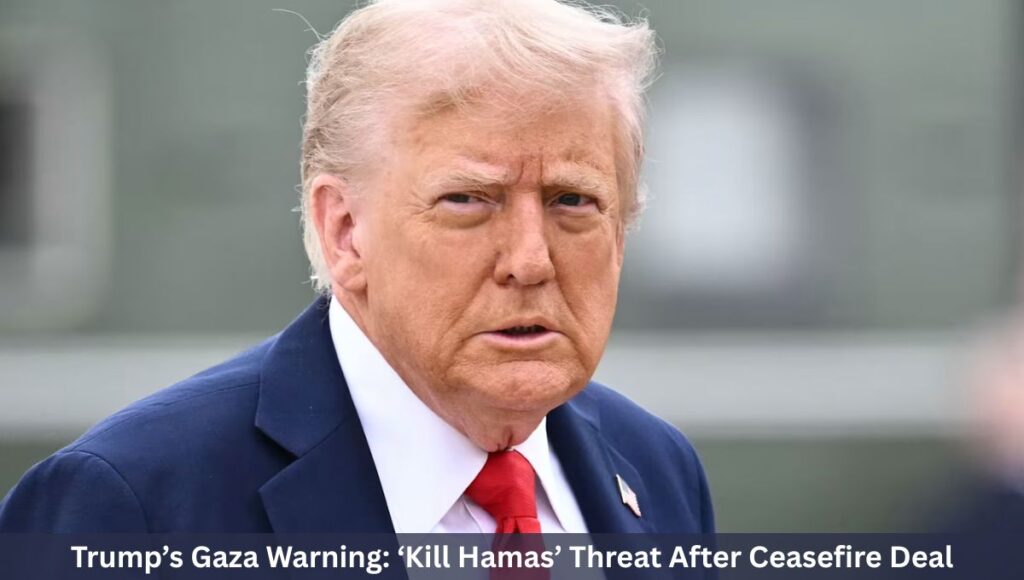
Trump’s Gaza Warning: ‘Kill Hamas’ Threat After Ceasefire Deal
“We Will Have No Choice But to Go In and Kill Them”
In his post, Trump wrote,
“If Hamas continues to kill people in Gaza, which was not the Deal, we will have no choice but to go in and kill them.”
The statement, short but forceful, sparked immediate speculation about whether Trump was threatening direct U.S. military intervention. However, within hours, the president clarified that the warning did not imply American troops would be sent into Gaza.
“It’s not going to be us,” Trump told reporters. “We won’t have to. There are people very close, very nearby that will go in and they’ll do the trick very easily — but under our auspices.”
The comments appeared to refer to Israel, which remains poised for renewed action should Hamas fail to uphold the terms of the peace agreement.
Trump’s Sudden Reversal on Hamas Killings
Trump’s latest warning marks a sharp turnaround from his earlier comments. Just 48 hours before his threat, the president had appeared to defend Hamas’s actions against what he called “very bad gangs” in Gaza.
On Tuesday, he told reporters:
“They did take out a couple of gangs that were very bad, very, very bad gangs. And they did take them out, and they killed a number of gang members. And that didn’t bother me much, to be honest with you. That’s OK.”
The remarks drew widespread criticism, with many accusing Trump of condoning extrajudicial executions by the militant group.
By Wednesday, however, both the tone and the message had changed. A senior U.S. military commander stationed in the Middle East publicly urged Hamas to cease attacks on civilians, signaling a deliberate effort by the administration to distance itself from Trump’s earlier position.
Speaking later to CNN, Trump appeared to soften his stance again, suggesting that his earlier support for Hamas’s crackdown might have been premature:
“I’m doing more research on it. It could be gangs plus,” he said — a vague remark seemingly intended to clarify his earlier defense of Hamas’s actions.
Also Read: Violence between Hamas and gangs flares in Gaza, calling disarmament into question
Ceasefire Under Strain: “This Was Not the Deal”
Trump’s ceasefire plan, signed just days earlier, was heralded as the first real step toward peace in Gaza after years of war. The deal required Hamas to return all hostages — both alive and dead — by a Monday deadline. Failing that, the group was to provide full information on the deceased and deliver their remains “as soon as possible.”
However, as the week progressed, Israel accused Hamas of violating the deal, claiming it had not returned all hostages or provided complete information about those who died.
Israeli Prime Minister Benjamin Netanyahu said on Wednesday, “Israel will not compromise. Hamas must meet every condition of the deal regarding the return of the hostages’ bodies.”
Hamas, meanwhile, insisted it had complied, asserting that it had turned over all remains accessible to its forces. The group’s armed wing claimed that “special equipment” would be required to recover the remaining bodies buried under rubble from earlier airstrikes.
Also Read: Hamas Executes 50 Rivals After Ceasefire – Inside Gaza’s Deadly Power Struggle
Trump Clarifies: “We” Means Israel, Not the U.S.
Trump’s Truth Social post — especially his use of the word “we” — quickly raised confusion. Was the U.S. president threatening American intervention in Gaza, or was he signaling that Israel would take the lead?
The White House later moved to clarify that Trump’s “we” referred to Israel acting under U.S. coordination, not U.S. troops directly engaging in combat.
While Trump declined to specify how he would enforce his warning, he emphasized that patience was wearing thin. “They will disarm,” he said, “and if they don’t do so, we will disarm them — and it’ll happen quickly and perhaps violently.”
The remark reinforced Trump’s insistence that Hamas must surrender its weapons and withdraw from governance in Gaza — a condition that the group has yet to publicly accept.
Inside Gaza: Clashes, Executions, and “Very Bad Gangs”
Reports from Gaza this week described deadly clashes between Hamas and armed clans, accused of looting humanitarian aid and working as Israeli collaborators.
Following the fighting, Gaza’s Interior Ministry announced a general amnesty for gang members who had not participated in the violence. Yet several public executions were reported, prompting outrage among Palestinians and international human rights groups.
Palestinian Authority President Mahmoud Abbas condemned the killings, calling them a “heinous crime” and a flagrant violation of human rights. In a statement, his office said:
“What happened represents a crime, a flagrant violation of human rights, and a serious assault on the principle of the rule of law.”
Hamas, however, claimed that many of those targeted were collaborators who had aided Israel during the 2023 war, when Israeli officials admitted to arming some Gaza gangs to destabilize Hamas’s rule.
Among those killed was prominent Palestinian journalist Saleh Aljafarawi, reportedly shot by gang members linked to Israel, according to local sources.
Israel’s Response: Threat of Renewed War
Israel has warned it will resume military operations in Gaza if Hamas fails to meet the obligations of Trump’s ceasefire plan.
Israeli Defense Minister Israel Katz said the military had been instructed to prepare for the “complete defeat of Hamas in Gaza” if the group refuses to disarm and return all hostages’ remains.
Katz declared, “If Hamas refuses to uphold the agreement, Israel, in coordination with the U.S., will return to fighting and act to achieve the total defeat of Hamas.”
Trump echoed that stance during a White House press briefing, saying:
“We want the weapons to be given up. And they’ve agreed to do it. Now they have to do it. And if they don’t, we’ll do it.”
Hostage Returns and Delays
Under the deal, Hamas returned 20 living hostages to Israel on Monday and sent the remains of seven deceased captives. Another 21 individuals remain unaccounted for.
According to the Israeli army, one of the returned bodies was later found not to belong to a hostage, further complicating verification efforts. Hamas stated that it had released all the Israeli hostage remains within its reach.
The delay has fueled Israeli frustration and led to restrictions on humanitarian aid entering Gaza — a move condemned by relief agencies.
A Palestinian relief official noted that around 800 aid trucks entered Gaza on Sunday through the Kerem Shalom and Kissufim crossings, an improvement from the usual 300 per day but still far short of the 1,000 trucks needed daily.
No aid reportedly entered Gaza on Monday, the same day Hamas released the last of the living hostages taken during the October 7, 2023 attacks that sparked the war.
Trump’s Ceasefire: “A New Middle East” Under Pressure
When Trump first announced the ceasefire, he hailed it as “the dawn of a new Middle East.” But his latest remarks — and the ongoing disputes — have cast doubt on the truce’s durability.
The fragile peace remains under strain from Israeli incursions, Hamas crackdowns, and the slow pace of humanitarian recovery. Israel continues to justify daily killings in Gaza as “border violations,” despite ambiguity over where those restricted zones lie.
Meanwhile, Hamas accuses Israel of using the aid blockade as political leverage, and of deliberately delaying the opening of the Rafah crossing with Egypt — a vital gateway for medical evacuations and supplies.
Trump, however, has remained adamant that his plan will succeed if both sides adhere to their commitments. “We know that we have a commitment from them,” he said, referring to Hamas. “If they don’t behave, we’ll take care of it.”
A Delicate Balance Between Peace and Power
Trump’s dual message — threatening destruction while claiming to preserve peace — underscores the delicate balance his administration faces in managing post-war Gaza.
His repeated assertion that “Israel will do the trick” suggests that Washington’s role will remain indirect, providing diplomatic cover and strategic support rather than direct military involvement.
Still, the rhetorical escalation — especially Trump’s use of phrases like “kill them” and “disarm them quickly” — has sparked unease among global observers.
Critics warn that such language could inflame tensions just as fragile progress is being made on humanitarian fronts. Yet supporters argue that Trump’s bluntness is part of his “maximum pressure” strategy, aimed at forcing Hamas to comply.
Trump and Netanyahu: Coordination and Confidence
On Thursday, Trump reportedly spoke with Israeli Prime Minister Benjamin Netanyahu, though details of their conversation have not been disclosed.
Speaking afterward from the Oval Office, Trump projected confidence that the ceasefire deal will hold.
“We know that we have a commitment from them, and I assume they’re going to honor their commitment,” he said of Hamas. “If they don’t behave, we’ll take care of it.”
The remarks suggest ongoing coordination between Washington and Jerusalem, even as tensions over implementation persist.
Outlook: Uncertain Road Ahead for Gaza Truce
For now, the Trump-brokered ceasefire remains in place — but fragile. Reports of executions, retaliatory strikes, and disrupted aid convoys threaten to unravel the agreement just days after it was signed.
Trump’s warning to “kill Hamas” if violence continues represents the most forceful language he has used since taking office in 2025. Whether it signals a real policy shift or merely political posturing remains to be seen.
But one thing is clear: the future of Gaza’s peace — and Trump’s self-declared “new Middle East” — now hinges on whether Hamas, Israel, and Washington can keep a volatile truce alive amid mounting distrust and competing agendas.
Related Posts:
- Dramatic Moments Behind Trump’s Gaza Peace Push and…

- Trump’s Breakthrough Gaza Ceasefire Deal 2025: Key Insights

- 5 Major Takeaways from the US Supreme Court's…

- 5 Powerful Highlights as Trump Lands Second Nobel…

- 11 Explosive Revelations From Ted Cruz’s Leaked…

- Trump’s 20-Point Gaza Peace Plan Gains Urgent Global…
