
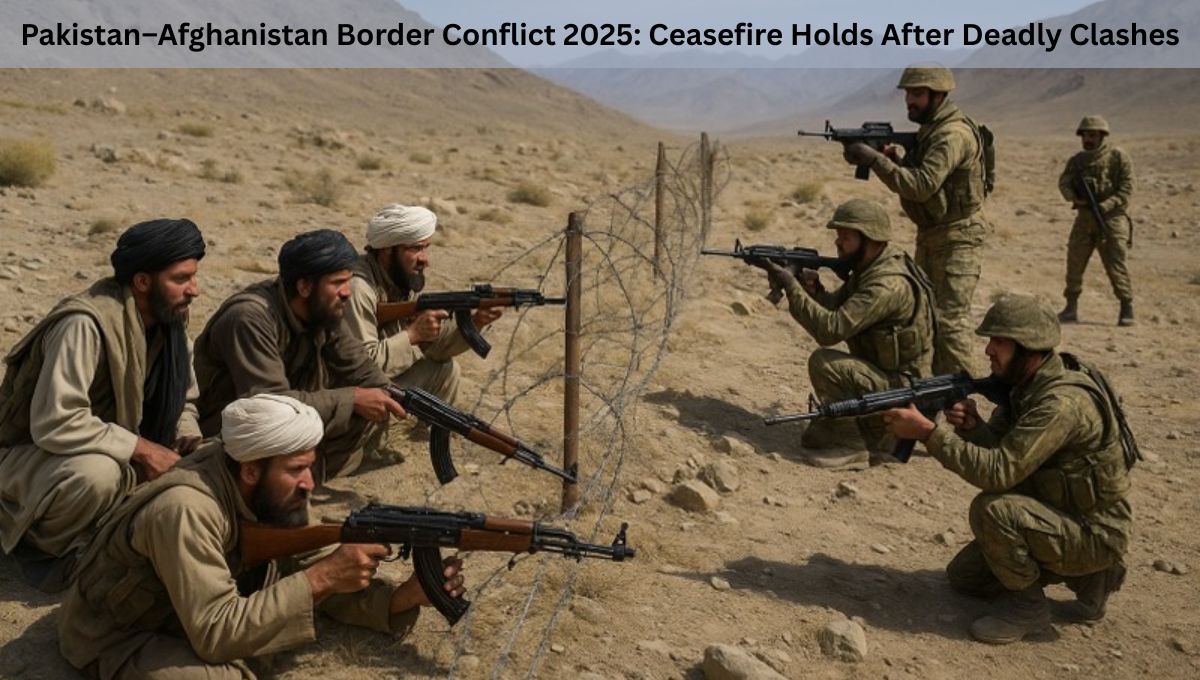
Pakistan–Afghanistan Border Conflict 2025: Ceasefire Holds After Deadly Clashes killing dozens. Pakistan Prime Minister Shehbaz Sharif on Thursday said that “the ball is in the Afghan Taliban’s court” regarding the prospect of a permanent ceasefire. His remarks came a day after both countries agreed to a 48-hour truce following days of heavy cross-border fighting that killed dozens of civilians and soldiers on both sides.
Sharif said Pakistan remained ready to cooperate with Afghanistan if its leadership “resolves the issue and addresses our demands within 48 hours.” He reiterated that militants from the banned Tehreek-e-Taliban Pakistan (TTP) must be eliminated and that Afghan territory should not be used for attacks on Pakistan.
Pakistan–Afghanistan Border Conflict 2025: Ceasefire Holds After Deadly Clashes
Tensions Rise Along the Durand Line
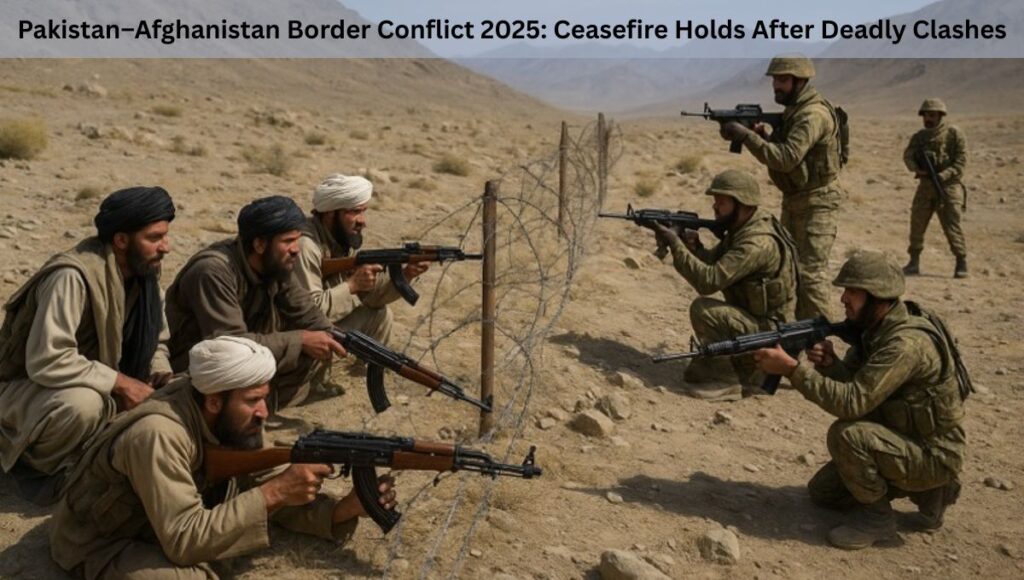
The temporary halt in hostilities came after a week of intense clashes across multiple border sectors. Fighting broke out again on Wednesday night before both governments confirmed a ceasefire agreement. Local officials in border regions told AFP that no new fighting had been reported overnight, indicating the truce was holding.
Pakistani officials said additional paramilitary units were deployed along sensitive border stretches to prevent renewed fighting. On Friday, however, brief exchanges of fire were reported, with both sides accusing each other of ground assaults.
According to the Pakistani Foreign Ministry, the truce was requested by Kabul and took effect at 6 p.m. local time on Wednesday. The Afghan Taliban’s chief spokesperson, Zabihullah Mujahid, claimed that the ceasefire was implemented “at the insistence of the Pakistani side.”
UN Confirms Civilian Toll in Spin Boldak
The United Nations Assistance Mission in Afghanistan (UNAMA) confirmed that at least 17 civilians were killed and more than 340 were injured in the Spin Boldak region of Kandahar. Most casualties were caused by artillery fire and drone strikes near populated areas.
UNAMA urged both sides to bring “a lasting end to hostilities to protect civilians and prevent further loss of life.” The mission is still assessing the full extent of casualties, though officials described it as the deadliest border crisis since 2021, when the Taliban returned to power in Kabul.
Noor Wali Mehsud: The Militant at the Centre of the Tensions
Who Is the TTP Chief?
At the heart of the recent escalation is Noor Wali Mehsud, leader of the Tehrik-e-Taliban Pakistan (TTP). The Pakistani airstrike in Kabul on October 9 reportedly targeted an armoured vehicle believed to be carrying Mehsud, who is listed under the United Nations Security Council’s ISIL (Da’esh) and Al-Qaida Sanctions List.
Mehsud, also known as Mufti Noor Wali Mehsud or Abu Zar Azzam, became TTP chief in June 2018, succeeding Maulana Fazlullah. According to the UN listing, the TTP under Mehsud’s leadership has been responsible for numerous attacks in Pakistan, targeting both security personnel and civilian areas.
The TTP maintains links with Al-Qaeda and coordinates with other regional militant groups. UN records indicate that, as of November 2022, Mehsud was based in Paktika Province, Afghanistan. He remains subject to a global asset freeze, travel ban, and arms embargo under UN sanctions.
Mehsud, a native of South Waziristan, is also known as a religious scholar and author of Inqilab Mehsud South Waziristan: From British Raj to American Imperialism, a text outlining the group’s ideological views.
Airstrike in Kabul and Aftermath
The October 9 strike marked Pakistan’s first reported operation inside Kabul since the 2022 U.S. drone attack that killed Al-Qaeda leader Ayman al-Zawahiri. Afghan officials denied reports of TTP presence in Kabul, calling the strike a violation of sovereignty. Mehsud later appeared in a video message, confirming he had survived.
Following the attack, cross-border clashes intensified, causing casualties and displacing hundreds of civilians along the frontier. By mid-October, security forces on both sides remained on high alert, with intermittent shelling reported in Khost, Paktika, and North Waziristan.
Taliban’s Symbolic Victory in the Information War
Videos circulating on social media showed Taliban fighters displaying captured Pakistani tanks and holding up trousers allegedly belonging to Pakistani soldiers. The footage, widely shared on X (formerly Twitter), quickly went viral under the hashtag #93000, referencing the 1971 surrender of Pakistani troops to Indian forces.
Afghan activists dubbed the event the “93,000 Pants Ceremony 2.0,” mocking Pakistan for what they portrayed as a symbolic defeat. Pakistan has not verified the authenticity of the videos.
While both sides claimed to have initiated the ceasefire, Afghanistan appears to have gained a psychological edge in the online narrative. “Today was the day of 93,000 pants ceremony 2.0,” Kabul-based journalist Wakeel Mubariz posted on social media, referring to the 1971 war.
Regional and Diplomatic Reactions
United Nations and Regional Powers Urge Restraint
The United Nations and regional partners including Qatar and Saudi Arabia have called on both countries to exercise restraint. “Hostilities must cease to protect civilians,” UNAMA said, noting that humanitarian operations were already stretched due to Afghanistan’s ongoing economic crisis.
The border crossings at Spin Boldak and Torkham remained closed through Thursday, halting trade and humanitarian supplies. Both economies are experiencing significant losses from the suspension of cross-border commerce.
International Commentary
Former Indian diplomat Amar Jit Singh, who previously served as Consul General in Afghanistan, described Pakistan’s strikes as the “blunder of the century,” warning they could push Islamabad into “yet another war with disastrous consequences.” He said the Afghan people “will not tolerate external aggression,” recalling the failures of previous foreign powers in Afghanistan.
Singh also claimed that Afghanistan recently denied visas to Pakistan’s Defence Minister and senior military officials, an unusual diplomatic snub. His remarks reflect a broader concern in South Asian circles that renewed hostilities could destabilize the region.
Also Read: Wary of Taliban ceasefire, Pak runs to Trump, makes bizarre India claim
Pakistan’s Domestic Challenges Amid the Conflict
Pakistan has faced a sharp rise in militant attacks since the Taliban took control of Kabul in 2021. According to official data, more than 2,400 deaths were recorded in Pakistan during the first three quarters of 2025, surpassing the total for all of last year.
Islamabad accuses the Afghan Taliban of sheltering the TTP, whose members originate mainly from Pakistan’s tribal areas. The Inter-Services Intelligence (ISI) and the military are leading operations against the group, which demands localised enforcement of Islamic law and restoration of tribal autonomy.
Analysts note that Pakistan’s military establishment — long dominant in shaping Afghan policy — now faces an acute dilemma. Its decades-long strategy of supporting the Taliban to secure a friendly government in Kabul has backfired, as the Taliban refuse to expel TTP militants.
Why Pakistan and the Taliban Fell Out
When the Taliban returned to power in 2021, Pakistani leaders celebrated, believing it would enhance regional security and limit India’s influence. However, relations have soured as mutual distrust and conflicting interests surfaced.
Pakistan expected the Taliban to repatriate or disarm TTP fighters, but instead, the group consolidated its operations within Afghanistan. The Taliban, for their part, see Pakistan’s cross-border strikes as violations of sovereignty and betrayals by a former ally.
A Breakdown of Mutual Expectations
Pakistan’s security establishment historically maintained ties with the Taliban while also cooperating with the U.S. during its occupation of Afghanistan. This dual approach, analysts say, sowed the seeds for the current mistrust.
Now, Pakistan refers to the Taliban administration as a “regime” rather than a government, urging it to form a more inclusive system. It has also hinted at further military action inside Afghan territory if the Taliban fail to act against the TTP.
Also Read: Afghanistan–Pakistan Border Clashes 2025: Key Facts Behind the Deadly Escalation
Kabul Drone Strikes Deepen Crisis
Two Drone Attacks on Kabul
Afghanistan’s Taliban government accused Pakistan of carrying out two drone strikes on Kabul on Wednesday, hours before the truce was announced. According to Khalid Zadran, a spokesman for Kabul police, the strikes hit a civilian house and a marketplace, killing at least five people and wounding dozens.
Medical officials described injuries caused by shrapnel, burns, and blunt trauma. Initially, Taliban spokesman Zabihullah Mujahid said the blasts were caused by an oil tanker explosion, before officials later attributed them to foreign drones.
Pakistan has not publicly confirmed responsibility for the strikes. However, security sources in Islamabad said the attacks targeted “terror facilitators linked to the TTP.”
Economic and Humanitarian Fallout
Trade and Movement Halted
The conflict has disrupted trade routes that are vital to both countries. Afghanistan, a landlocked nation, depends heavily on access to Pakistani ports and highways. The closure of border crossings has led to millions of dollars in trade losses, with perishable goods stranded on both sides.
Truck convoys, normally transporting fuel, wheat, and consumer goods, remain halted, adding strain to already fragile supply chains. Humanitarian agencies have warned that continued tensions could worsen Afghanistan’s food insecurity crisis.
Impact on Refugees and Civilians
Pakistan continues to host over three million Afghan refugees, many of whom fled decades of conflict. The recent fighting has reignited debates in Islamabad about deporting undocumented Afghans, a move criticized by rights groups.
Civilians in border districts have been forced to flee renewed shelling. The UNHCR and local NGOs report that hundreds have sought temporary shelter in makeshift camps.
Military Capabilities and Strategic Realities
While Pakistan possesses advanced air power and drone capabilities, the Taliban’s guerrilla warfare tactics make any full-scale confrontation costly and unpredictable.
The Taliban’s Supreme Leader, Haibatullah Akhundzada, commands significant religious influence in Pakistan’s border regions, potentially complicating Islamabad’s efforts to mobilize domestic support for a prolonged conflict.
Analysts warn that any fatwa or call to arms from Akhundzada against Pakistan could destabilize the country internally, given the presence of sympathetic Islamist groups and seminaries in Pakistan.
The Role of Mediation and Regional Diplomacy
Qatar and Saudi Arabia Step In
Diplomatic sources confirm that Qatar and Saudi Arabia helped broker the latest ceasefire. Taliban Foreign Minister Amir Khan Muttaqi said in New Delhi last week that Taliban forces ceased retaliatory fire after mediation efforts from Doha and Riyadh.
Regional analysts view these countries as the most credible intermediaries trusted by both sides. They have called for sustained engagement to convert the temporary truce into a comprehensive peace framework.
Calls for Dialogue
Both Islamabad and Kabul publicly insist they want peace but continue to issue mutually accusatory statements. Experts argue that a durable peace will require addressing core issues — especially Pakistan’s demand that the Taliban disarm or expel the TTP and Afghanistan’s insistence on sovereign control over its territory.
The Stakes Ahead
Neither Pakistan nor Afghanistan can afford a protracted conflict. Pakistan is battling a weak economy, political instability, and internal insurgencies. Afghanistan remains isolated and impoverished, with limited access to international aid.
A renewed war could devastate both nations, derail regional trade corridors, and open space for extremist groups like the Islamic State–Khorasan Province (ISKP).
For now, the 48-hour ceasefire continues to hold, but tensions remain high along the 2,611-kilometre Durand Line. Both governments face domestic and international pressure to avoid escalation and seek dialogue.
Conclusion
The current pause in hostilities offers a brief opportunity for de-escalation between two uneasy neighbours. However, deep-seated mistrust, competing strategic interests, and the TTP’s continued presence on Afghan soil make lasting peace uncertain.
As one senior Pakistani official in Peshawar put it, “We are holding our fire for now — but it depends on Kabul’s next move.” For both nations, the challenge ahead lies not in winning another battle, but in preventing a new war in a region that has seen too many.
Related Posts:
- 7 Alarming Signs of Escalation as Pak-Afghan…
- Afghanistan–Pakistan Border Clashes 2025: Key Facts…

- Afghanistan–Pakistan War 2025: Inside the 48-Hour Ceasefire

- 5 Key Takeaways as Pakistan–Afghanistan Peace Talks…

- 8 Shocking Developments in the Pakistan–Afghanistan…
- Pakistan’s Bold Airstrikes in Kabul: Af-Pak Crisis…
