

7 Alarming Signs of Escalation as Pak-Afghan Tensions Explode After Deadly Airstrikes kill 10 civilians, including nine children. Tensions between Pakistan and Afghanistan have surged sharply once again following a devastating series of alleged airstrikes that Kabul says were carried out by Pakistan on Tuesday night.
According to Afghan officials, the strikes killed 10 civilians—including nine children and a woman—across Khost, Kunar and Paktika provinces, triggering a furious response from the Taliban government and plunging bilateral relations into yet another crisis.
The deadly escalation comes barely a month after cross-border clashes erupted over Pakistani drone strikes near Kabul, and just weeks after a ceasefire—brokered by Qatar and Turkey—managed to halt heavy fighting that had left around 70 people dead on both sides.
Now, with the Taliban denouncing the strikes as a “crime” and Pakistan staying silent, fears are mounting that South Asia may be headed toward a dangerous confrontation.
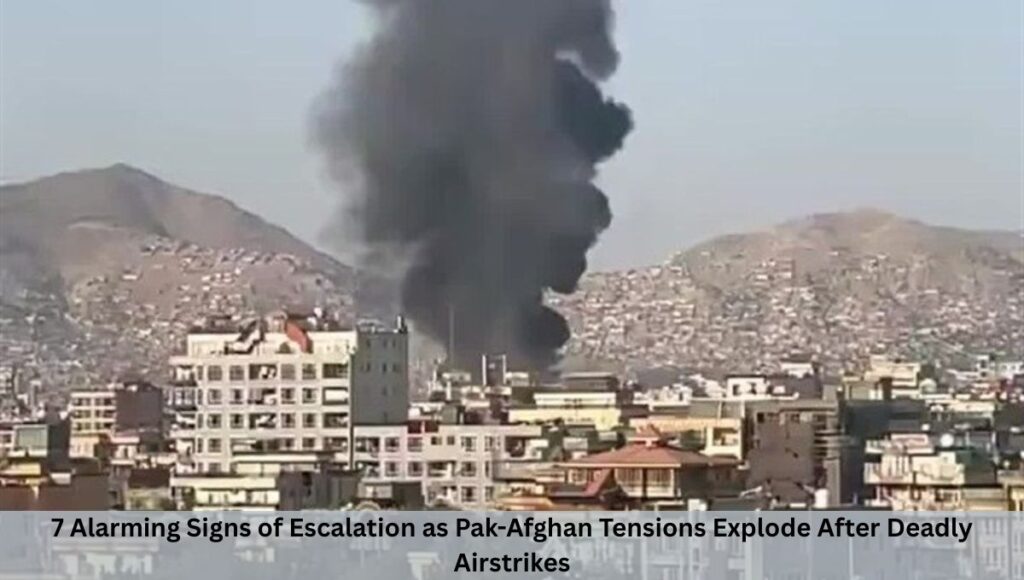
7 Alarming Signs of Escalation as Pak-Afghan Tensions Explode After Deadly Airstrikes
The Deadly Night Strikes That Sparked Outrage
Afghan Government Says Pakistani Jets Hit Civilian Homes
On Tuesday, Taliban spokesperson Zabihullah Mujahid announced on X (formerly Twitter) that Pakistani jets and drones had bombed multiple locations:
- Khost province: A civilian home destroyed
- Kunar province: Additional strikes
- Paktika province: More explosions reported
According to Mujahid, nine children—five boys and four girls—and a woman were killed in Khost when a bomb struck the home of local resident Waliat Khan in the district of Gurbuz.
He described the attack as a violation of Afghanistan’s sovereignty, adding:
“Afghanistan has the legitimate right to defend itself. We will deliver the necessary response at the appropriate time.”
The spokesperson insisted the attack was a “blatant violation” of international norms and airspace sanctity, directly accusing Pakistan of crossing a red line.
Pakistan Remains Silent
As of Tuesday night, Pakistan’s military and civilian leadership had not issued any formal comment, despite mounting pressure from international media and Afghan officials.
This silence is seen by analysts as a sign that Islamabad may be weighing its options or preparing a strategic response.
A Fragile Ceasefire Now Hanging by a Thread
The airstrikes come at a sensitive time. Following deadly border clashes in October, Qatar and Turkey intervened to negotiate a temporary ceasefire between Pakistan and the Afghan Taliban.
However, that ceasefire was already under strain due to:
- Continued militant movement across the border
- Accusations by Pakistan that TTP leaders are operating freely from Afghan soil
- Kabul’s claims that Pakistan conducts strikes inside Afghanistan without provocation
Two rounds of talks in Istanbul had failed to yield a stable long-term agreement.
This latest bombing has raised fears that all diplomatic progress may now unravel.
Peshawar Suicide Attack Adds Fuel to the Fire
Just a day before the alleged Pakistani strikes, a major attack rocked Peshawar, where two suicide bombers and a gunman stormed the headquarters of the Federal Constabulary.
The assault left:
- 3 officers dead
- 11 others injured
While no group claimed responsibility, Pakistan immediately suspected the Tehrik-e-Taliban Pakistan (TTP)—a militant organization allied with the Afghan Taliban. Many TTP leaders are believed to reside in safe havens across the border.
State broadcaster PTV reported that the attackers were Afghan nationals, and President Asif Zardari blamed “foreign-backed Fitna al-Khawarij”—Islamabad’s term for TTP fighters it accuses Kabul of sheltering.
The attacks in Pakistan have heightened calls for Islamabad to respond decisively to TTP’s cross-border operations.
Islamabad’s New Doctrine After Kabul Strikes
Pakistan Warns Kabul That It Will Strike Back
Just weeks earlier, Pakistan shocked Afghanistan by launching retaliatory strikes inside Kabul, targeting TTP networks and top leaders.
According to a report by The Express Tribune, Pakistani officials described those strikes as:
“an unmistakable message… that Pakistan will no longer restrict its counterterrorism responses to its own soil.”
A senior official stated:
“The Kabul strikes were not a one-off episode. If the Taliban fail to act, Pakistan will act.”
Psychological Impact on the Taliban
Pakistani intelligence assessments claim the Kabul operation had a significant psychological effect on the Afghan Taliban leadership.
Officials believe that:
- Taliban leaders are more cautious
- TTP networks have been disrupted
- Cross-border attacks have seen a temporary decline
According to one official:
“For the first time in years, Pakistan’s message has been loud and clear: allow your soil to be used against us, and there will be consequences—even inside Afghanistan.”
This new security doctrine has sharply changed Islamabad’s posture toward Kabul, raising the stakes of any cross-border confrontation.
Taliban Vows ‘Appropriate’ Response to Civilian Deaths
As news of the children’s deaths spread, outrage gripped parts of Afghanistan. In Khost, an AFP correspondent saw villagers digging graves and sifting through the rubble of the collapsed home.
The Taliban issued a stern statement:
“Defending our airspace, territory, and people is our legitimate right. We will respond appropriately at the right time.”
This suggests that Kabul may be contemplating a retaliatory strike or military action—an alarming prospect given the already tense situation.
Cross-Border Clashes Have a Long History
Relations between Pakistan and Afghanistan have been fraught for decades, but tensions escalated sharply after the Taliban returned to power in August 2021.
After the takeover:
- TTP activity inside Pakistan surged
- Islamabad accused Taliban of harboring militants
- Kabul accused Pakistan of violating its sovereignty
The October clashes, in which dozens died, were among the worst in years.
A Qatar-brokered ceasefire temporarily halted hostilities, but both sides failed to solidify mechanisms for border security.
Pakistan demanded a written guarantee that TTP fighters would be prevented from operating from Afghan soil—a request Kabul refused.
Civilians Continue Paying the Price
The latest attack highlights the tragedy of civilians trapped between geopolitical tensions and militant networks.
In Khost:
- A family home was reduced to rubble
- Nine young children and a woman were killed
- Survivors wept as they dug graves and searched for belongings
Human rights groups warn that civilian casualties—if confirmed—could inflame anti-Pakistan sentiment across Afghanistan.
The Taliban also insisted that they do not permit anyone to use Afghan soil for attacks against Pakistan or any other nation, stating that Islamabad should respect Afghan sovereignty.
The Role of TTP in the Crisis
TTP—A Trigger for Escalation
The Tehrik-e-Taliban Pakistan remains at the heart of the renewed tensions.
Key points:
- TTP is a separate entity from the Afghan Taliban but aligned ideologically
- Many TTP leaders escaped to Afghanistan after military operations in Pakistan
- Pakistan says these fighters use Afghan territory to mount attacks
- Kabul denies providing sanctuary but has failed to curb TTP activity
The Afghan Taliban reportedly fears that cracking down on TTP could fracture its own ranks, as several TTP and Taliban commanders share deep tribal and ideological ties.
International Mediation May Be Needed Again
Given the rapidly escalating situation, regional actors may need to intervene.
Potential mediators include:
- Qatar, which previously brokered a ceasefire
- Turkey, which hosted earlier talks
- China, which has close ties with both governments
- Saudi Arabia and UAE, which have increasing influence in Kabul
The international community remains concerned that escalating border tensions could destabilize the region and embolden extremist groups.
What Comes Next? Rising Fear of Retaliation
Analysts warn that both Pakistan and Afghanistan are trapped in a dangerous cycle:
- TTP attacks Pakistan
- Pakistan strikes inside Afghanistan
- Taliban threatens retaliation
- Border clashes escalate
With the Taliban openly promising an “appropriate response,” fears grow that:
- Retaliatory attacks may occur
- The ceasefire could collapse
- TTP could exploit the chaos
- Civilians may face more casualties
A Pakistani official stated bluntly regarding future attacks:
“If there is another attack, we will act immediately.”
This posture leaves little room for diplomatic maneuvering.
Conclusion
The killing of nine children and a woman in Khost has reignited volatile Pak-Afghan tensions, raising the prospect of renewed cross-border violence and retaliatory strikes. With both governments entrenched in their positions—Pakistan demanding action against TTP and Afghanistan condemning alleged Pakistani airstrikes—the region stands on the brink of another dangerous escalation.
The coming days will determine whether cooler heads prevail, or whether South Asia will witness yet another prolonged crisis with devastating consequences for civilians on both sides of the border.
Also Read: 5 Key Takeaways as Pakistan–Afghanistan Peace Talks Hit Deadlock
Also Read: Everything you need to know about the Pakistan-Afghanistan conflict
Related Posts:
- Afghanistan–Pakistan Border Clashes 2025: Key Facts…

- Pakistan–Afghanistan Border Conflict 2025: Ceasefire…

- Afghanistan–Pakistan War 2025: Inside the 48-Hour Ceasefire

- 8 Shocking Developments in the Pakistan–Afghanistan…
- Pakistan–Afghanistan Conflict: 10 Civilians Killed…

- 7 Shocking Details: 13-Year-Old Executes Man Before…
