

19 Bold Shifts: Inside Zelenskyy’s High-Stakes Talks With Trump on a Revised Ukraine Peace Deal after tense Geneva negotiations. Ukrainian President Volodymyr Zelenskyy has confirmed that the controversial U.S. peace plan proposed under President Donald Trump is undergoing major changes, reducing a widely criticised 28-point document to a more manageable 19-point framework.
Thank you for reading this post, don't forget to subscribe!The revised draft emerged after dramatic, high-level Geneva talks involving Ukrainian, U.S., and European negotiators — discussions Zelenskyy described as “constructive but extremely challenging.”
As the stakes continue to rise in the Russia-Ukraine war, Zelenskyy said the most sensitive issues will now be discussed privately and directly with Trump, signalling that the path toward a potential deal remains delicate and politically explosive.
In a statement on Telegram, the Ukrainian leader emphasised that Kyiv remains committed to peace but will not compromise its dignity or sovereignty. “Ukraine will never be an obstacle to peace,” Zelenskyy said. “Our delegation has returned from Geneva, and now there are fewer points – no longer 28 – and many of the right elements have been taken into account. I will discuss the sensitive issues with President Trump.”
The president underscored that millions of Ukrainians “deserve a dignified peace” and insisted that Kyiv’s leadership is ready to continue negotiations as quickly as possible.
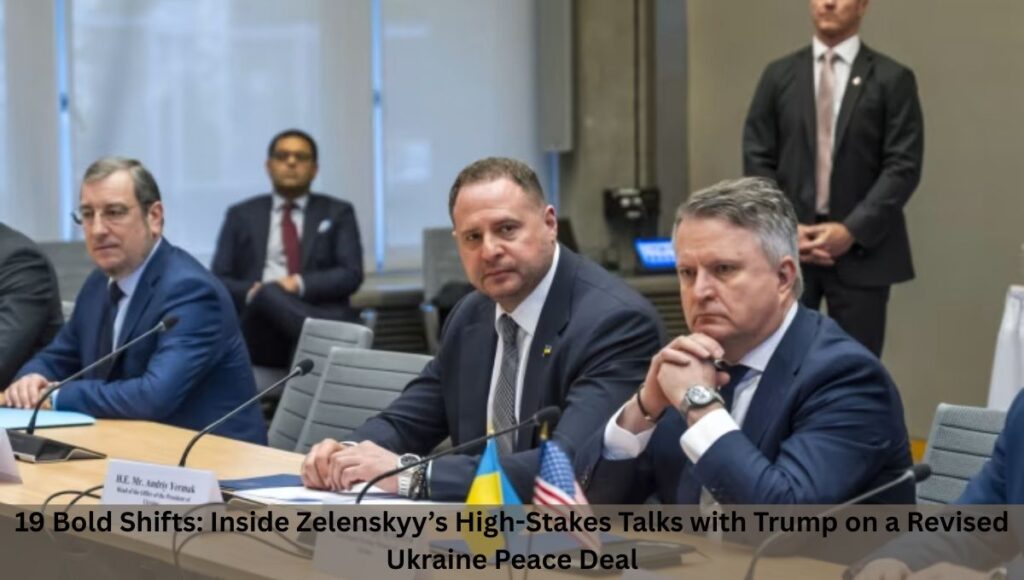
19 Bold Shifts: Inside Zelenskyy’s High-Stakes Talks with Trump on a Revised Ukraine Peace Deal
From 28 Points to 19: How Geneva Talks Reshaped Trump’s Peace Plan
The Geneva meetings were convened urgently after the leak of Trump’s 28-point peace plan, a document that drew immediate outrage in Kyiv, Brussels, and even within parts of the U.S. government. The initial draft reportedly called for Ukraine to cede Luhansk and Donetsk, slash its military, accept limits on NATO aspirations, and halt efforts to prosecute Russian war crimes.
The backlash was swift.
European governments accused Washington of pushing terms that mirrored Moscow’s demands. Ukrainian officials warned that the plan amounted to “enforced capitulation.” Even Trump’s Secretary of State Marco Rubio insisted publicly that the proposal was not written by the Kremlin after a firestorm erupted online.
Faced with mounting pressure, all sides gathered in Geneva for an intense two-day diplomatic marathon. Delegates shuttled across the city in dark, unmarked limousines. Ukrainian chief negotiator Andriy Yermak was seen looking visibly grim.
But by late Sunday, Rubio announced that “tremendous progress” had been made and that only “a couple of delicate” points remained unresolved. A joint U.S.-Ukraine statement confirmed the creation of an “updated and revised framework document.”
According to Ukraine’s Deputy Foreign Minister Sergiy Kyslytsya, the new plan is stripped down to just 19 points, with “very little left” from the Trump administration’s original draft.
What Has Been Removed From the Old 28-Point Plan
Multiple contentious clauses have been dropped, significantly improving the proposal from Kyiv’s perspective. Among the deleted elements:
1. No Forced Surrender of Luhansk and Donetsk
The most explosive requirement — that Ukraine surrender the remaining parts of Donbas — is gone. This was a red line Zelenskyy vowed never to cross.
2. No Mandatory NATO Freeze
The earlier plan reportedly blocked Ukraine from ever joining NATO. That language has been erased.
3. No Army Size Reduction
The original proposal required Ukraine to slash its military to between 400,000 and 600,000 troops. This cap was unacceptable amid an active war.
4. No Blanket Amnesty for Russian War Crimes
The 28-point plan had called for forgiving all wartime crimes, including atrocities documented by international investigators. European negotiators insisted this be removed.
5. No Automatic Recognition of Russian Control of Occupied Territories
Initial drafts would have recognised Crimea, Luhansk, and Donetsk as de facto Russian. That clause is absent from the revised document.
European leaders involved in the counter-proposal — including those from Germany, France, and the UK — pushed hard to eliminate these provisions. Berlin’s Chancellor Friedrich Merz called the updated plan “significantly modified,” describing the changes as “positive and more realistic.”
European Counter-Proposals Helped Rebalance the Deal
European negotiators were alarmed by Trump’s first draft, describing it as “tilted dangerously toward Moscow.” They drafted their own amendments, many of which Reuters later published, prompting a fresh diplomatic storm.
Their version proposed:
- No surrender of Donbas
- A NATO-style U.S. security guarantee for Ukraine
- No permanent limit on Ukraine’s military size
- No blanket amnesty for war crimes
- No automatic prohibition on NATO membership
Although Moscow dismissed the European proposal as “unconstructive,” much of its content appears to have shaped the new 19-point framework.
Zelenskyy Signals Openness — But Wants to Seal Details with Trump Personally
Despite his deep frustration over the original plan, Zelenskyy is now cautiously signalling that the revised peace plan is moving in a more acceptable direction.
He confirmed that the current draft contains “many of the correct points” and appears closer to a foundation that Ukraine could negotiate from — though not necessarily accept outright.
However, he stressed that the most sensitive issues — particularly those involving territory, security guarantees, and political obligations — require direct talks with Trump.
The Ukrainian leader expressed gratitude that “the American side is approaching this constructively,” but warned that Kyiv would only sign a deal that preserves Ukraine’s dignity, sovereignty, and future security.
Why Sensitive Issues Must Be Discussed Directly With Trump
Several items remain highly contentious, including:
● Security guarantees
Kyiv insists on Article-5-style guarantees — meaning the U.S. would be obligated to defend Ukraine if Russia invaded again. This is the hardest point of all.
● Treatment of occupied territories
Even though the forced surrender clause is gone, the issue of Donbas’ future remains unresolved.
● NATO membership
Washington is open to ambiguity; Ukraine wants eventual membership explicitly preserved.
● Long-range weapon restrictions
Some proposals still include limiting Ukraine’s ability to strike deep into Russian territory.
Given the political sensitivity, Zelenskyy argues that only a leader-to-leader conversation can resolve these items.
Why the U.S. Pushed for Rapid Progress
Trump has been unusually blunt: he wants a Ukraine peace deal “fast,” and earlier suggested a Thanksgiving deadline — a timeline widely criticized as unrealistic.
White House Press Secretary Karoline Leavitt said most issues between Kyiv and Washington are now resolved, but she also confirmed that no meeting is scheduled between Trump and Zelenskyy this week.
Insiders say Trump wants a major foreign-policy victory and believes ending the war would deliver it. Ukraine, meanwhile, desperately needs stability but refuses to accept a deal that resembles surrender.
Inside the High-Pressure Atmosphere in Geneva
Diplomatic observers described the Geneva atmosphere as “grim,” “tense,” and “at times bordering on breakdown.” Senior officials:
- moved between hotels in blackout vehicles
- held parallel meetings with European advisers
- exchanged drafts at rapid pace
- worked around the clock to salvage the proposal
One eyewitness noted Ukrainian negotiator Andriy Yermak appeared “stony-faced” — reflecting Kyiv’s fear that the U.S. might pressure Ukraine into unacceptable concessions.
For much of Sunday, U.S. and Ukrainian envoys were seen shuttling between venues in a frenzy of last-minute work before the public announcement of progress.
Despite Progress, Russia Shows No Sign of Compromising
Even if the U.S., Ukraine, and Europe settle on a plan, Russia has not signalled readiness to end the war. Analysts say Vladimir Putin believes he currently holds the advantage.
Tatiana Stanovaya of the Carnegie Russia Eurasia Center argues that Putin feels emboldened by:
- political turmoil in Kyiv
- corruption scandals
- challenges in mobilising new troops
- recent Russian battlefield gains
“Russia’s position is: ‘We have laid out our demands. Take them or don’t,’” she said. “‘If you accept, we stop. If not, we continue.’”
This is why security guarantees remain the most important factor for Ukraine — and why the new peace plan must ensure that Russia cannot simply regroup and attack again.
What the New 19-Point Plan Likely Includes
While the full document has not been released publicly, officials suggest the revised points include:
- A ceasefire along existing front lines
- A phased withdrawal of Russian forces from newly occupied areas
- No surrender of Luhansk or Donetsk
- A diplomatic pathway to address remaining territorial disputes
- No NATO membership veto
- U.S.-led security guarantees for Ukraine
- Limits on certain weapons but no forced demilitarisation
- A framework for reconstruction
- Steps for prisoner exchanges
- International monitoring of compliance
Kyiv sees this new outline as something they could “eventually consider” — but only after direct talks between Zelenskyy and Trump.
Where the Peace Process Stands Now
After days of chaotic diplomacy, threats, pressure, and emergency negotiations, the world is essentially back to waiting — this time for the two presidents to meet.
What’s clear now:
- The original 28-point plan is dead.
- A new 19-point framework is on the table.
- Zelenskyy will handle the final and most delicate issues personally.
- Trump wants a fast deal, but timelines remain unclear.
- Russia has not yet indicated willingness to halt fighting.
For Ukraine, the hope is that the revised plan no longer resembles surrender — and instead forms the basis of a dignified, enforceable peace. Until Trump and Zelenskyy meet, the world will continue watching, waiting, and wondering how close — or how far — the war is from its end.
Also Read: 7 Urgent Truths Behind Trump’s Controversial Ukraine Peace Plan
Also Read: US, Ukraine craft revised peace plan in ‘best ever talks’ of Trump’s tenure
Related Posts:
- 5 Powerful Highlights as Trump Lands Second Nobel…

- Trump’s 2025 Gaza Peace Plan Signing and Historic…

- 7 Shocking Reasons FIFA’s Peace Prize for Trump…

- 11 Explosive Revelations From Ted Cruz’s Leaked…
- Trump’s 20-Point Gaza Peace Plan Gains Urgent Global…

- Dramatic Moments Behind Trump’s Gaza Peace Push and…
