
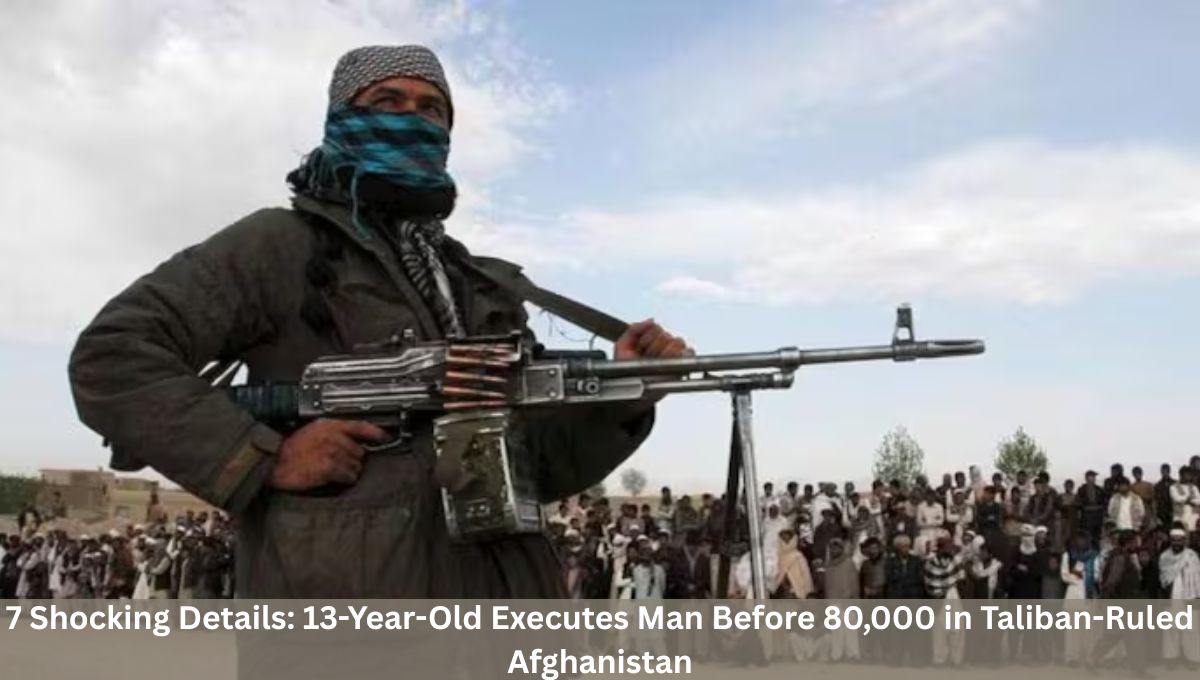
7 Shocking Details: 13-Year-Old Executes Man Before 80,000 in Taliban-Ruled Afghanistan, marking the Taliban’s 11th public execution since 2021 and triggering global outrage. A chilling and unprecedented scene unfolded in Afghanistan’s eastern Khost province this week, where a 13-year-old boy executed a man convicted of murdering 13 members of his family, including nine children.
The public execution, held inside a packed sports stadium, drew an estimated 80,000 spectators, marking one of the largest public gatherings for a judicial killing since the Taliban returned to power in 2021.
According to multiple Afghan and international reports, including statements from the Taliban-run Supreme Court, the convicted man—identified as Mangal—was sentenced to death for the murder of Abdul Rahman and 12 of his relatives in Khost earlier this year.
The execution was carried out under Qisas, a form of retributive justice permitted under the Taliban’s interpretation of Sharia law. The United Nations, human rights organizations, Afghan activists, and global observers have strongly condemned the execution, describing it as “inhumane,” “cruel,” and “a manufactured cycle of violence involving children.”
This article explores what happened inside the stadium, the Taliban’s expanding use of public executions, global reactions, and what this incident means for Afghanistan’s future.
7 Shocking Details: 13-Year-Old Executes Man Before 80,000 in Taliban-Ruled Afghanistan
Inside the Stadium: How the Public Execution Unfolded
Tens of Thousands Gather for a Grim Spectacle
Witnesses and videos circulating on social media show an immense crowd filling and surrounding the stadium—men standing shoulder to shoulder, climbing onto rooftops, and pressing against gates to witness the execution. Taliban officials and the victims’ relatives were also present.
Amu News, TOLOnews, and other Afghan outlets reported that around 80,000 people attended—one of the largest public events since the Taliban takeover. Chants of religious slogans erupted as the convicted man was brought forward.
A Child Forced to Pull the Trigger
What has stunned the world is the revelation that the execution was carried out by a 13-year-old boy, reportedly a relative of the victims. According to local sources, the boy was asked whether he wished to forgive the murderer—an option permitted under Qisas. When he refused, he was handed a firearm.
He fired multiple shots, killing Mangal instantly.
Human rights advocates have described this moment as a clear example of the Taliban using children in acts of violence, potentially violating international laws protecting minors from involvement in conflict and punishment.
The Crime That Led to the Death Sentence
The Taliban’s Supreme Court released an extensive statement identifying the executed man as Mangal, son of Tala Khan, originally from Paktia province and living in Khost at the time of the murders.
According to the court’s findings, Mangal entered the family home of Abdul Rahman and killed an extended family of 13, including Rahman himself, nine children, and several adult relatives. The killings reportedly took place in the Ali Shir and Terezio districts of Khost approximately ten months ago.
Conviction Through Taliban Courts
The case moved swiftly through:
- A court of first instance
- A provincial appeals court
- The Taliban-run Supreme Court
All courts upheld the death sentence. The final approval came from Hibatullah Akhundzada, the Taliban’s reclusive supreme leader, whose signature is required for executions.
The court emphasized that the victims’ families were offered the choice of forgiveness or financial compensation but insisted on Qisas, ensuring the execution would proceed.
Taliban’s Return to Public Executions Under Sharia Law
Since regaining control of Afghanistan in 2021, the Taliban have reinstated strict Sharia punishments, including public executions, floggings, and amputations.
This execution marks the 11th judicial execution carried out by the Taliban since their return to power. During their previous rule in the 1990s, such punishments were common, often carried out in football stadiums or city squares.
Justifying the Spectacle
Taliban officials defended the execution as a necessary act of justice.
Mostaghfar Gurbaz, spokesperson for the Khost governor, stated:
“This man deliberately targeted women and children. Such crimes demand the strictest punishment.”
Kabul-based pro-Taliban journalist W.A. Mubariz echoed similar sentiments on social media, saying public executions demonstrate the strength and implementation of an “Islamic system.”
But human rights groups argue that the Taliban’s interpretation of justice lacks transparency, due process, and compliance with international legal standards.
International Outrage and Condemnation
United Nations: “Inhumane and Contrary to International Law”
Richard Bennett, the UN Special Rapporteur on Afghanistan, issued an urgent appeal hours before the execution, urging the Taliban to halt the act.
After the execution was confirmed, Bennett wrote:
“Public executions are inhumane, a cruel and unusual punishment, and contrary to international law.”
He also stressed that involving a child in carrying out a killing represents a direct assault on human dignity and violates global conventions protecting minors.
Afghan Activists Condemn “Exhibition of Brutality”
Afghan women’s rights activist Golchehrah Yaftali posted a searing critique:
“The Taliban have turned Afghanistan into an exhibition of brutality. Involving children in such horrific scenes destroys their minds and futures.”
She warned that actions like these embed violence into Afghan society, shaping a new generation accustomed to extremism and cruelty. Prominent journalist and activist Nilofar Ayoubi added that the sight of a 13-year-old executing someone should be a “trigger warning to the world.”
The Taliban’s Justice System Under Scrutiny
Human rights organizations and legal experts have repeatedly raised concerns about the Taliban’s judicial system, pointing to:
- Lack of transparent trials
- Absence of defense representation
- Limited or no appeal mechanisms for defendants
- Confessions allegedly obtained under coercion
- Harsh punishments that violate international norms
Groups such as Amnesty International and Human Rights Watch warn that Afghanistan’s justice system has devolved into a punitive, opaque, and authoritarian structure with little oversight.
Qisas and the Taliban’s Interpretation of Sharia
Qisas—meaning retributive justice—allows victims’ families to:
- Demand a death sentence
- Accept monetary compensation
- Or forgive the offender entirely
However, under Taliban rule, Qisas often leads to public executions, particularly when the crime involves multiple victims or children. Critics argue that the Taliban’s enforcement of Qisas is selective, politically motivated, and designed to showcase power.
Child Involvement Raises Deep Ethical and Legal Questions
For many observers, the most disturbing aspect of the execution is the forced involvement of a child.
Violation of International Child Protection Laws
International conventions—including the UN Convention on the Rights of the Child, to which Afghanistan is a signatory—explicitly forbid:
- The participation of children in executions
- Child recruitment or involvement in armed conflict
- Exposing children to extreme violence
Legal experts warn that the Taliban have now crossed a new threshold, potentially opening the door to wider use of minors in punitive or military activities.
Psychological Impact on Afghan Children
Child psychologists argue that forcing a child to kill—even in a judicial setting—inflicts long-lasting trauma:
- PTSD
- Desensitization to violence
- Identity instability
- Increased likelihood of future violent behavior
In a society already scarred by decades of war, such practices could deepen generational trauma.
Thousands Cheer as the Taliban Display Authority
Despite the global outrage, the massive turnout at the stadium raises difficult questions. Many residents interviewed by Afghan outlets expressed support for the public execution.
One resident said:
“A man who kills children and women deserves this. No one does such a thing.”
Another added that harsh punishments serve as a deterrent in rural provinces with limited law enforcement.
However, analysts suggest that such large gatherings may also reflect:
- Lack of entertainment or events in Taliban-controlled regions
- Social pressure to attend
- Curiosity rooted in decades of exposure to violence
Still, the Taliban have historically used public executions as a political tool—a means of demonstrating complete authority.
Two Additional Convictions Pending Execution
The Supreme Court revealed that two other men—reported to be sons of the executed convict—were also sentenced to death in connection with the murders. However, their executions were postponed because some heirs of the victims are currently abroad.
Taliban officials stated that Qisas cannot be carried out until all eligible family members are physically present to confirm their decision. This raises concerns that further public executions may follow.
What the Execution Means for Afghanistan’s Future
Human rights analysts say this event underscores several troubling trends in Taliban-ruled Afghanistan:
1. Public executions are resurging as state spectacles
The Taliban appear determined to normalize public punishment as part of their governance model.
2. Children are increasingly exposed to—and involved in—extreme violence
A dangerous precedent has now been set, raising fears of child radicalization.
3. Afghanistan is drifting further from international norms
Despite repeated calls from the UN and other bodies, the Taliban continue to disregard global legal standards.
4. Human rights and women’s rights face continued erosion
The Taliban’s broader agenda includes banning girls’ education, restricting women’s movement, and eliminating safeguards for due process.
Conclusion
The public execution in Khost—attended by 80,000 people and carried out by a 13-year-old boy—has become one of the most distressing and symbolic events since the Taliban returned to power. It reflects the regime’s firm adherence to its interpretation of Sharia law, the normalization of state violence, and the deepening humanitarian and legal crisis in Afghanistan.
While the Taliban defend such punishments as essential to maintaining order, global leaders and Afghan activists warn that public executions, especially those involving children, will only entrench cycles of brutality and trauma.
As Afghanistan continues to face economic collapse, diplomatic isolation, and social repression, the world watches with growing alarm—wondering what future awaits the country’s most vulnerable, especially its children.
Also Read: 7 Shocking Facts About the Jenin Killings After Apparent Surrender
Related Posts:
- 5 Major Takeaways from the US Supreme Court's…

- 7 Alarming Signs of Escalation as Pak-Afghan…

- Afghanistan–Pakistan Border Clashes 2025: Key Facts…

- 8 Shocking Developments in the Pakistan–Afghanistan…
- Afghanistan–Pakistan War 2025: Inside the 48-Hour Ceasefire

- Pakistan–Afghanistan Border Conflict 2025: Ceasefire…
