

7 Shocking Facts About the Jenin Killings After Apparent Surrender, sparking war crime accusations and global condemnation. The killing of two Palestinian men by Israeli forces in the occupied West Bank city of Jenin has reignited intense controversy, raised allegations of extrajudicial executions, and fueled a growing diplomatic crisis.
Thank you for reading this post, don't forget to subscribe!Video footage circulating widely on social media appears to show the two Palestinian men surrendering—hands raised, shirts lifted to expose their bodies, and kneeling on the ground—before Israeli Border Police officers fatally shot them moments later.
The incident occurred during a broad Israeli military operation targeting armed groups in Jenin and its surrounding areas, part of a months-long campaign across the northern West Bank. The deaths have sparked outrage among Palestinians, renewed accusations of war crimes, and prompted sharp criticism from human rights groups and international governments.
This article provides a detailed, structured, and comprehensive account of what happened, the conflicting narratives, the political reactions, and the broader context of deteriorating security in the West Bank.
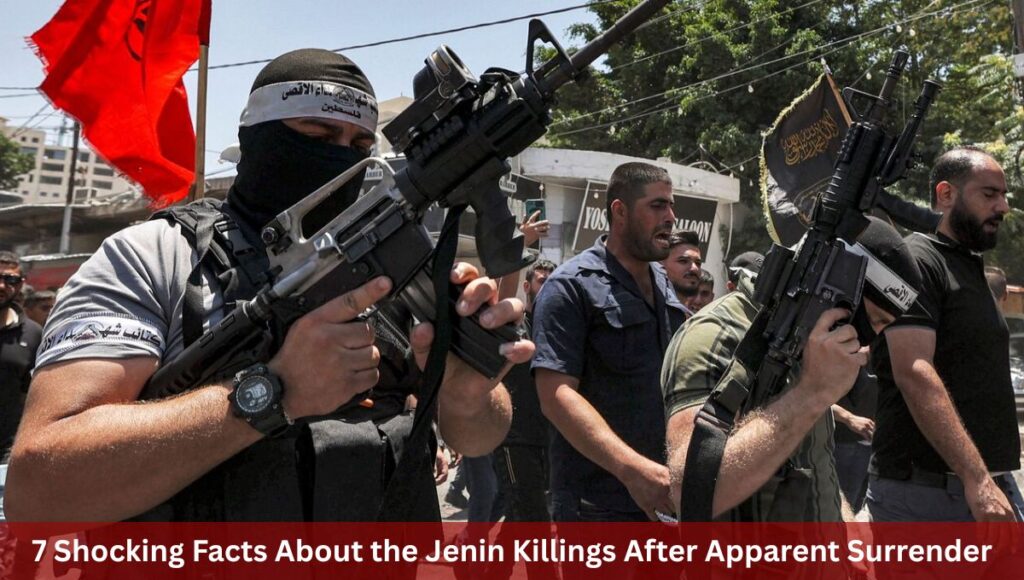
7 Shocking Facts About the Jenin Killings After Apparent Surrender
The Video That Sparked Global Outrage
Footage shared by Palestinian media, Reuters, and other news outlets shows a moment that has quickly become emblematic of the escalating violence in the West Bank. Two men emerge slowly from a building in the Jenin refugee camp.
Their hands are raised high, and they appear to be following the instructions of Israeli Border Police officers positioned around the structure. One of the men lifts his T-shirt above his chest, seemingly to demonstrate that he is unarmed.
The pair then kneel on the ground, surrounded by officers. After a short period, the men are seen moving back toward the building’s entrance. Within seconds, Border Police officers open fire at close range.
Later footage shows at least one of the men lying motionless on the ground. Journalists, eyewitnesses, and humanitarian workers have said the video strongly suggests that the men were in the process of surrendering when they were shot.
A Reuters journalist at the scene corroborated key details: the men exited with their hands up, shots were heard shortly after they were directed back inside, and the reporter later saw a lifeless body near the entrance.
Israeli Authorities Confirm Killings and Launch Review
In a joint statement released by the Israel Defense Forces (IDF) and Israel Police, authorities acknowledged that their forces opened fire on the two men and confirmed the deaths. They stated that the incident was “under review” by field commanders and would be referred to the relevant authorities for further examination.
According to the statement, Israeli forces had surrounded the building during an operation to apprehend two men they described as:
“Wanted individuals affiliated with a terror network operating in Jenin.”
They accused the men of involvement in throwing explosive devices and firing on security forces. The IDF said a surrender procedure lasted several hours and that the suspects exited the structure only after engineering equipment was used to dismantle part of the building.
The statement noted:
“Following their exit, fire was directed toward the suspects.”
However, the statement did not address why officers fired on the men after they had exited with raised hands, nor the apparent order directing the men to re-enter the building before shots were fired. To critics, the omission was glaring.
Palestinian Authority: ‘A Deliberate Israeli War Crime’
The Palestinian Authority (PA) reacted sharply, condemning what it called a “brutal field execution” and a “fully-fledged war crime.”
The West Bank’s General Authority for Civil Affairs identified the two men as:
- Al-Muntasir Mahmoud Qassem Abdullah, 26
- Youssef Ali Youssef Asasa, 37
PA officials said the men were unarmed and attempting to surrender when they were executed.
Jenin Governor Kamal Abu al-Rub described the killings as a “cold-blooded execution”, insisting that those responsible must face accountability. He expressed skepticism that Israel would conduct a serious investigation, citing a historical pattern of internal reviews that rarely lead to indictments.
Human rights organizations across the region echoed the PA’s assessment, calling the incident symptomatic of a broader trend of impunity and extrajudicial killings.
Itamar Ben Gvir Praises Officers: ‘Terrorists Must Die’
Israel’s far-right National Security Minister, Itamar Ben Gvir, publicly backed the officers involved, posting on X:
“The fighters acted exactly as expected of them — terrorists must die!”
Ben Gvir, a controversial figure known for his hardline positions, dismissed criticism of the shooting and insisted that the men were terrorists who posed an imminent threat. His endorsement of the killings drew widespread condemnation from Palestinian leaders and several Israeli opposition politicians.
Inside Israel, Hadash-Ta’al chair Ayman Odeh shared the video and described the event as:
“An execution… The death penalty law for Palestinians has not yet been approved, but it has been enforced for a long time.”
Conflicting Accounts From Border Police Officers
Israeli Border Police officers involved in the incident reportedly told Army Radio that the men appeared to disobey instructions.
According to their account:
- They were concerned the men might be armed or carrying explosives.
- The men allegedly acted against orders.
- One suspect reportedly moved back into the building without authorization, and the second followed him.
- Officers opened fire due to what they described as a perceived threat.
This explanation clashes sharply with what is visible in the widely circulated footage. The lack of reference in official statements to the men kneeling, lifting their shirts, or lying on the ground has intensified the controversy.
A Long and Escalating Israeli Campaign in the West Bank
The Jenin incident occurred amid a sweeping Israeli crackdown across northern West Bank towns, including Jenin, Tubas, Tammum, and al-Aqaba. Israeli military operations have intensified since October 2023, when Hamas launched its attack on southern Israel, igniting the Gaza war.
Israel claims its West Bank operations are aimed at dismantling armed groups responsible for attacks on soldiers and settlers.
Key facts about the broader campaign:
- Over 220 sites were searched in recent days.
- Dozens of Palestinians were questioned.
- Several suspects were arrested.
- Attack helicopters and drones have supported ground operations.
- Israeli raids in the West Bank now average 47 per day — double the rate of two years ago.
According to UN figures, more than 1,000 Palestinians have been killed in the West Bank since October 2023 by Israeli forces or settlers. Israel says many of those killed were gunmen or involved in attacks. At least 44 Israelis have been killed in Palestinian attacks or military operations in the West Bank during the same period.
Human Rights Groups: Extrajudicial Killing and Apartheid Practices
Human Rights Watch, Amnesty International, and other groups have sharply criticized Israel’s military conduct in the West Bank.
Recent reports accuse Israel of:
War Crimes
Including forced displacement, destruction of civilian infrastructure, and unlawful killings.
Crimes Against Humanity
Particularly related to forced evictions and systematic abuses.
Collective Punishment
Through sweeping raids, demolitions, and mass detentions.
Apartheid Policies
Amnesty International described the Jenin raids as part of:
“Israel’s cruel system of apartheid against Palestinians.”
Human rights groups argue that Israeli reviews of such incidents almost never result in accountability, reinforcing a long-running culture of immunity for security personnel.
Forced Evictions and Demolitions: A Growing Crisis
The Jenin refugee camp has faced repeated raids, demolitions, and forced evictions.
According to Roland Friedrich, UNRWA’s director for the West Bank:
- More than 200 buildings in the Jenin camp have demolition orders.
- Twelve buildings are slated for demolition this week alone.
- Another eleven face partial demolition.
Friedrich described the destruction as:
“Systematic… aimed at re-engineering the topography of refugee camps.”
These actions, he said, violate international law and deepen humanitarian suffering.
International Government Reactions
The incident comes at a time of growing international pressure on Israel.
Four major European powers — France, Germany, Italy, and the United Kingdom — issued a rare joint statement urging Israel to:
- Protect Palestinian civilians
- Reduce settler violence
- Reverse settlement expansions
- Restore withheld Palestinian tax revenues
- Strengthen the Palestinian Authority rather than weaken it
Their statement warned that the destabilization of the PA could threaten both regional stability and Israel’s own security. The U.S. has also expressed concern over rising violence in the West Bank, though Washington has not issued a direct condemnation of the Jenin incident.
Calls for International Protection
Palestinian leaders and human rights groups have called for:
- UN peacekeeping forces
- International monitors
- Accountability mechanisms outside of Israeli military courts
The Palestinian Foreign Ministry argued that only international intervention can halt Israel’s “killings, demolitions, and forced expulsions” in the West Bank. Hamas, though not claiming the two deceased men as members, called the killings an “execution” and urged foreign governments to act.
Historical Context — Surrender Killings and Military Investigations
Cases of Palestinians being shot after apparent surrender are not new.
Israeli military investigations have historically had:
- Low rates of prosecution
- Even lower rates of conviction
- A pattern of “operational justifications” used to close cases
- Reports often sealed or minimally transparent
Experts say this contributes to mistrust and further inflames tensions.
What Happens Next?
Internal Review
The IDF says commanders on the ground will review the incident before forwarding it to higher authorities.
Possible Outcomes
- Administrative review with internal disciplinary measures
- Closing the case with no criminal charges
- A rare criminal investigation
Political Pressure
International condemnation may influence Israel’s handling of the investigation, especially given recent scrutiny of West Bank operations.
However, the strong public support from National Security Minister Ben Gvir may embolden security forces and shape internal political dynamics.
The Broader Impact — A Region on Edge
The killings in Jenin underscore a dangerous escalation of violence in the West Bank, occurring alongside:
- Mass displacement
- Settler attacks
- Intensified Israeli military raids
- Worsening humanitarian conditions
- A deteriorating political environment
The situation risks triggering:
- Wider unrest
- Breakdown of PA governance
- Increased recruitment into Palestinian armed groups
- Further erosion of diplomatic engagement
The Jenin killings have become a symbol of a conflict sliding toward deeper instability.
Conclusion
The shooting of two Palestinian men who appeared to surrender during an Israeli raid in Jenin has ignited a fresh wave of outrage, condemnation, and geopolitical tension. With video evidence contradicting official explanations, accusations of war crimes growing louder, and international pressure mounting, the incident is shaping up to be a major flashpoint in the already volatile West Bank.
The killings highlight the dangerous trajectory of the conflict: increased militarization, eroding accountability, deepening humanitarian crises, and the absence of meaningful political dialogue. Whether the internal Israeli review leads to accountability—or becomes another forgotten case—remains to be seen.
But for many Palestinians, the Jenin incident is yet another painful reminder of a system they view as entrenched, violent, and unjust.
Also Read: Hamas Executes 50 Rivals After Ceasefire – Inside Gaza’s Deadly Power Struggle
Also Read: Israeli troops kill two Palestinians in West Bank. Here’s what happened
Related Posts:
- 5 Major Takeaways from the US Supreme Court's…

- 5 Key Dimensions of U.S.–Israel Relations Amid…

- Hamas Executes 50 Rivals After Ceasefire – Inside…

- 5 Shocking Facts About the Racially Aggravated Rape…

- 7 Heartbreaking Facts About Venezuela's Earthquake Disaster
- 7 Shocking Details: 13-Year-Old Executes Man Before…
