7 Alarming Signals as Putin Pushes Ultimatum Over Trump’s Ukraine Peace Plan, saying it could be a basis for talks but demanding full Ukrainian withdrawal. Russian President Vladimir Putin has delivered his clearest—and most uncompromising—position yet on the United States’ proposed peace plan for Ukraine, warning that Moscow will seize more Ukrainian land by force unless Kyiv withdraws from all territories claimed by Russia.
His remarks, made in Bishkek during a trip to Kyrgyzstan, come at a moment of intense diplomatic maneuvering involving Washington, Kyiv, and European capitals. The US delegation—led by Special Envoy Steve Witkoff and potentially joined by Jared Kushner—is expected in Moscow early next week, as the Trump administration attempts to accelerate negotiations that it claims are making “tremendous progress.”
But Putin’s ultimatums, combined with fierce backlash over the origins and content of the US-Russia peace plan, cast a long shadow over the diplomatic push. What follows is an in-depth examination of the evolving peace efforts, Putin’s demands, Zelensky’s position, US political turmoil over the Russia-leaning proposal, and the geopolitical stakes now shaping the war’s next chapter.
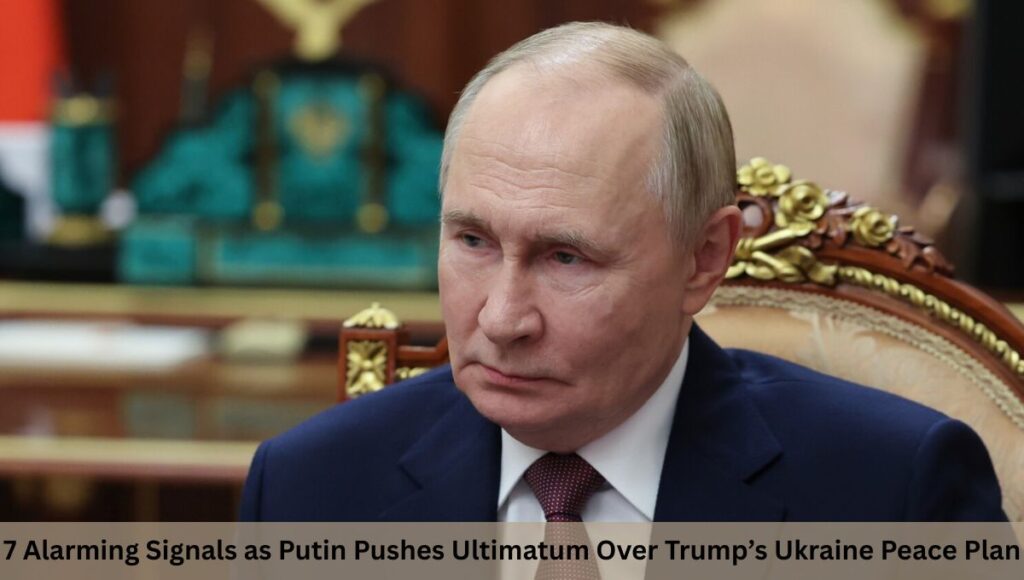
7 Alarming Signals as Putin Pushes Ultimatum Over Trump’s Ukraine Peace Plan
Putin Says US Plan Could Be a “Basis”—But Only on Moscow’s Terms
During a press conference in Kyrgyzstan, Putin confirmed that Russia has received the latest version of the US peace proposal—originally a 28-point plan drafted with heavy Russian influence and later revised in Geneva.
He stated bluntly:
“In general, we agree that this can be the basis for future agreements… But every word matters.”
Yet he immediately paired that with an ultimatum that undercuts almost any chance of quick progress:
“Once Ukrainian troops withdraw from the territories they occupy, military action will stop. If they don’t withdraw, we will achieve this through military means.”
This is one of Putin’s most forceful public statements tying ceasefire conditions directly to Ukrainian withdrawal—a demand Kyiv has repeatedly rejected as tantamount to surrender.
Moscow’s Demands: Full Ukrainian Withdrawal From Claimed Territories
Russia is currently occupying roughly 20% of Ukraine’s internationally recognized territory, including:
- Nearly all of Luhansk
- Parts of Donetsk
- Occupied portions of Kherson
- Large areas of Zaporizhzhia
- And Crimea, annexed illegally in 2014
But Russia is demanding more.
Putin’s Territorial Ultimatum
Moscow insists on:
- Complete Ukrainian withdrawal from all land Russia claims, including areas still under Kyiv’s control
- International recognition of Russian sovereignty over those regions
- Recognition of Russia’s permanent control over Crimea
- Guarantees Ukraine will not join NATO
- Prohibition of foreign troops or long-range weapons on Ukrainian soil
For Ukraine, these concessions would represent not only territorial loss but also strategic and political capitulation—red lines that Zelensky and European allies have vowed never to cross.
Zelensky Rejects Withdrawal Demand but Leaves Room for Negotiated Points
In his nightly video address, Ukrainian President Volodymyr Zelensky acknowledged ongoing talks with US officials and signaled that discussions on the revised plan would continue.
But he emphasized:
“Ukraine will not withdraw from its land and will not betray its dignity.”
At the same time, Zelensky hinted that compromise may be unavoidable given the grinding war:
“Even the strongest metal can break.”
Ukraine’s Red Lines
Ukraine refuses to accept:
- Permanent territorial loss
- Any settlement recognizing Russia’s annexations
- A ban on future NATO membership
- Demilitarization that leaves Ukraine defenseless
For Kyiv and its allies, rewarding Russia’s aggression would shatter European security principles and embolden future invasions.
The Controversial US-Russia Peace Plan: Who Really Wrote It?
A major strand of controversy erupted in Washington after lawmakers claimed that the original peace plan presented by the Trump administration looked like it had been “written in Russian.”
US Senators Sound the Alarm
Several senators, including Republican Mike Rounds and independent Angus King, publicly stated that:
- The plan resembled a Russian wish list
- It was not drafted by the US State Department
- Some officials first saw it only after it was announced
- It included demands previously rejected by US leadership
Senator Rounds said bluntly:
“It looked more like it was written in Russian to begin with.”
The State Department Denies the Claims
Secretary of State Marco Rubio and the State Department called those statements “blatantly false,” insisting the US authored the plan using Ukraine’s input.
But skepticism persists—especially after new reporting revealed meetings between Trump allies Steve Witkoff and Jared Kushner with Russian sovereign wealth fund head Kirill Dmitriev in Miami.
Dmitriev, a longtime Putin confidant, was sanctioned by Washington in 2022.
The Original 28-Point Plan: “Skewed Toward Russian Demands”
Before revisions in Geneva, the initial 28-point plan reportedly included:
- Recognition of Russian control of Crimea
- Transfer of the entire Donbas region to Russia
- A mandate blocking Ukraine from NATO permanently
- Restrictions on Ukraine’s military size
- A ban on foreign troops and long-range weapons
This was considered an extraordinary alignment with Kremlin goals. European leaders reacted with shock. Ukraine called it an “impossible choice.”
The revised plan, now down to 19 points, reportedly softens some demands but still skirts the issue of territorial sovereignty—arguably the most critical obstacle.
European Leaders Express Deep Concern
Europe is watching the negotiations with growing alarm. European Commission President Ursula von der Leyen said Russia still views Europe as a “sphere of influence” to be “carved up.”
Poland’s Prime Minister Donald Tusk demanded clarity:
“It would be good to know for sure who is the author of the plan and where it was created.”
European diplomats worry the Trump administration may prioritize a rapid settlement—even one favorable to Russia—in order to claim a foreign policy victory.
Russia’s Military Claims: “Positive Dynamic Everywhere on the Front”
Despite heavy losses, Putin says Russia has momentum.
He declared:
“There is a positive dynamic everywhere on the front.”
This confidence comes as Russia makes incremental gains, especially around Pokrovsk in eastern Ukraine.
But US-based conflict monitor ISW warns that:
- Russia’s battlefield progress is slow
- A rapid takeover of all Donetsk is “not imminent”
- A full Russian victory is not inevitable even with current momentum
Still, Russia hopes even small gains can strengthen its negotiating position.
Putin Doubles Down on Zelensky’s “Illegitimacy”
Another obstacle to negotiations is Putin’s repeated assertion that Zelensky is no longer a legitimate leader. Because Ukraine is under martial law and elections cannot be held, Putin claims the government lacks authority—making it “pointless” to sign agreements.
This is widely dismissed outside Russia. Ukraine’s parliament unanimously affirmed Zelensky’s legitimacy earlier this year.
Yet Putin’s argument could serve as a pretext:
- to avoid signing formal agreements
- to delegitimize Ukraine internationally
- to justify bypassing Kyiv in favor of dealing only with the US
This presents a serious legal and diplomatic barrier to any peace plan.
The Coming Week: High-Stakes US, Russia, and Ukraine Diplomacy
Major developments are expected within days.
US Delegation Heads to Moscow
Steve Witkoff will lead the delegation.
Trump says Jared Kushner may join.
Their mission:
discuss the revised peace plan directly with Kremlin leadership.
US Officials Also Visiting Kyiv
Ukraine is preparing for meetings with:
- Steve Witkoff’s team
- US Army Secretary Dan Driscoll
- Potential Trump administration advisers
A flurry of negotiations will aim to narrow remaining differences between:
- Washington
- Kyiv
- Moscow
None of the sides currently agree on territory—the biggest sticking point.
Zelensky’s Tightrope: Between Losing Territory and Losing the US
Ukraine depends heavily on US military and economic support. This gives Washington enormous leverage.
Zelensky has described the choice before him as:
- Loss of dignity (ceding land)
- Loss of a key partner (risking a rift with the US)
Ukraine’s European allies fear Washington may pressure Kyiv into concessions that undermine long-term security.
Ground Realities: War Continues Despite Diplomacy
Even as peace proposals circulate, fighting on the ground intensifies.
Recent events include:
- A major Russian drone attack in Zaporizhzhia
- Persistent shelling along the eastern front
- Ukrainian counter-drone defenses struggling to keep pace
- Continued Russian attempts to push toward strategic towns in Donetsk
Negotiations and conflict are unfolding simultaneously—a dynamic that historically favors the side with battlefield momentum.
Putin’s Strategic Messaging: Open to Negotiation, Closed to Compromise
Putin’s statements reveal a clear dual strategy:
1. Signal openness to the US
- Accepting the US plan “as a basis”
- Praising American willingness to consider Russia’s views
- Welcoming Witkoff and Kushner to Moscow
2. Threaten Ukraine with expanded war
- Demand full withdrawal
- Promise to seize land “by force”
- Declare readiness to fight “to the last Ukrainian”
3. Undermine Ukraine’s government
- Calling Zelensky illegitimate
- Suggesting no binding agreement can be signed
- Positioning the US—not Ukraine—as the true negotiating partner
This strategy aims to drive a wedge between Washington and Kyiv.
What a Possible Deal Might Look Like—And Why It’s Still Unlikely
Based on current public statements, a settlement palatable to all sides remains extremely difficult.
Russia wants:
- Full Ukrainian withdrawal
- Recognition of annexed regions
- NATO ban
- No foreign troops
- Long-range weapons restrictions
Ukraine wants:
- Full territorial integrity
- Security guarantees
- NATO pathway preserved
- No legitimization of Russia’s occupation
The US wants:
- A settlement ending the war
- Protection for Ukraine
- Stability in Europe
- A diplomatic “win”
These positions are fundamentally incompatible.
Key Takeaways: 7 Alarming Signals from Putin’s Remarks
- Putin’s acceptance of the US plan as a “basis” masks harsh, non-negotiable demands.
- He issued the clearest ultimatum yet: withdrawal or forced seizure.
- Russia claims Ukraine’s leadership is illegitimate, complicating any deal.
- Washington faces controversy over the plan’s origins and Russian influence.
- European leaders deeply distrust the proposal and fear concessions.
- Ukraine remains under immense pressure, both militarily and diplomatically.
- Despite talks, fighting continues—and could escalate further.
Conclusion: A Peace Plan on Paper, But No Peace in Sight
The coming weeks will reveal whether the US-led effort to forge a peace deal can break the deadlock—or whether negotiations collapse under the weight of irreconcilable demands.
Putin’s rhetoric suggests Russia believes time and momentum are on its side. Zelensky believes surrendering territory would destroy Ukraine’s future. The US seeks a diplomatic breakthrough but faces domestic and international backlash.
For now, the war continues as the diplomatic arena becomes the new frontline—with massive implications for Ukraine, Europe, and global security.
Also Read: 7 Powerful Signals Russia Is Rejecting Trump’s Ukraine Peace Plan
Also Read: Ukraine desperate to keep Trump on its side in peace talks, while saving its sovereignty