Trump Threatens Military Action in Nigeria Over Alleged Christian Killings, drawing sharp rebuke from Abuja. U.S. President Donald Trump has threatened “fast” military action in Nigeria, accusing the government of failing to protect Christians from Islamist insurgents, a move that has triggered sharp pushback from Nigerian officials and reignited debate over Washington’s approach to global religious freedom.
Speaking on Truth Social, Trump said the United States would “immediately stop all aid and assistance” to Africa’s most populous nation and was preparing to “go in guns-a-blazing” unless Abuja cracked down on what he described as a “Christian genocide.”
“If we attack, it will be fast, vicious, and sweet, just like the terrorist thugs attack our cherished Christians,” Trump wrote. “Radical Islamists are responsible for this mass slaughter.”
The remarks came hours after the president was briefed on a Fox News report alleging that Christians in Nigeria were being killed by Islamist groups. Within hours, the issue became a focus of the White House’s weekend messaging, according to officials familiar with the matter.
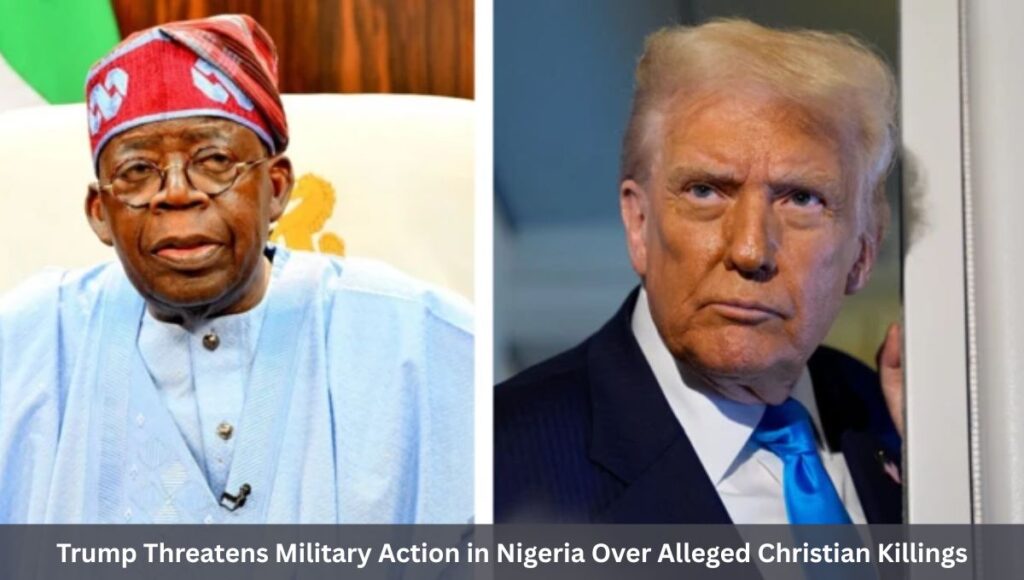
Trump Threatens Military Action in Nigeria Over Alleged Christian Killings
Nigeria Pushes Back: “Impossible Under Our Constitution”
Nigerian Foreign Minister Yusuf Tuggar rejected Trump’s assertion, saying any state-backed religious persecution was “impossible” under the country’s laws.
“This is what shows that it’s impossible for there to be a religious persecution that can be supported in any way, shape or form by the government of Nigeria at any level — be it federal, regional, or local,” Tuggar said at a joint press conference in Berlin.
Tuggar pointed to Nigeria’s “constitutional commitment to religious freedom and the rule of law,” calling Trump’s threat a misunderstanding of the nation’s complex security realities.
Presidential spokesman Bayo Onanuga said Abuja was “shocked” by the idea of a potential U.S. invasion but emphasized that Nigeria “would welcome assistance as long as our territorial integrity is respected.”
“We are shocked that President Trump is mulling an invasion of our country,” Onanuga told CNN. “The killings are not sanctioned by the Nigerian government. Terrorist groups such as Boko Haram and ISIL are responsible for the crisis.”
White House Orders Pentagon to Prepare Contingency Plans
Trump’s directive to the Pentagon to “prepare for possible action” in Nigeria caught many by surprise, including within the U.S. military.
“President Trump was elected in a landslide victory to accomplish his peace-through-strength agenda. The Department of War stands ready to execute the Commander in Chief’s direction,” Pentagon spokesperson Sean Parnell said.
Defense Secretary Pete Hegseth added that the Pentagon was “preparing for action” and had requested contingency plans.
Personnel within U.S. Africa Command (AFRICOM) were recalled to headquarters in Germany over the weekend to discuss potential scenarios, sources familiar with the situation told CNN.
Trump, speaking to reporters aboard Air Force One, declined to rule out sending U.S. troops to Nigeria. “Could be,” he said when asked about possible deployments or airstrikes. “They’re killing record numbers of Christians in Nigeria. We’re not going to allow that to happen.”
Abuja’s Response: Cooperation, Not Confrontation
In a statement, Nigerian President Bola Tinubu reiterated his government’s commitment to religious tolerance.
“The characterization of Nigeria as religiously intolerant does not reflect our national reality,” Tinubu said. “Our administration continues to address security challenges that affect citizens across faiths and regions.”
Tinubu, a Muslim from southern Nigeria married to a Christian pastor, noted that his government maintains balanced representation across religious lines in key military and political appointments.
Foreign Ministry spokesperson Kimiebi Imomotimi Ebienfa told Al Jazeera, “There is no Christian genocide in Nigeria. Muslims, Christians, and traditional worshippers alike have been victims of terrorist attacks. We reject any narrative that frames the conflict as a war on one religion.”
Adviser Daniel Bwala said Nigeria would “welcome U.S. help in tackling insurgents,” but urged respect for sovereignty. “We don’t take it literally, because we know Donald Trump thinks well of Nigeria,” he told Reuters.
On the Ground: A Web of Conflicts
Nigeria, home to over 230 million people, faces a complex security crisis involving jihadist insurgencies, herder-farmer conflicts, and organized banditry.
The Boko Haram insurgency, active since 2009, has killed over 40,000 people and displaced two million, according to the UN Office for the Coordination of Humanitarian Affairs (UNOCHA). The group and its offshoot, the Islamic State West Africa Province (ISWAP), have targeted schools, markets, and both churches and mosques.
Rights monitors stress that both Muslims and Christians have been victims. “They bomb markets. They bomb churches. They bomb mosques,” said Nigerian conflict analyst Bulama Bukarti. “They do not discriminate.”
A May 2025 report by Amnesty International recorded 10,200 civilian deaths in two years across six states, with Benue and Plateau hardest hit. Much of the violence stemmed from disputes over land and grazing rights between nomadic herders and farming communities.
In Nigeria’s northwest, heavily armed “bandit” groups conduct kidnappings and extortion. These groups, not ideologically driven, have destabilized vast rural regions. Military operations supported by local vigilante forces have struggled to restore order.
Religious Freedom and U.S. Policy
Trump’s remarks mark a renewed emphasis on religious freedom as a cornerstone of U.S. foreign policy.
In October 2025, the U.S. State Department redesignated Nigeria as a “Country of Particular Concern” (CPC) under the International Religious Freedom Act, citing “severe violations of religious freedom.” The label allows sanctions on nations found complicit in systematic persecution.
Trump, in his Truth Social post, confirmed that designation, saying, “Christianity is facing an existential threat in Nigeria.”
The CPC listing had been removed under the Biden administration in 2021. Its reinstatement under Trump has been celebrated by evangelical advocacy groups in the U.S., including campaigns led by Senators Ted Cruz and Josh Hawley.
Cruz, an evangelical Christian from Texas, introduced legislation in September to sanction Nigerian officials “ignoring or facilitating the mass murder of Christians.”
At the same time, rights observers urge caution. “Labeling Nigeria solely as a violator of Christian rights risks oversimplifying a complex conflict,” said Ladd Serwat, Africa analyst at the crisis-monitoring group ACLED.
The African Union Commission on Peace and Security also warned against “generalizations,” saying Nigeria’s conflicts are “complex and multidimensional.”
Evangelical Pressure and Domestic Context
Trump’s move aligns with his long-standing support from American evangelical voters, who view global Christian persecution as a key foreign policy issue.
Paula White-Cain, Trump’s spiritual adviser, praised his stance, saying he had “taken a strong stand for persecuted Christians in Nigeria.”
The president’s focus on the issue — reportedly sparked by a Fox News segment — reflects his sensitivity to evangelical concerns ahead of midterm elections.
Within conservative circles, Nigeria has become emblematic of what they view as “ignored Christian suffering” worldwide. Massad Boulos, Trump’s adviser on Arab and African affairs, told Nigerian media that both Christians and Muslims are victims, but that “the president wants attention drawn to the plight of Christians.”
Trump has previously raised the issue with Nigerian leaders. During a 2018 White House meeting, he told then-President Muhammadu Buhari, “We are deeply concerned by religious violence in Nigeria, including the burning of churches and the killing and persecution of Christians.”
Buhari replied that the violence stemmed from economic and social tensions, not government discrimination.
Nigeria’s Complex Security Landscape
Analysts say Trump’s “guns-a-blazing” rhetoric obscures the layered nature of Nigeria’s violence.
A 2024 Reuters review of 1,923 documented civilian attacks found only about 50 incidents were explicitly religious in motive. Most stemmed from land conflicts, terrorism, or criminal activity.
“The narrative of a Christian genocide is misleading,” said Ebenezer Obadare, senior fellow for Africa studies at the Council on Foreign Relations. “Both Muslims and Christians are dying in Nigeria’s conflicts. The correct response is cooperation, not invasion.”
UNOCHA estimates 7.8 million Nigerians now require humanitarian assistance, while the World Food Programme warns of worsening food insecurity due to disrupted farming.
The International Committee of the Red Cross called the crisis in northern Nigeria “among the most urgent in Africa,” citing school closures, displacement, and malnutrition.
President Tinubu has pledged new funding and troop deployments: 30,000 soldiers currently serve in joint operations across conflict zones, and ₦50 billion ($62 million) has been allocated for humanitarian aid.
The Nigeria Security and Civil Defence Corps has begun recruiting 10,000 new personnel to bolster rural security.
International and Regional Response
The European Union has committed €48 million in humanitarian and development aid to Nigeria in 2025, targeting conflict-affected regions.
The African Union’s Peace and Security Council has deployed observers to monitor trends in northern states.
“The wrong thing to do is to invade Nigeria,” said Obadare. “Doing that will be counterproductive.”
U.N. officials caution that U.S. military involvement could destabilize regional counterterrorism coordination. Neighboring Niger, where the U.S. withdrew its last troops in 2024, remains a fragile security partner.
An African diplomat based in Addis Ababa said Trump’s comments “undermine multilateral efforts” to address regional instability. “What Nigeria needs is capacity building, not unilateral action,” he said.
Inside Washington: A “Peace Through Strength” Message
White House officials defended Trump’s approach as consistent with his “peace through strength” doctrine.
“At President Trump’s direction, the Department of War is planning options for possible action,” spokesperson Anna Kelly told CNN. “Any announcements will come from the President directly.”
One adviser described Trump’s comments as part of an “Art of the Deal strategy” — using strong language to push Nigeria toward stronger action against militants.
“His threats are meant to get results,” the aide said. “Nigeria is now paying attention.”
But critics within the administration worry about the lack of coordination. “The snap-to reaction reflects frustration with policymaking via social media,” one military official told reporters.
Trump’s posts over the weekend triggered confusion inside AFRICOM and the Pentagon, where staff sought clarification on the president’s intent.
Despite the uncertainty, Hegseth reaffirmed that “the Department of War stands ready.”
Experts Urge Context and Caution
Experts warn that framing Nigeria’s conflict as a religious war risks inflaming tensions in a nation split roughly evenly between Muslims and Christians.
“Insurgent groups such as Boko Haram present their campaigns as anti-Christian, but in practice their violence devastates entire communities,” said ACLED’s Serwat.
Analyst Bukarti called Trump’s claims “a dangerous far-right narrative.” “It’s divisive, and it’s only going to further increase instability in Nigeria,” he said.
Human rights groups have urged both Washington and Abuja to focus on improving intelligence sharing, community engagement, and socioeconomic support for at-risk regions.
The African Union Commission on Peace and Security reiterated that “efforts must take into account local contexts and avoid generalisations.”
Religious Freedom and U.S. Global Policy
Trump’s Nigeria comments have revived scrutiny of America’s global religious freedom agenda.
Since the passage of the International Religious Freedom Act of 1998, successive administrations have used the CPC designation to pressure countries accused of systematic persecution.
Under Trump’s second term, the issue has returned to the forefront. He has pledged to “defend persecuted Christians worldwide” and instructed the State Department to “prioritize freedom of religion as a pillar of U.S. diplomacy.”
Critics argue that the focus risks politicizing human rights assessments. Supporters say it restores moral clarity to U.S. policy.
“The president’s words reflect genuine concern,” said a senior White House official. “America cannot stand by when Christians are slaughtered abroad.”
A Deeply Intertwined Conflict
Nigeria’s turmoil remains deeply rooted in geography and economics. Rapid population growth, climate stress, and competition for land and water have fueled clashes.
“Religion is one layer among many,” said sociologist Ladd Serwat. “The line between criminality, extremism, and ethnic rivalry is thin. Solutions must be comprehensive.”
The government’s challenge, analysts say, is to deliver security while avoiding sectarian narratives that could inflame divisions.
Tinubu has ordered local peace dialogues in Plateau and Nasarawa states, and the federal government continues to coordinate with the African Union and United Nations on humanitarian support.
The Road Ahead
While the likelihood of U.S. military intervention remains uncertain, Trump’s remarks have already shifted diplomatic dynamics. Nigeria’s government has sought to calm tensions, saying it remains open to dialogue.
“We will continue to engage with our partners, including the United States, in a spirit of mutual respect,” said Foreign Minister Tuggar.
Whether Washington’s renewed focus on religious freedom translates into direct action will depend on political will — and on how both governments balance faith, security, and sovereignty.
As one senior Nigerian official put it: “We need cooperation, not confrontation. Our people have suffered enough.”
Also Read: Trump Considers Military Strikes on Venezuelan Drug Cartels as F-35 Jets Deploy to Caribbean
Also Read: China Supports Nigeria Amid US Threats over Alleged Religious Violence
Related Posts:
- 7 Explosive Reactions as Trump Threatens Military…

- 9 Powerful Facts Behind Trump’s Deadly US Strikes on…
- 7 Explosive Developments as Trump Bars South Africa…

- 11 Explosive Warnings as Trump Vows to ‘Knock the…

- Trump’s 2025 Gaza Peace Plan Signing and Historic…

- Trump's 3 Blunt Warnings to China and Russia Over…