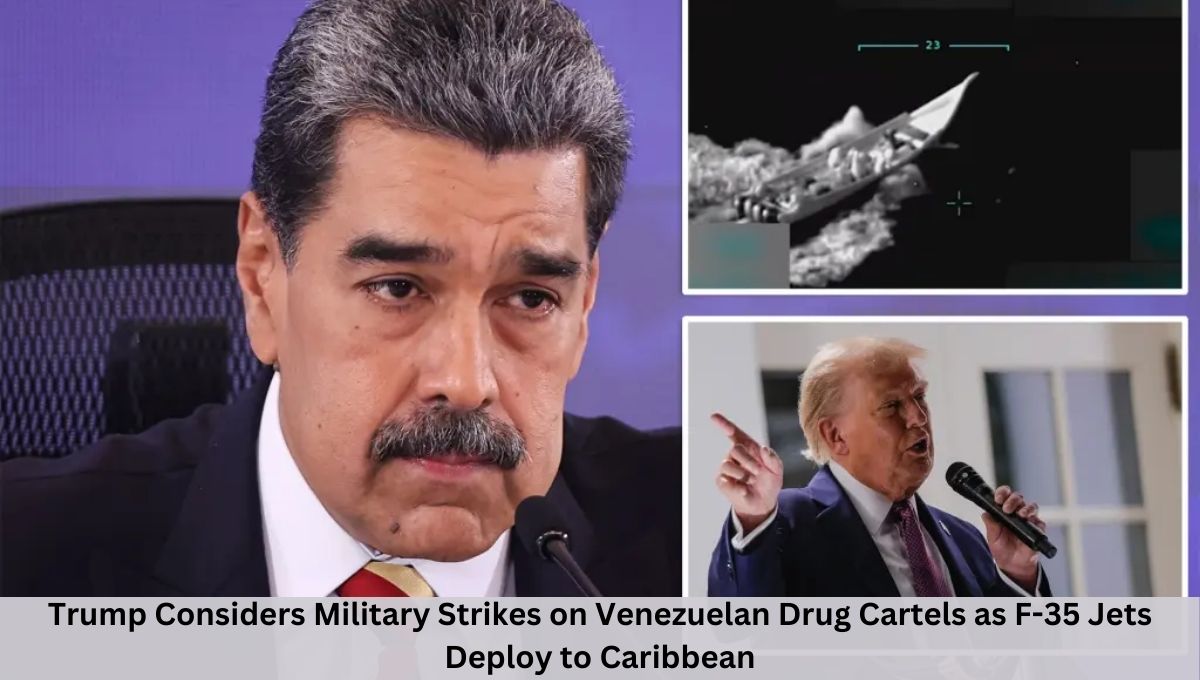
Trump Considers Military Strikes on Venezuelan Drug Cartels as F-35 Jets Deploy to Caribbean, intensifying pressure on President Nicolás Maduro. The United States is once again at the center of a Latin American crisis. Reports from CNN, AP, and other outlets suggest that President Donald Trump is seriously considering military strikes against drug cartels operating inside Venezuela.
The development follows a dramatic U.S. strike on a Venezuelan speedboat earlier this week, in which 11 people were killed, and a major escalation of American military deployments in the Caribbean.
The situation has triggered alarm across the Western Hemisphere. While the Trump administration frames the escalation as part of a broader counter-narcotics campaign, critics argue that Washington’s moves appear designed to intensify pressure on Venezuelan President Nicolás Maduro possibly edging toward regime change.
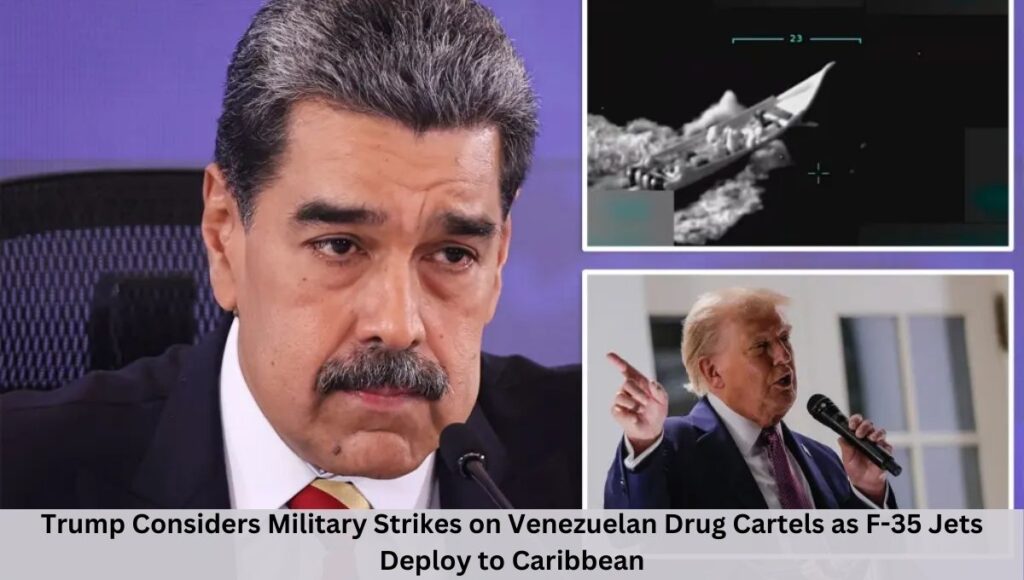
Trump Considers Military Strikes on Venezuelan Drug Cartels as F-35 Jets Deploy to Caribbean
U.S. Strike on Venezuelan Boat: A Catalyst for Escalation
The immediate spark came from a U.S. strike in the southern Caribbean, which destroyed a speedboat allegedly linked to Venezuela’s Tren de Aragua gang. The attack killed 11 people, marking one of the most direct U.S. military actions in Latin America in years.
Trump defended the decision, citing America’s worsening opioid and fentanyl crisis. More than 300,000 overdose deaths in recent years, he said, should be treated as wartime casualties.
“Think if you’re in a war and you lose 300,000 … We’re not going to allow it to happen,” Trump told reporters.
Caracas, however, denounced the strike as an “extrajudicial killing”, accusing Washington of fabricating evidence to justify aggression. Maduro’s government maintains that the victims were civilians and insists that Venezuela plays only a minor role in global narcotics trafficking.
Also Read: Can US strikes on suspected drug boats off Venezuela be legally justified?
Trump Issues Warning: Venezuelan Jets Risk Being Shot Down
Tensions escalated further when two Venezuelan F-16 fighter jets approached the USS Jason Dunham, a U.S. Navy destroyer patrolling Caribbean waters. The Pentagon called the maneuver “highly provocative”.
Trump wasted no time in issuing a blunt warning:
“If they put us in a dangerous position, they’ll be shot down.”
The president added that he had given his generals full authority to respond, making clear that Venezuelan aircraft threatening U.S. ships would face immediate retaliation.
The U.S. Military Build-Up: A Show of Force in the Caribbean
The scope of Washington’s military deployments near Venezuela is striking. According to Pentagon briefings and media reports, the U.S. presence includes:
- 10 F-35 stealth fighter jets deployed to Puerto Rico for counter-cartel missions.
- At least seven U.S. Navy warships, including destroyers USS Jason Dunham and USS Gravely, as well as the cruiser USS Lake Erie.
- Three amphibious assault ships USS Iwo Jima, USS San Antonio, and USS Fort Lauderdale carrying over 4,500 Marines and sailors.
- A nuclear-powered fast-attack submarine, armed with Tomahawk missiles, positioned off Venezuela’s coast.
- U.S. Marines from the 22nd Marine Expeditionary Unit conducting amphibious landing exercises in Puerto Rico.
The Pentagon insists the deployments are part of a counter-narcotics operation. Yet the size of the build-up one of the largest in years has fueled speculation about whether regime change could be the hidden objective.
Trump Denies Regime Change Plans But Raises Questions
When asked if Washington’s goal was to remove Maduro, Trump replied:
“We’re not talking about that. But we are talking about the fact that Venezuela had an election, which was a very strange election, to put it mildly.”
The comment referred to Venezuela’s 2024 presidential election, which Maduro claims he won but which opposition groups and many foreign observers denounced as fraudulent.
While Trump denied seeking regime change, his administration doubled the reward for Maduro’s capture to $50 million and accused him of heading a narco-terrorist cartel.
This contradiction denying invasion while escalating militarily has left analysts and regional leaders wary.
Maduro’s Response: Calls for Dialogue, Warns of War
In a nationally broadcast address, Venezuelan President Nicolás Maduro urged Washington to step back from confrontation:
“None of the differences we have and have had can lead to a military conflict. It has no justification.”
Maduro rejected U.S. allegations of drug trafficking, noting that Venezuela produces no coca leaf and is not a major cocaine-processing hub like Colombia.
He accused Washington of recycling old Cold War tactics, replacing anti-communist rhetoric with narco-terrorism charges as a pretext for intervention.
Despite his appeals for dialogue, Maduro mobilized the Venezuelan military (340,000 soldiers) along with eight million reservists and militia members. He warned that any U.S. attack would trigger an “armed struggle”.
Also Read: Trump Doubles Maduro Bounty to $50 Million Amid Drug Trafficking Charges
The Legal Controversy: Congress Kept in the Dark
The strike on the Venezuelan boat has sparked controversy in Washington. A scheduled Congressional briefing was abruptly canceled, leaving lawmakers without details on the legal basis for military action.
Later, the White House sent a letter to House Speaker Mike Johnson and Senate President Pro Tempore Chuck Grassley, arguing that Trump acted within his constitutional authority as commander-in-chief.
The letter, however, admitted that:
“It is not possible at this time to know the full scope and duration of military operations that will be necessary.”
Critics argue that without evidence linking the boat to drug cartels, the strike could be a violation of international law.
Marco Rubio: Leading the Charge Against Maduro
One of the most vocal figures in this campaign is Senator Marco Rubio, who has long advocated a hardline stance on Venezuela.
Rubio was the first official to disclose details about the boat strike, stating:
“Instead of interdicting it, on the president’s orders, we blew it up. And it’ll happen again. Maybe it’s happening right now.”
He has consistently portrayed Maduro as a fugitive drug trafficker and argued that designating cartels as terrorist organizations gives Washington full legal authority to use military force.
Rubio has even dismissed UN reports that downplay Venezuela’s role in the cocaine trade, calling them “fake reporting”.
Venezuela’s Role in the Drug Trade: A Disputed Narrative
The debate over Venezuela’s role in the narcotics trade remains contentious.
- UN reports suggest Venezuela plays only a minimal role in global cocaine trafficking.
- Experts argue that while Venezuela does not produce cocaine, it functions as a transit hub for Colombian shipments heading to the U.S. and Europe.
- U.S. officials claim that Tren de Aragua and corrupt Venezuelan security forces profit from smuggling routes.
- Maduro’s critics say illegal gold mining and contraband also sustain parallel economies that help keep his government afloat.
Despite this, many analysts question whether Washington is inflating Venezuela’s importance in the drug trade to justify broader intervention.
Opposition Leaders Praise Trump’s Hardline
Venezuelan opposition figures, especially María Corina Machado, have applauded Washington’s stance.
Machado, speaking to U.S. media, thanked Trump for “taking the right approach with courage and clarity.” She described Maduro’s government as a criminal enterprise and said U.S. pressure would help bring about change.
On social media, she mocked the government’s militia recruitment efforts, posting photos of empty squares and claiming citizens had “disobeyed” by refusing to enlist.
Still, some observers warn that opposition leaders risk raising false hopes of imminent U.S. military intervention, a tactic that has failed before and could deepen public disillusionment.
Trump’s “Green Light” Doctrine: Terrorists as Combatants
According to CNN sources, Trump has given the military “green light” authority to treat cartel members as enemy combatants rather than criminals.
This policy blurs the line between law enforcement and counterterrorism, effectively militarizing the war on drugs.
While supporters argue this allows the U.S. to act decisively against cartels, critics warn it could lead to extrajudicial killings, undermine international law, and provoke direct clashes with Venezuelan forces.
Regional and Global Stakes
The crisis is not limited to Venezuela. Analysts warn that a U.S. military campaign could have ripple effects across Latin America and beyond.
- Russia, China, and Iran maintain close ties with Caracas, supplying economic aid, arms, and technology. Any U.S. escalation risks sparking a new proxy conflict in the region.
- Caribbean and South American neighbors are deeply concerned. Countries like Colombia and Brazil are wary of instability spilling across borders.
- The United Nations has urged both sides to exercise restraint and respect sovereignty.
For ordinary Venezuelans, the specter of conflict adds to an already dire reality of economic collapse, food shortages, and mass migration.
Conclusion: A Dangerous Moment in U.S.-Venezuela Relations
President Donald Trump’s weighing of military strikes on Venezuelan cartels represents one of the most dramatic escalations in U.S.-Venezuela relations in years.
While the administration insists the goal is counter-narcotics enforcement, the scale of the military build-up, the political framing of Maduro as a narco-terrorist, and the history of U.S. interventions in Latin America suggest a broader strategy at play.
For now, Trump continues to deny plans for regime change but with warships, F-35 jets, and thousands of Marines on Venezuela’s doorstep, the world is watching closely to see whether Washington’s “maximum pressure” campaign crosses the line into outright military confrontation.