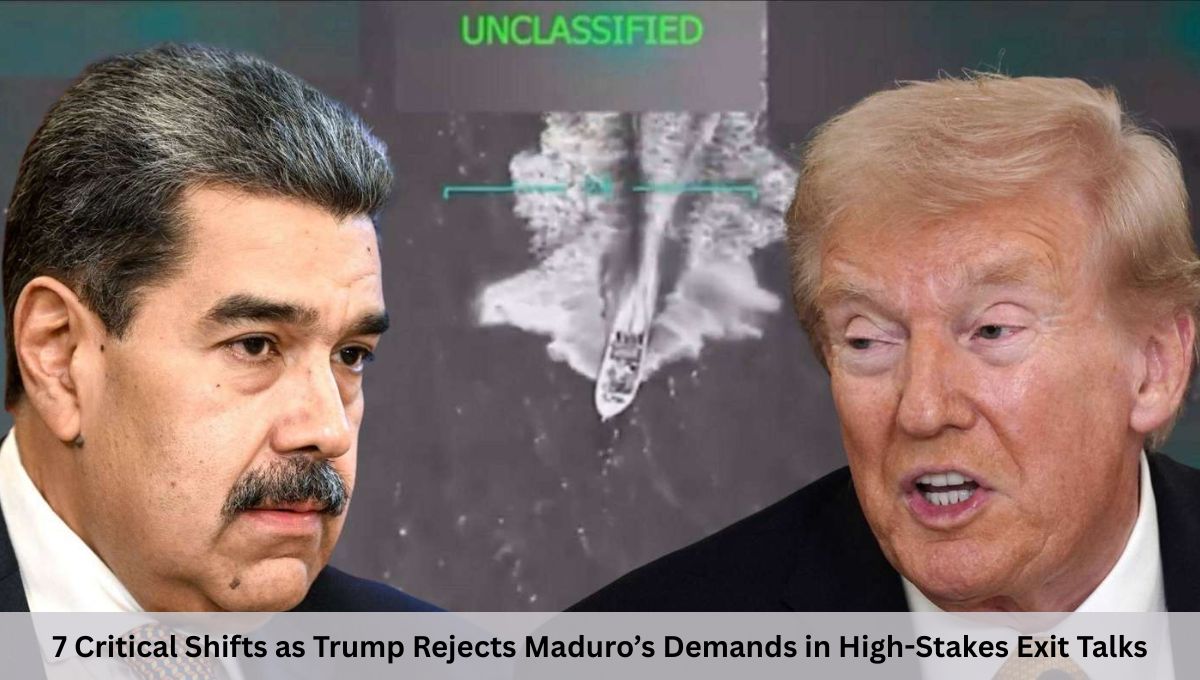
7 Critical Shifts as Trump Rejects Maduro’s Demands in High-Stakes Exit Talks for immunity and sweeping sanctions relief. Venezuela’s political crisis has entered one of its most volatile phases in years after reports surfaced that President Nicolás Maduro sought a US-guaranteed safe exit—only to be rebuffed by President Donald Trump during a brief and tense phone call.
According to Reuters and multiple US media outlets, the call lasted under 15 minutes and ended with Washington rejecting nearly all of Maduro’s demands, including legal immunity, sanctions relief, and protection for more than 100 officials in his government.
The fallout has been enormous: airspace closures, intensified US military posturing, renewed scrutiny of lethal anti-drug operations in the Caribbean, and rising fears that the ongoing confrontation may escalate into a regional flashpoint.
The crisis deepened further after Trump warned of potential “very soon” US strikes targeting Venezuelan territories tied to the long-running border dispute with Guyana. This article examines the dramatic developments, the political and military implications, and why Washington and Caracas are now closer than ever to a dangerous tipping point.
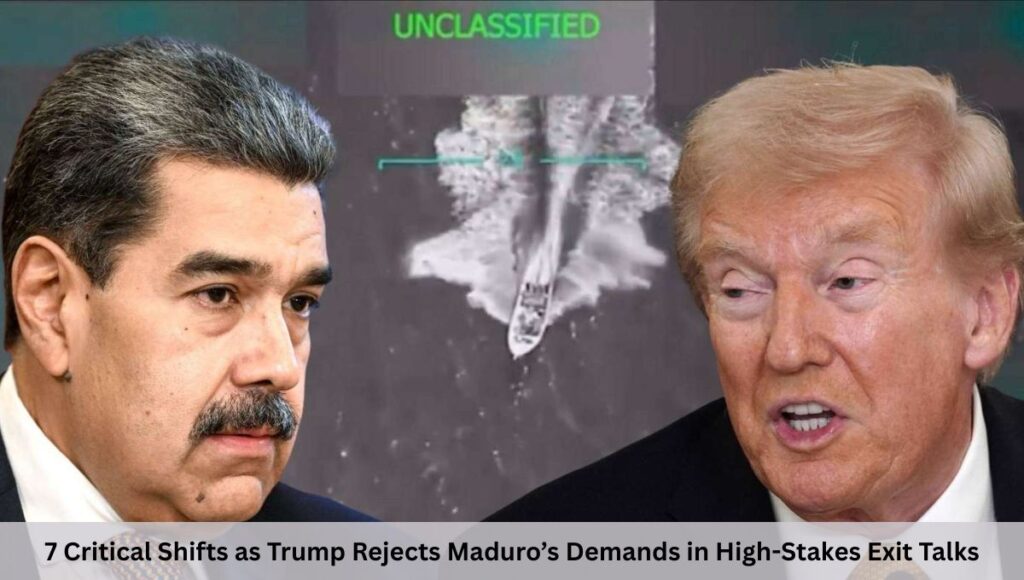
7 Critical Shifts as Trump Rejects Maduro’s Demands in High-Stakes Exit Talks
Maduro’s Secret Call to Trump: A Last Attempt at Survival
According to Reuters, Maduro and Trump spoke in a call last month that caught both Caracas and Washington observers by surprise. The Venezuelan leader reportedly expressed willingness to step down and leave the country, but only under extremely favorable terms.
Maduro’s reported requests included:
- Full legal immunity for himself and his family
- Complete lifting of US sanctions
- Protection for over 100 Venezuelan officials accused by Washington of corruption, narcotics trafficking, and human rights abuses
- Closure of his case before the International Criminal Court
- A proposal that Vice President Delcy Rodríguez oversee an interim government ahead of new elections
Trump reportedly rejected nearly all of these conditions, offering instead a one-week window for Maduro to leave Venezuela “to a destination of his choice.” That deadline expired on Friday.
The very next day, Trump declared Venezuela’s airspace “closed in its entirety,” a move that blindsided Caracas and triggered widespread speculation about imminent military action.
While Trump acknowledged the call publicly on Sunday, he refused to provide details. The White House has also remained silent, adding to the uncertainty.
The failed call comes amid a months-long US pressure campaign targeting Maduro’s inner circle and alleged narcotics networks.
21 strikes on suspected drug-smuggling vessels
Since September, US forces have carried out at least 21 strikes on alleged drug-smuggling boats linked by American officials to the Cartel de los Soles, a shadowy network that Washington designated a foreign terrorist organization. The attacks have killed more than 83 people, raising legal and ethical concerns in the US Congress and among international law experts.
Massive bounties for Maduro and top Venezuelan officials
The US has placed:
- $50 million bounty for information leading to Maduro’s arrest
- $25 million rewards for senior allies, including Diosdado Cabello
All accused have denied involvement in drug trafficking.
A message of absolute loyalty
As news of the call broke, Maduro appeared outside Miraflores Palace with loyalists Cilia Flores and Cabello, telling supporters:
“Absolute loyalty at the cost of my own life. I will never fail you.”
His defiant speech underscored the regime’s unease—and its determination to resist.
Trump’s National Security Meeting Raises Alarms
On Monday, Trump convened a high-level Oval Office meeting with top advisers, including:
- Secretary of State Marco Rubio
- Pentagon chief Pete Hegseth
- Chairman of the Joint Chiefs General Dan Caine
The agenda reportedly included “next steps on Venezuela,” intensifying fears that the administration may be preparing a major escalation.
While no details were released, the timing—just days after Trump’s surprise airspace closure and warnings of potential land operations—has fueled speculation among analysts and foreign governments.
Confusion Over Airspace Closure: Pre-Invasion Indicator or Messaging Tactic?
Trump’s abrupt assertion that Venezuela’s airspace should be considered “closed in its entirety” prompted widespread confusion even within the Pentagon, which reportedly was not informed ahead of time.
Airspace closures are often associated with:
- No-fly zones
- Pre-strike positioning
- Escort operations
- Ground invasions
When asked to clarify, Trump insisted that observers should not “read anything into it”—a statement that did little to calm speculation.
Washington-based analysts have interpreted the move in two possible ways:
1. A pressure tactic to force Maduro to flee
By closing airspace, Trump may be attempting to corner the Venezuelan leader, limiting escape routes and intensifying diplomatic and psychological pressure.
2. A prelude to potential military action
Others warn that the closure mirrors historical patterns preceding airstrikes, particularly given Trump’s public threats and the ongoing naval buildup.
The US military presence in the Caribbean has surged dramatically. According to Al Jazeera, approximately 15,000 US personnel are now stationed in the region.
Deployed assets reportedly include:
- USS Gerald R. Ford, the world’s largest aircraft carrier
- USS Winston S. Churchill
- USS Bainbridge
- Supporting destroyers, logistics vessels, and surveillance aircraft
These assets are positioned near Puerto Rico, which has become a key staging ground for US operations.
Why the buildup matters
Naval deployments of this scale are rarely symbolic. They serve multiple purposes:
- Power projection
- Interdiction of alleged narcotics routes
- Deterrence against foreign actors (Russia, Iran)
- Preparation for potential ground operations
The Pentagon has also hinted at cyber operations targeting PDVSA, Venezuela’s state-owned oil giant.
Debate Over “Kill Orders” and the Legal Status of Anti-Drug Strikes
The Biden and Trump administrations alike have faced criticism for US maritime strikes against alleged Venezuelan drug traffickers. But a Washington Post and CNN report last week triggered new scrutiny, alleging that Defense Secretary Pete Hegseth issued a verbal order to “kill all people” aboard a suspected smuggling vessel. Two survivors reportedly triggered a “follow-on strike” to eliminate the remaining individuals.
Were these orders legal?
Legal experts are divided:
- Some argue the US is not in an active armed conflict with Venezuela, making lethal strikes illegal.
- Others claim “narco-terrorism” falls under transnational threats that justify military action.
- A group of former military lawyers warned the orders, “if true,” could constitute war crimes.
Hegseth has denied issuing a kill order, and Trump backed him, saying:
“He did not say that, and I believe him 100 percent.”
The White House later confirmed the second strike occurred under Admiral Frank Bradley’s authority, calling it an act of self-defence.
Maduro Retaliates: Border Mobilization and Asymmetric Warfare Threats
As tensions intensified, Maduro mobilized 150,000 troops along Venezuela’s border regions and issued fierce warnings.
He accused Trump of pursuing:
- Regime change
- Imperialist aggression
- Attempts to seize Venezuela’s 5.5 million barrels per day in oil reserves
Russian President Vladimir Putin reportedly offered “unlimited support” during a call, while China urged restraint to protect its $60 billion in loans.
The Orinoco Belt and Essequibo: A New Flashpoint?
The most explosive development came when Trump threatened “very soon” US strikes tied to the Orinoco Belt and Venezuela’s territorial claims over Guyana’s Essequibo region.
Why Essequibo matters:
- It spans 100,000 square kilometers
- Rich in minerals, water, and timber
- Home to ExxonMobil’s $55 billion Stabroek Block
- Guyana administers it; Venezuela claims it
Maduro’s 2023 referendum endorsing annexation reignited the decades-old dispute, which Trump has framed as a “socialist land grab.”
Trump’s Mar-a-Lago threat
In a fiery speech flanked by maps, he said:
“If Maduro doesn’t hand over those fields… we’ll take them. Boots on the ground. Strikes from the air. Whatever it takes.”
The comments sent shockwaves through Latin America.
Regional Reaction: Fears of a 2026 Flashpoint
Brazil and Colombia have urged de-escalation through the Organization of American States, fearing a conflict that could destabilize the region.
Analysts warn:
- A US invasion could mirror Iraq 2003
- Costs could exceed $100 billion
- Instability could spill across borders
- US–Brazil and US–Colombia ties could suffer
The crisis is now viewed as one of the most dangerous geopolitical escalations in the Western Hemisphere in decades.
What Happens Next? Three Possible Scenarios
Scenario 1: Maduro Flees
Given the pressure, Maduro could attempt to negotiate modified exit terms—possibly through intermediaries like Turkey, China, or Mexico.
Scenario 2: Limited US Strikes
Washington may target:
- Cartel de los Soles infrastructure
- PDVSA facilities
- Border troop positions
- Maritime smuggling lanes
Scenario 3: Full-Scale Military Intervention
Considered unlikely but increasingly discussed, especially after Trump’s Mar-a-Lago remarks and naval deployments.
Conclusion: A Crisis Entering Its Most Dangerous Phase
The breakdown of the Trump–Maduro call has set off a chain reaction that now threatens Venezuela, Guyana, the Caribbean, and broader US–Latin American relations.
Between airspace closures, military buildups, controversial strikes, and explosive threats over the Orinoco Belt, the crisis has reached a point where any miscalculation could trigger regional conflict.
While diplomatic options remain, time appears to be running out—and the world is watching.
Also Read: 7 Critical Revelations in the Venezuela Boat Strike Scandal
Also Read: Trump Rejected Maduro Requests on Call, Options Narrow for Venezuela Leader, Sources Say
Related Posts:
- 11 Explosive Revelations From Ted Cruz’s Leaked…
- 5 Major Takeaways from the US Supreme Court's…

- 5 Powerful Highlights as Trump Lands Second Nobel…

- Can the EU and NATO Impose Tariffs on India and…

- Trump’s 20-Point Gaza Peace Plan Gains Urgent Global…

- 7 Heartbreaking Facts About Venezuela's Earthquake Disaster