7 Powerful Revelations from New Ukraine Peace Talks with Putin that could shape the next phase of diplomacy. The most recent diplomatic push to end the Russia-Ukraine war has produced one of the most complex and contradictory moments since the full-scale invasion began. With United States envoys Steve Witkoff and Jared Kushner spending five hours behind closed doors with Russian President Vladimir Putin in Moscow, expectations surged that a breakthrough might be possible.
But the signals emerging from Washington, Moscow and Kyiv paint a far more nuanced—and troubling—picture. While Donald Trump says Putin “would like to end the war,” the Kremlin insists “no compromise” has been found. Ukraine acknowledges “positive significance” but warns that peace requires pressure on Moscow. NATO leaders stress long-term commitment.
And European allies argue that Putin has “no intention of stopping the war.” These mixed messages raise an essential question: What do the latest Ukraine talks reveal about Putin’s state of mind, his intentions, and the future of the conflict? Drawing on the statements, reactions, and strategic behavior of all sides, this article explores seven key revelations that define the current diplomatic landscape—and why a durable peace remains elusive.
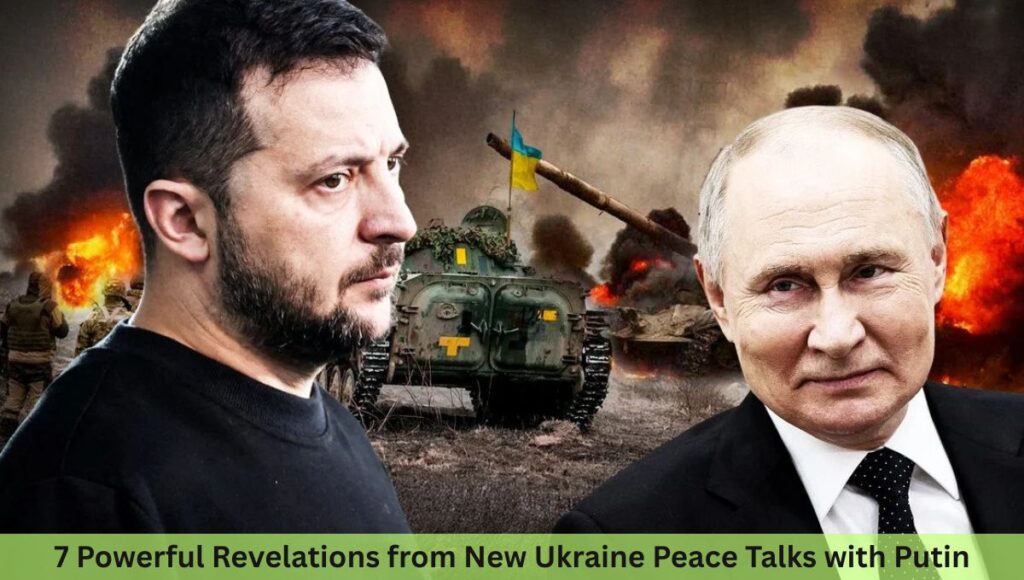
7 Powerful Revelations from New Ukraine Peace Talks with Putin
1. Putin Is Not Ready to Sign a Peace Deal — At Least Not Yet
Throughout the recent communications from the Kremlin, one theme stands out: Putin is not prepared to accept any of the proposals on the table.
Kremlin foreign policy aide Yuri Ushakov, speaking after the five-hour meeting with the US envoys, put it bluntly:
“No compromise version has yet been found.”
This was no surprise.
For weeks before the meeting, Putin had intensified his public rhetoric:
- Accusing the Ukrainian government of being a “thieving junta”
- Claiming Russia is “driving the initiative” on the battlefield
- Wearing military fatigues and appearing on state TV with frontline maps
- Celebrating alleged military gains that Ukraine and Western agencies dispute
These optics, familiar in Putin’s political style, are meant to project strength and inevitability. Nearly four years into the full-scale invasion, Putin still believes—or wants the world to believe—that time is on his side.
The Kremlin narrative is clear:
- Russia can absorb losses
- Russia can outlast Ukraine
- Russia can outmaneuver the West
- Russia can dictate conditions
This belief remains central to Putin’s refusal to budge on two issues:
- Territory Russia has captured
- Ukraine’s future relationship with NATO
Until those red lines are softened, the Kremlin sees no reason to agree to a peace deal that would jeopardize what it views as strategic victories. Even though Russia faces growing economic pressures, Putin continues to appear confident that the war is sustainable—at least in the short to medium term.
2. The Economic Strain on Russia Is Real—but Not Enough to Force Putin’s Hand
One of the more revealing comments from Putin in recent weeks concerned the Russian economy:
“In several sectors, production output… actually decreased. Are we satisfied with such trends? No.”
Despite sanctions, Russia is still financing its war effort. But pressure is clear:
- Declining oil and gas revenues
- A rising budget deficit
- A dependence on wartime production for GDP
- Labor shortages due to mobilization and emigration
Yet none of this has pushed Putin toward compromise.
The Kremlin keeps the domestic narrative tightly controlled. In public appearances, Putin insists that:
- Russia remains economically resilient
- The West is weakening
- Time will force Ukraine to fold
- Nothing threatens Russia’s overall strategy
Behind closed doors, however, his own officials admit to “imbalances” and shrinking output.
So why doesn’t economic pressure shift the Kremlin’s approach?
Because Putin calculates that:
- He can manage domestic discontent
- He can continue financing the war
- He can exploit uncertainty in Western politics
- He can leverage Trump’s desire for a deal
Until those conditions change, economics alone won’t compel a Russian retreat.
3. Trump’s Envoys Returned Convinced Putin “Wants to Make a Deal”—But the Kremlin Isn’t Acting Like It
From Washington, the tone was noticeably different.
Donald Trump said Steve Witkoff and Jared Kushner gave him one clear impression from Moscow:
“Putin would like to make a deal.”
According to Trump:
- Putin wants to end a costly war
- He wants to restore trade relations
- He wants to normalize ties with the US
- He wants to reduce battlefield casualties
Trump described the meeting as “very good” and “reasonably successful.”
But he was also careful to add:
“It does take two to tango.”
This acknowledgment matters.
Because while Trump interprets the meeting as showing Russian willingness, the Kremlin not only denies compromise—it seems almost irritated by the US push. In fact, Putin appeared to relish the fact that the US was the one knocking on his door, not the other way around.
Why the US and Russian Readouts Sound So Different
The conflicting interpretations stem from strategic motives:
For Trump:
- Demonstrating diplomatic progress strengthens his leadership image
- Advancing an “America-led peace” bolsters US influence
- Forcing Ukraine toward concessions helps deliver a quick result
- Presenting Putin as open to negotiation makes Trump look uniquely capable
For Putin:
- Appearing sought-after boosts his prestige
- Rejecting compromise shows resolve
- Maintaining ambiguity keeps Trump invested
- Avoiding concessions pressures Ukraine
- Every delay strengthens Moscow’s leverage
Thus, while Washington hears an opening, Moscow broadcasts resistance. The truth likely lies somewhere in between.
4. Ukraine Is Guardedly Optimistic—but Increasingly Anxious
Ukraine’s Foreign Minister Andrii Sybiha confirmed that US envoy Steve Witkoff briefed Ukraine’s negotiating team after the Moscow talks.
He called the US assessment “positive”, but noted:
- Details are withheld for security reasons
- Kyiv remains cautious
- Ukraine’s red lines remain intact
President Volodymyr Zelenskyy said diplomacy must be paired with pressure:
“A dignified peace is only possible if Ukraine’s interests are taken into account.”
He emphasized that Ukraine will not accept:
- Loss of sovereign territory
- A deal signed behind its back
- Compromise on long-term security guarantees
Despite some private speculation that Kyiv may be discussing land-swap scenarios, Zelenskyy’s public message is unwavering:
“Peace depends on Ukraine’s interests.”
But Ukraine is also facing major pressures:
- A shortage of manpower
- Front-line casualties
- Falling Western ammunition supplies
- Political infighting in Kyiv
- Deteriorating energy infrastructure
- Fatigue after nearly four years of war
- A sense that Western attention is shifting
And there is one deeper concern:
Trump’s unpredictability itself affects morale.
For 11 months, Ukrainian leaders have been dealing not just with battlefield threats—but with uncertainty from Washington. Kyiv fears being pressured into accepting a bad deal. Even more alarming is the possibility that Trump could lose interest and disengage altogether.
5. NATO Warns That Putin Is “Wrong”—the Alliance Isn’t Going Anywhere
During a meeting in Brussels, NATO leaders voiced strong support for continued aid to Ukraine.
Secretary General Mark Rutte issued a direct warning:
“Putin is wrong to think he can outlast NATO.”
Rutte added:
- Two-thirds of allies have committed to new weapons shipments worth $4 billion
- NATO remains united
- Ukraine will not be abandoned
But Europe’s internal divide is widening.
Hungary’s Foreign Minister Péter Szijjártó condemned NATO’s approach:
“A brutal war fanaticism has gripped European members of NATO.”
He insisted Hungary will send no weapons or funds to Ukraine and accused the alliance of sabotaging Trump’s peace efforts. This split is exactly what Putin has long sought. And he may interpret European disunity as further incentive to delay a deal.
6. Ukraine’s NATO Membership Was a “Key Question”—and Remains a Dealbreaker
Yury Ushakov confirmed that Ukraine’s desire to join NATO was a central topic in the Moscow talks.
The Kremlin’s stance remains:
- Ukraine must never join NATO
- The issue is non-negotiable
Kyiv’s stance remains:
- Ukraine needs NATO to protect itself
- Security guarantees must be ironclad
This is the same impasse that has stalled negotiations since the invasion began. The US delegation reportedly discussed ways to address Russia’s objections—but both sides remain far apart. This single issue may be harder to resolve than territory.
7. Putin Sees Strategic Advantage in Delaying—Not Concluding—Diplomacy
Putin’s mindset at this moment appears driven by several strategic calculations:
He believes he is winning—slowly, but surely.
Even small battlefield gains reinforce Russian messaging.
He sees Ukraine weakened—militarily, economically, psychologically.
Kyiv’s struggles fuel Putin’s confidence.
He sees Trump eager for a deal, and Europe divided.
This strengthens Moscow’s negotiating leverage.
He sees time as a weapon.
Every month that passes wears down Ukraine and tests Western unity.
He views war, not peace, as the best path to retaining power.
Putin’s political system is built on wartime mobilization and nationalistic fervor.
He enjoys the optics of American envoys pleading for compromise.
This plays into his long-held ambition to appear the equal—or even the superior—of the United States.
Thus, for Putin, delaying diplomacy may be more beneficial than concluding it.
What Happens Next? Key Scenarios
The coming months will depend heavily on the interplay between:
- Trump’s next decision
- Ukraine’s military resilience
- NATO’s unity
- Russia’s battlefield momentum
- Economic strain inside Russia
- Domestic politics in Ukraine and Europe
Scenario 1 — Trump Pushes Harder and Pressures Ukraine
This could accelerate talks, but risks:
- Weakening Ukraine’s negotiating position
- Encouraging Russian intransigence
- Creating a deal that collapses later
Scenario 2 — Trump Steps Back If Progress Stalls
This is Kyiv’s biggest fear.
If Washington disengages:
- Ukraine would face enormous battlefield challenges
- Russia might push aggressively
- European aid may not be enough
Scenario 3 — The War Enters a New Phase of Stalemate
This is currently the most likely scenario. Moscow, Kyiv, and Washington may continue maneuvering diplomatically without breakthrough—but also without major shifts in the war.
Conclusion — A Peace Deal Remains Distant, Despite High-Level Talks
The latest round of Ukraine peace diplomacy is neither a breakthrough nor a collapse. Instead, it is a revealing snapshot of the geopolitical realities shaping the conflict.
Putin signals strength.
He shows no willingness to compromise on territory or NATO.
Trump signals optimism.
He believes a deal is possible—but also admits that the outcome is uncertain.
Zelenskyy signals resolve.
He remains committed to defending Ukraine’s interests, even under immense pressure.
NATO signals endurance.
It promises long-term support, though internal divisions persist.
Russia signals patience.
Putin is content to delay, believing time benefits his strategy.
These dynamics mean that a meaningful, durable peace is still far away. Diplomacy will continue—but under conditions shaped not by goodwill or trust, but by pressure, leverage, and strategic calculation.
For Ukraine, the stakes remain existential.
For Russia, the war remains a tool of power.
For Trump, it is a test of leadership and influence.
For Europe, it is a battle for security and unity.
And for the world, the path to peace remains uncertain—defined by ambition, fear, calculation, and the unpredictable moves of leaders whose interests rarely align.
Also Read: 7 Striking Developments: Russia–US Talks on Ukraine End With ‘No Compromise’
Also Read: Why Putin won’t agree to latest Ukraine peace plan