

7 Striking Developments: Russia–US Talks on Ukraine End With ‘No Compromise’ over territorial control. High-stakes diplomacy between Russia and the United States has once again failed to deliver a breakthrough, with a senior Kremlin official confirming that “no compromise” was reached on the core issue of Ukrainian territorial control.
The stalled talks underscore just how far apart Moscow and Washington remain as the war enters its fourth year, even as both sides engage in the most serious dialogue since the conflict began. The discussions, held late Tuesday in Moscow, came at a moment of intense geopolitical tension, with Russian President Vladimir Putin warning that Russia is “ready” for war if Europe “wants one.”
The comments set a combative tone just hours before the arrival of US envoys Steve Witkoff and Jared Kushner, dispatched by President Donald Trump as part of Washington’s effort to finalize a peace plan.
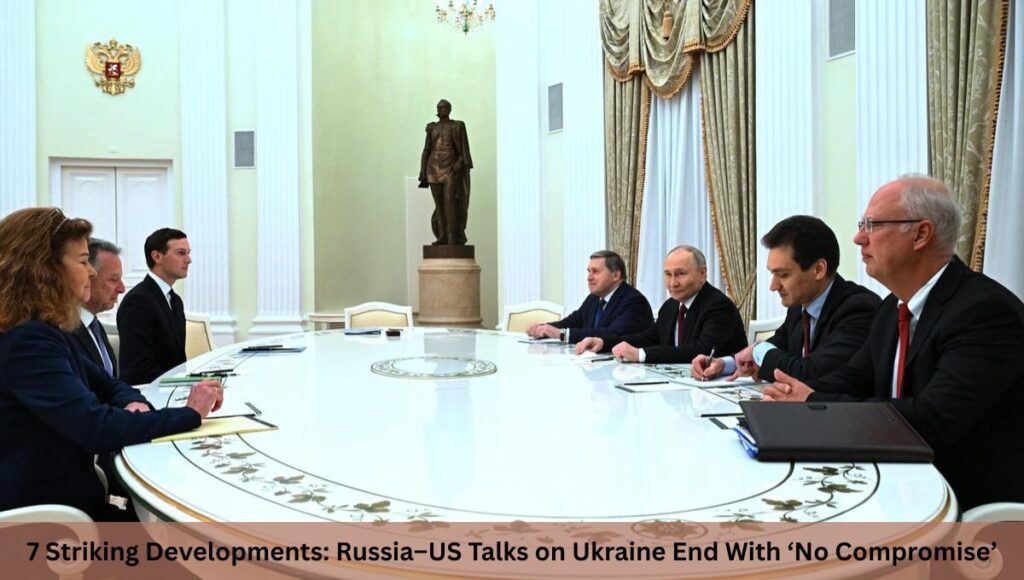
7 Striking Developments: Russia–US Talks on Ukraine End With ‘No Compromise’
No Compromise on Territory After Five-Hour Moscow Talks
The meeting lasted almost five hours—stretching past midnight—and was described by Kremlin foreign policy advisor Yury Ushakov as “very useful and constructive.” Yet despite the extended length and unusually high-level attendance, the Kremlin made clear that the central issue dividing the two sides remains unresolved.
Territory at Core of Stalemate
Ushakov said bluntly:
“So far, we haven’t found a compromise.”
The sticking point:
Russia insists on recognition of its control over Ukrainian territory—including parts of Donbas, Zaporizhia, and Kherson—while the US and Ukraine reject any territorial concessions.
Though the US delegation presented updated proposals, Ushakov said only “some American solutions” are acceptable and many still “do not suit us.”
US Peace Plan Faces Resistance From All Sides
The Moscow talks follow weeks of back-channel diplomacy. A US peace plan leaked earlier—a 28-point proposal—faced strong criticism from Ukraine and its European allies, who argued it made excessive concessions to Russia. European officials reportedly pushed for major revisions.
Washington then updated the proposal after talks with a Ukrainian delegation in Geneva, making it “more palatable to Kyiv,” according to European diplomats.
European Amendments Trigger Putin’s Fury
Ahead of the US delegation’s arrival in Moscow, Putin accused European governments of trying to sabotage American attempts to end the war:
“They are on the side of war. Their changes are aimed at blocking the entire peace process.”
He claimed that European leaders were presenting demands “absolutely unacceptable to Russia,” particularly on territorial issues and Ukraine’s relations with NATO.
Putin Warns Europe: ‘We Are Ready for War’
In some of his starkest rhetoric in months, Putin declared:
“We are not planning to go to war with Europe. But if Europe wants to and starts, we are ready right now.”
The Russian president also signaled a harsher military posture, saying Russia would increase attacks on Ukrainian ports, ships, and tankers supporting Kyiv’s supply lines. The comments appeared designed to send a message to both NATO and the American negotiators.
Kremlin Frustrated as War Expands
Russia claims Ukrainian allies are prolonging the war by discouraging concessions and providing Kyiv with weapons. Meanwhile, Russia has captured more ground in 2025 than in any year since its 2022 invasion, now controlling over 19% of Ukraine, according to analytical maps cited by Reuters.
The Kremlin believes this strengthened military position should reflect in any peace arrangement.
Ukraine Rejects Concessions: ‘Territorial Integrity Non-Negotiable’
Ukrainian officials responded sharply to Putin’s remarks and the stalled talks.
Foreign Minister Andrii Sybiha said:
“It is clear Putin does not want the war to end. Yesterday he said he would fight through winter. Today he threatens ports and navigation.”
President Volodymyr Zelenskyy, speaking in Dublin, said only a “dignified peace” is acceptable and warned of Western fatigue:
“It’s the goal of Russia to withdraw America’s interest from this situation.”
Kyiv maintains that any peace deal requiring territorial surrender would be a “capitulation,” and Zelenskyy reiterated that protecting Ukraine’s sovereignty is the “biggest challenge” in negotiations.
Washington Remains Hopeful, But Admits Difficulty
Though the US did not immediately comment after the Moscow talks, the White House previously signaled optimism. Press secretary Karoline Leavitt said the administration was “very optimistic” heading into the meeting.
President Trump, however, acknowledged the complexity:
“Not an easy situation. What a mess.”
US officials reportedly hope the Moscow discussions will lead to a second stage of talks with Ukraine—possibly within days and potentially in Brussels.Trump’s envoys Witkoff and Kushner may meet Ukrainian representatives as early as Wednesday, according to Kyiv sources.
Kremlin Demands: NATO, Donbas, and the ‘Initial Causes’ of War
Russia insists that any peace deal must address what it calls the “initial causes” of the conflict. Historically, these demands include:
- A halt to NATO expansion, especially into Ukraine.
- Recognition of Russia’s control over annexed Ukrainian regions.
- Restrictions on Ukraine’s military size and armament.
- Neutrality guarantees preventing a future Kyiv–NATO alliance.
A senior NATO official said there is “no indication” Russia is prepared to make “meaningful concessions,” reiterating that Moscow seeks to ensure Ukraine remains militarily weakened.
Symbolic Diplomacy: Envoys Spotted at Red Square
Ahead of the talks, Russian media filmed Steve Witkoff, Jared Kushner, and Kremlin representative Kirill Dmitriev walking through Moscow’s Red Square. The footage circulated widely, showcasing the unusual diplomatic pairing.
Witkoff and Dmitriev were later seen lunching at a Michelin-starred restaurant, dining on caviar, quail, venison, and crab, according to reports. The optics highlighted the mix of political symbolism and informal diplomacy surrounding the effort.
Russia Claims New Territorial Gains; Ukraine Denies
As negotiations unfolded, Russia announced it had captured Pokrovsk, a “city of special significance” in the Donbas region. Kyiv immediately denied the claim, accusing Moscow of trying to project an illusion of unstoppable momentum.
Putin said:
“From this base, the Russian army can easily advance in any direction the General Staff deems promising.”
These statements appeared intended to strengthen Russia’s bargaining position.
What Happens Next?
High-Level Follow-Up Expected
Zelenskyy said he expects to speak directly with the US negotiation team and is “waiting for signals.” He indicated that if the feedback is positive, Ukraine would dispatch a “higher-level delegation” for further talks on “global but swift decisions.”
Moscow Sees Talks as Ongoing
Ushakov emphasized that “a lot of work lies ahead both in Washington and Moscow.” Despite no compromise, both sides agree that dialogue will continue—suggesting the talks may not be a failure, but rather the beginning of a long negotiation process.
The Bottom Line
The Russia–US talks in Moscow, while extensive and unusually direct, produced no breakthrough on the central issue of Ukrainian territorial control. Putin’s harsh warnings to Europe, continued military escalation, and insistence on sweeping security guarantees all signal that the path to a peace deal remains fraught.
Yet the very fact that both sides engaged in nearly five hours of negotiation indicates a rare diplomatic opening—one that may slowly shape the contours of a future settlement, even if compromise remains distant today.
For now, the war grinds on, diplomacy continues, and the world watches the next moves from Washington, Moscow, and Kyiv.
Also Read: 28-Point ‘Secret’ US-Russia Peace Plan: Inside Trump’s Bold Ukraine Gamble
Also Read: No compromise reached, but constructive: Russia on Ukraine peace talks with US
Related Posts:
- 5 Major Takeaways from the US Supreme Court's…

- 7 Powerful Measures: Trump Sanctions Russian Oil…

- In 8 Moves, EU Targets China-Linked Refineries and…

- 7 Critical Reasons the Donbas Is the Most Explosive…
- 9 Explosive Claims as Trump Says US Winning Iran War

- Trump’s 20-Point Gaza Peace Plan Gains Urgent Global…
