
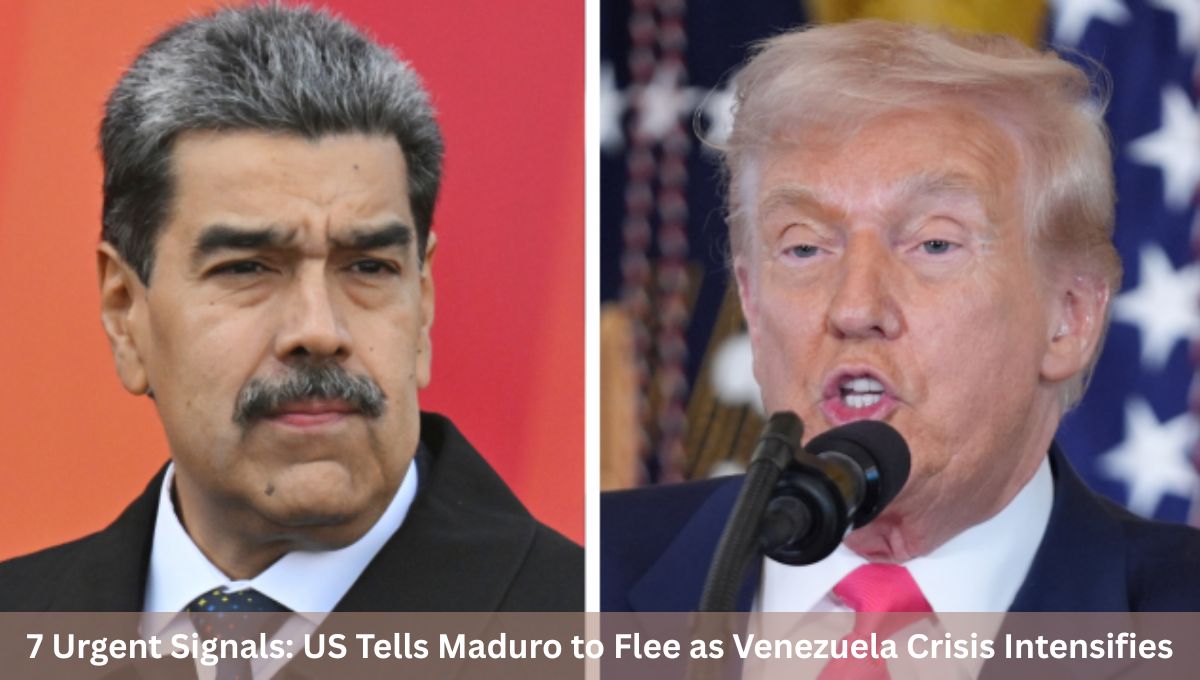
7 Urgent Signals: US Tells Maduro to Flee as Venezuela Crisis Intensifies, with airspace closures, military build-ups, and deadly strikes on alleged drug boats. A fresh wave of geopolitical turmoil has erupted across the Americas after a US senator revealed that Washington offered Venezuelan President Nicolás Maduro an opportunity to flee the country—potentially to Russia or another destination—as part of mounting pressure over what the Trump administration calls Venezuela’s role in drug trafficking networks.
Thank you for reading this post, don't forget to subscribe!Republican Senator Markwayne Mullin ignited controversy on Sunday with a televised claim that the United States had given Maduro a chance to leave Venezuela voluntarily. Coupled with President Donald Trump’s shock declaration that Venezuelan airspace was “closed in its entirety,” concerns are rising that the region may be on the brink of a major conflict or, at minimum, a dramatic escalation of US-led operations.
This comprehensive report examines the senator’s statement, Trump’s military posture, internal debates within Washington, and the growing backlash from Caracas and global observers.
7 Urgent Signals: US Tells Maduro to Flee as Venezuela Crisis Intensifies
Senator Mullin: “We Gave Maduro an Opportunity to Leave”
In an interview with CNN, Senator Markwayne Mullin made one of the most direct public acknowledgments yet of an American offer for Maduro to abandon Venezuela. “We gave Maduro an opportunity to leave. We said he could leave and go to Russia or he could go to another country,” Mullin stated.
The senator did not specify when or how the offer was made, but his remarks align with recent reports that the US government has been exploring multiple “exit ramps” for Maduro amid intensifying efforts to dismantle what US officials call drug trafficking operations linked to the Venezuelan state.
Despite heightened fears across Latin America of a looming US invasion, Mullin insisted that President Donald Trump was not preparing a land war. “No, he’s made it very clear we’re not going to put troops into Venezuela,” Mullin said. “What we’re trying to do is protect our own shores.”
His reassurances have done little to settle anxieties given the dramatic expansion of US military assets in the Caribbean and the recent spate of deadly strikes.
Trump Declares Venezuelan Airspace “Closed in Its Entirety”
The most jarring signal came Saturday when President Trump issued a blunt and sweeping directive on social media.
“To all Airlines, Pilots, Drug Dealers, and Human Traffickers, please consider THE AIRSPACE ABOVE AND SURROUNDING VENEZUELA TO BE CLOSED IN ITS ENTIRETY.”
The statement created immediate diplomatic shockwaves. Venezuela condemned the declaration as:
- “A colonial threat”
- “Illegal, unjustified aggression”
- A violation of international law and sovereignty
Caracas accused Washington of pursuing a “permanent policy of aggression”, claiming the US seeks to justify an eventual regime change operation.
International observers were equally puzzled. No such airspace closure has been formally recognized by US aviation authorities or international civil aviation bodies, and senior US military officials reportedly had little prior warning.
Operation Southern Spear: Deadly US Strikes in the Caribbean
The crisis cannot be understood without the backdrop of Operation Southern Spear, the US-led campaign targeting alleged drug-smuggling vessels departing from Venezuela.
Since September:
- At least 21 boats have been struck
- More than 83 people have been killed
- Many of the victims’ identities and cargo remain undisclosed
- Legal scholars and human rights groups have called the strikes potentially illegal extrajudicial killings
The Pentagon asserts the boats belonged to “narco-terrorist networks,” which the US recently designated as foreign terrorist organizations (FTOs)—a label typically reserved for extremist groups like al-Qaeda.
Critics argue that “Cartel de los Soles”, one of the groups the US accuses of drug trafficking, is not a centralized cartel but rather a loose network of corrupt actors historically linked to Venezuelan military officials.
The lack of transparency over the strikes has triggered bipartisan concern in the US, prompting congressional investigations.
Reports of a “Double-Tap” Strike Intensify Scrutiny
Controversy intensified after reports emerged that US Defense Secretary Pete Hegseth had verbally authorized a “kill everyone on board” order during a September operation.
US media organizations—including The Washington Post and CNN—reported that after the initial strike on a suspected drug-smuggling vessel, at least two survivors were seen attempting to swim away. A senior admiral allegedly ordered a second strike to kill the survivors.
Legal experts warned such an order, if proven, could constitute:
- War crimes
- Violations of the law of armed conflict
- Unlawful killings under US and international law
Hegseth denied ever issuing such an instruction, and President Trump publicly defended him:
“He did not say that, and I believe him 100 percent.”
The White House later clarified that Admiral Frank Bradley had authorized the follow-on strike, which officials claimed was lawful and necessary “to eliminate the threat.”
Trump’s Mixed Signals: From “Closed Airspace” to “Don’t Read Too Much Into It”
Trump’s messaging remains contradictory. While his Saturday proclamation sounded like the precursor to large-scale military action, he tempered expectations on Sunday.
“Don’t read anything into it,” he told reporters aboard Air Force One. The ambiguity has fueled speculation among policymakers and regional leaders alike.
Analysts note that airspace closures are typically associated with:
- No-fly zones before military operations
- Preparations for targeted strikes
- Psychological pressure tactics
Some observers believe Trump is using the threat of force to pressure Maduro into exile without actually launching a full-scale operation—a move that could contradict Trump’s campaign pledge to avoid “stupid foreign wars.”
US Military Build-Up in the Caribbean Raises Alarm
Meanwhile, on-the-ground evidence points to a significant surge in US military readiness around Venezuela.
Assets currently deployed:
- USS Gerald R. Ford, the world’s most advanced aircraft carrier
- USS Winston S. Churchill (destroyer)
- USS Bainbridge (destroyer)
- Marine units positioned in the region
- Approximately 15,000 military personnel in or near US Caribbean territories
- Stealth aircraft and surveillance platforms
Reporting from Puerto Rico, Al Jazeera correspondent Phil Lavelle noted a “flurry of activity,” though he cautioned that the purpose of the buildup remains unclear.
White House Meeting Signals New Phase of Decision-Making
On Monday evening, President Trump held a high-profile meeting in the Oval Office to discuss “next steps” on Venezuela.
Attendees included:
- Secretary of State Marco Rubio
- Defense Secretary Pete Hegseth
- Joint Chiefs Chairman Gen. Dan Caine
- White House Chief of Staff Susie Wiles
- Deputy Chief of Staff Stephen Miller
According to sources, the conversation centered on:
- Reviewing the legality of recent strikes
- Assessing intelligence on alleged Venezuelan drug routes
- Determining potential “land operations”
- Evaluating diplomatic vs. military pressure
- Discussing Maduro’s possible exit options
The meeting came amid intense media scrutiny and bipartisan congressional pressure for transparency.
Maduro Responds: “We Do Not Want a Slave’s Peace”
In Caracas, President Nicolás Maduro delivered a fiery speech rejecting any form of coerced submission. “We want peace, but peace with sovereignty, equality, freedom! We do not want a slave’s peace, nor the peace of colonies!” Maduro declared.
He accused Washington of waging psychological terrorism over the past 22 weeks and praised Venezuelans for their resilience. Thousands of government supporters marched in Caracas, chanting slogans against US “threats” and warning against regime change attempts.
A Secret Phone Call Between Trump and Maduro
Adding further intrigue, President Trump confirmed that he had spoken directly with Maduro recently—the first such communication since Trump returned to office.
“I don’t want to comment on it. The answer is yes,” Trump said.
When asked if the call was productive, Trump replied:
“I wouldn’t say it went well or badly, it was a phone call.”
The New York Times reported that the discussion included the possibility of a future meeting between the two leaders—an idea that would dramatically alter the current narrative of hostility. Maduro has long insisted he is willing to speak with Trump “face-to-face.”
Is the US Preparing for Regime Change?
Multiple Reuters reports suggest the US is actively considering options that go beyond counter-narcotics operations, including:
- Overthrowing Maduro through military force
- Supporting internal military defections
- Seizing or blockading Venezuelan oil infrastructure
- Establishing restricted zones around Venezuela
Human rights organizations, including several US allies, have expressed deep concern.
They warn that:
- The strikes may violate maritime law
- Civilian casualties may be far higher than reported
- Escalation could plunge the region into a prolonged conflict
Venezuela’s National Assembly to Investigate US Strikes
Venezuela’s National Assembly announced it will create a commission to investigate the US boat strikes. The meeting was postponed until Tuesday without explanation, but officials say they intend to push forward.
Jorge Rodríguez, who leads the assembly, criticized the US but declined to comment on Trump’s phone call.
Regional Reaction: Fear, Confusion, and Strategic Calculations
Latin American governments are deeply divided:
- Some US allies (Colombia, Ecuador) are cautiously supportive of anti-drug operations
- Neighbouring states fear “spillover conflict” or refugee surges
- Left-leaning governments (Brazil under its current leadership, Mexico, Bolivia) warn that Washington is escalating illegally
Airlines, maritime operators, and humanitarian groups have requested clear guidance, as the airspace declaration has created uncertainty for travel and aid routes.
Is Maduro Being Pushed Toward Exile?
Analysts say the US strategy may revolve around making Maduro feel cornered enough to accept exile.
Possible destinations include:
- Russia (long-time ally)
- Cuba
- Turkey
- Iran
- Belarus
Moscow has not commented, though Russia has historically sent military advisers and equipment to bolster Maduro’s government.
The Domestic US Political Angle
Trump faces competing pressures:
Reasons he may avoid a full war:
- His MAGA base opposes foreign interventions
- Cost and risk of military operations
- Potential international backlash
- Humanitarian fallout
Reasons the administration may escalate:
- The FTO designation provides legal justification for strikes
- Hawks in Congress advocate harsher measures
- Trump has repeatedly highlighted Venezuela’s oil wealth
- Domestic political advantage in projecting toughness on drugs
This tension explains the contradictory messaging from the White House.
What Comes Next? Multiple Scenarios
Experts envision several possible developments:
1. Maduro flees the country
If exile becomes imminent, US operations may scale down, presenting a diplomatic “victory” for Trump.
2. Intensified US strikes
Further maritime attacks—or even land operations—could unfold in the name of counter-narcotics.
3. Negotiated settlement
The secret phone call could signal the possibility of a diplomatic breakthrough.
4. Major confrontation
A miscalculation in the Caribbean could ignite a regional conflict.
5. Status quo with continued tension
The most likely short-term scenario: more threats, more military deployments, but no ground invasion.
Conclusion: A Region on Edge as High-Stakes Moves Continue
The revelation that the United States encouraged Nicolás Maduro to flee—paired with Trump’s sweeping airspace declaration and a massive military buildup—has created one of the most dangerous flashpoints in the Western Hemisphere in decades.
As Operation Southern Spear continues deadly strikes at sea, and as Washington weighs its next steps, both nations appear locked in a precarious chess match with enormous consequences for the region.
Whether this crisis ends in negotiations, exile, expanded military action, or an unpredictable escalation remains one of the most urgent questions facing global diplomacy today.
Also Read: 7 Alarming Signals: Trump Threatens Strikes on Mexico to ‘Stop Drugs’
Also Read: Trump triumphant as Maduro begs for 3 snivelling ‘conditions’ before he will flee office
Related Posts:
- 7 Critical Shifts as Trump Rejects Maduro’s Demands…
- Trump Considers Military Strikes on Venezuelan Drug…

- Were Charlie Kirk’s Wife Erika and Kids present at…

- 9 Explosive Claims as Venezuela Slams US ‘Extortion’ at UN

- US Military Kills Three in Second Strike on…

- 9 Facts About Trump’s Drug Boat Strikes That Shook the World
