9 Explosive Claims as Venezuela Slams US ‘Extortion’ at UN as the greatest in its history. Venezuela has launched a fierce diplomatic attack against the United States at the United Nations, accusing Washington of engaging in what it described as “the greatest extortion” in the country’s history.
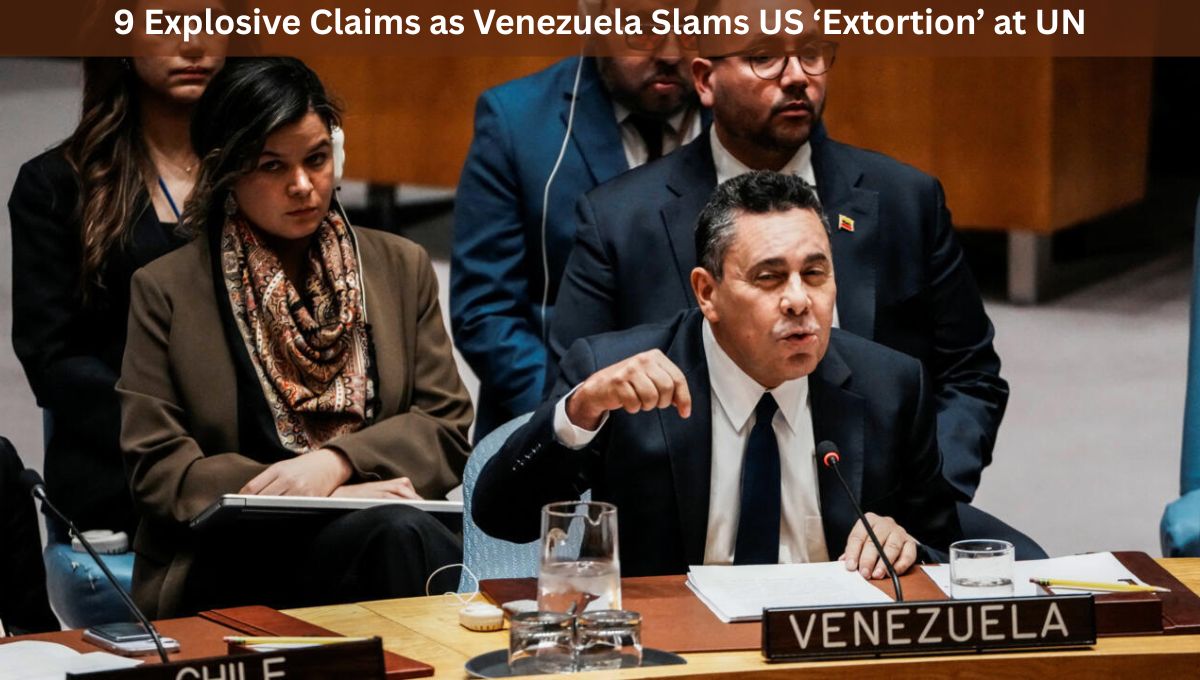
The accusations came during an emergency session of the UN Security Council convened to discuss the US seizure of Venezuelan oil tankers and the imposition of a naval blockade targeting vessels under American sanctions.
Caracas says the actions amount to piracy, looting, and illegal aggression under international law. The United States, however, maintains that its measures are lawful enforcement actions aimed at combating drug trafficking and cutting off funding to what it calls Venezuela’s “narco-terrorist” networks.
The confrontation has escalated into one of the most serious international crises involving Venezuela in recent years, drawing sharp criticism from Russia and China and renewed warnings about the erosion of international norms governing the use of force.
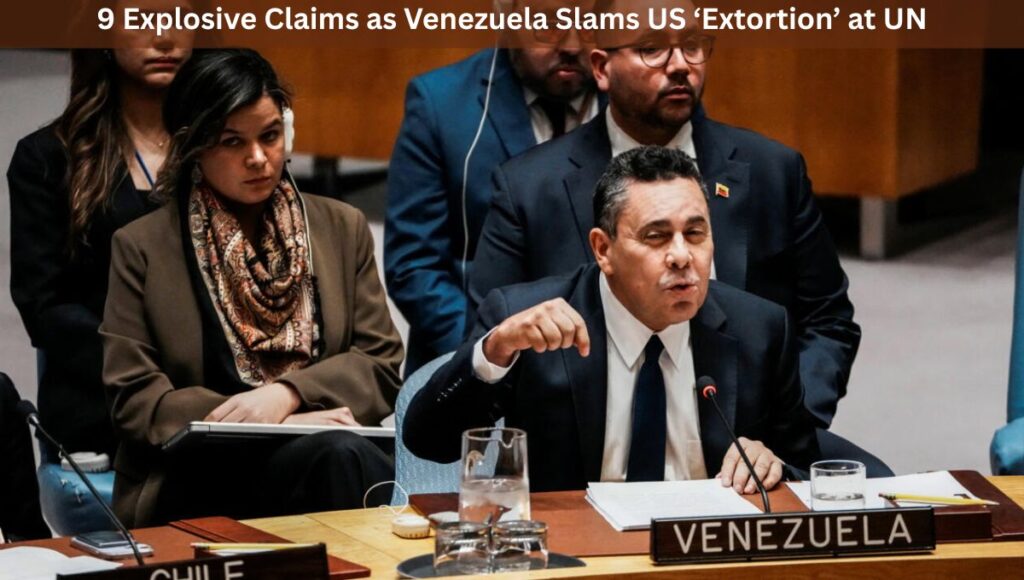
9 Explosive Claims as Venezuela Slams US ‘Extortion’ at UN
Emergency UN Security Council Meeting
The emergency meeting was requested by Venezuela earlier this month and supported by Russia and China.
It followed Washington’s seizure of at least two Venezuelan oil tankers off the country’s coast and reports that US authorities are pursuing a third vessel.
Speaking to the 15-member Security Council, Venezuela’s ambassador to the UN, Samuel Moncada, accused the United States of acting outside international law and using military force to seize Venezuelan resources.
“We are in the presence of a power that acts outside of international law, demanding that Venezuelans vacate our country and hand it over,” Moncada told the council. “This is the greatest extortion known in our history.”
Moncada described the seizure of oil and vessels as “worse than piracy,” arguing that the US has no jurisdiction in the Caribbean Sea to confiscate Venezuelan assets.
US Seizure of Venezuelan Oil Tankers
According to Venezuelan officials, US forces have seized at least two oil tankers carrying Venezuelan crude and confiscated an estimated four million barrels of oil.
President Donald Trump has publicly stated that the United States will keep or sell both the oil and the vessels involved.
On December 16, Trump ordered a naval blockade targeting all Venezuelan oil tankers sanctioned by Washington.
US officials insist the operation is being carried out by the Coast Guard as a law enforcement action rather than a formal military blockade.
Legal experts, however, argue that the scale and nature of the operation resemble a naval blockade, which is considered an act of war under international law if imposed without UN authorization.
US Justification: Drugs and Sanctions Enforcement
The Trump administration has framed its actions as part of a broader campaign against drug trafficking.
The president has accused Venezuelan President Nicolas Maduro of leading a drugs cartel and allowing criminal gangs to operate with impunity.
US Ambassador to the UN Mike Waltz told the Security Council that the United States does not recognize Maduro as Venezuela’s legitimate leader.
He argued that Venezuelan oil sales provide the financial lifeline that sustains Maduro’s grip on power.
“The reality of the situation is that sanctioned oil tankers operate as the primary economic lifeline for Maduro and his illegitimate regime,” Waltz said. “Maduro’s ability to sell oil enables his narco-terrorist activities.”
Washington has designated several international criminal groups, including Venezuela’s Tren de Aragua and the alleged “Cartel de los Soles,” as terrorist organizations.
Caracas denies the existence of such a cartel and rejects all allegations of state-sponsored drug trafficking.
In recent months, the United States has significantly expanded its military presence in the Caribbean and Pacific regions.
Officials say approximately 15,000 US troops, along with aircraft carriers, warships, and surveillance aircraft, have been deployed.
It is the largest US military deployment to the region since the 1989 invasion of Panama. Washington says the buildup is necessary to disrupt drug trafficking routes supplying fentanyl and cocaine to the United States.
Venezuela, Russia, China, and several independent analysts argue that the scale of the deployment goes far beyond counter-narcotics operations and represents a direct threat to regional security.
Deadly Strikes on Venezuelan Vessels
Since September, US forces have launched dozens of air and naval strikes on vessels they allege were involved in drug smuggling.
According to Venezuelan authorities and UN experts, more than 100 people have been killed in these operations.
Washington has not publicly provided evidence to support its claims that the targeted vessels were transporting illegal drugs.
Human rights advocates warn that the strikes may constitute extrajudicial killings and violations of the laws governing armed conflict.
“These killings amount to violations of the right to life,” a group of UN experts said in a joint statement. “They must be investigated, and those responsible held accountable.”
UN Experts Condemn US Blockade
Four United Nations human rights experts issued a rare joint condemnation of the US naval blockade, calling it an illegal act of armed aggression under international law.
“There is no right to enforce unilateral sanctions through an armed blockade,” the experts said. They noted that blockades are explicitly recognized as illegal aggression under the UN General Assembly’s 1974 Definition of Aggression.
The experts warned that the use and threat of force endanger civilian lives and undermine fundamental human rights across Venezuela and the wider region.
They called on the US Congress to intervene and prevent further military action.
Venezuela Warns of ‘Continental Ambitions’
At the Security Council meeting, Ambassador Moncada went further, warning that Venezuela is only the first target of a broader US strategy aimed at dominating Latin America.
“It’s not just about Venezuela. The ambition is continental,” Moncada said. “The US government wants us to be divided so it can conquer us piece by piece.”
He accused Washington of violating both international law and US domestic law by conducting military operations without congressional approval, which is required to formally declare war.
Russia and China Back Venezuela
Russia and China offered strong diplomatic backing to Venezuela, accusing the United States of bullying, intimidation, and aggression.
Russian Ambassador Vassily Nebenzia told the council that US forces were “illegally destroying civilian vessels” in the Caribbean Sea.
He warned that the actions against Venezuela could become a template for future interventions against other Latin American states.
“The acts by the US side run counter to all key norms of international law,” Nebenzia said, describing the blockade as an act of aggression.
China’s deputy permanent representative, Sun Lei, called on the United States to immediately halt its actions and avoid further escalation. He said Washington’s conduct seriously infringes on Venezuela’s sovereignty and legitimate rights.
China Denounces ‘Unilateral Bullying’
China emphasized its opposition to unilateral sanctions and the use of force without UN authorization.
Sun Lei argued that the sinking of vessels, seizure of oil tankers, and threats of military strikes cannot be justified as law enforcement measures.
“These are acts of intimidation,” he said. “Unilateral sanctions, long-arm jurisdiction, and the use or threat of force have no legitimacy under international law.”
Beijing reiterated its support for Venezuela’s right to choose its own development path and maintain mutually beneficial relations with other countries.
Maduro Rejects US Allegations
President Nicolas Maduro has categorically denied US accusations that his government is involved in drug trafficking.
Speaking during a visit to a trade fair in Caracas, Maduro said the UN Security Council was giving “overwhelming support” to Venezuela.
He accused the Trump administration of using drug allegations as a pretext to pursue regime change and seize Venezuela’s vast oil reserves, the largest proven reserves in the world.
“It is not drugs, it is not security, it is not freedom,” Moncada told the UN. “It is oil, it is mines, and it is land.”
Legal Debate Over Blockade
Under international law, a naval blockade imposed without UN authorization is considered an act of war.
The United States has attempted to sidestep this classification by describing its actions as Coast Guard enforcement of sanctions.
Critics argue that the scale, duration, and military nature of the operation undermine that claim. The UN Charter prohibits the use of force except in self-defense or with Security Council approval.
UN Secretary-General António Guterres has urged all parties to exercise restraint, de-escalate tensions, and resolve disputes through peaceful means.
Regional and Global Implications
The crisis has raised alarm across Latin America and the Caribbean, where many governments remain sensitive to memories of past US interventions.
Analysts warn that continued escalation could destabilize the region and undermine international norms.
Some experts also caution that normalizing unilateral military enforcement of sanctions could set a dangerous precedent globally, weakening the authority of the UN and the rules-based international order.
What Happens Next
Venezuela has called on the international community to take concrete steps to halt what it describes as illegal aggression and to hold US officials accountable. Russia and China have signaled they will continue to raise the issue at the UN.
For now, Washington shows no sign of backing down. US officials insist that cutting off Venezuela’s oil exports is essential to combating drug trafficking and protecting American security interests.
As tensions mount, the standoff underscores a deepening divide between major powers over the use of sanctions, military force, and the future of international law.
Whether diplomacy can defuse the crisis remains an open question, but the confrontation has already reshaped the geopolitical landscape of the Americas.
Also Read: 7 Explosive Claims Behind Trump’s Venezuela Oil Standoff
Also Read: Venezuela Slams US “Extortion” at UN as Russia and China Condemn Washington’s Escalation