7 Stunning Implications of Trump’s Dramatic Venezuela Tanker Seizure, signaling a pressure campaign on Maduro that is reshaping regional security, oil markets, and geopolitics. The Trump administration’s seizure of a massive oil tanker off the coast of Venezuela has triggered one of the most dramatic moments in the long-running confrontation between President Donald Trump and Venezuelan leader Nicolás Maduro.
What unfolded in the Caribbean this week—helicopters, armed U.S. operators, fast-rope insertions, and a White House announcement—was not simply another sanctions enforcement action. It signaled a turning point.
The decision to physically board a foreign-flagged vessel in international waters, seize control of it, and announce the action with such political fanfare places the United States and Venezuela on a collision course unlike anything seen in years.
It also introduces new strategic, economic, diplomatic, and legal variables that could alter the crisis far beyond the detention of a single vessel.
The tanker in question—the Skipper—has now become a symbol:
of U.S. resolve, of Venezuelan defiance, and of the risk that this confrontation could escalate from a sanctions dispute into a regional showdown.
This in-depth analysis examines why the tanker seizure happened, what it reveals about Trump’s strategy, how Maduro is reacting, and how the crisis might evolve.
7 Stunning Implications of Trump’s Dramatic Venezuela Tanker Seizure
I. The Seizure of the Skipper: A Watershed Moment in U.S.–Venezuela Tensions
A dramatic operation broadcast to the world
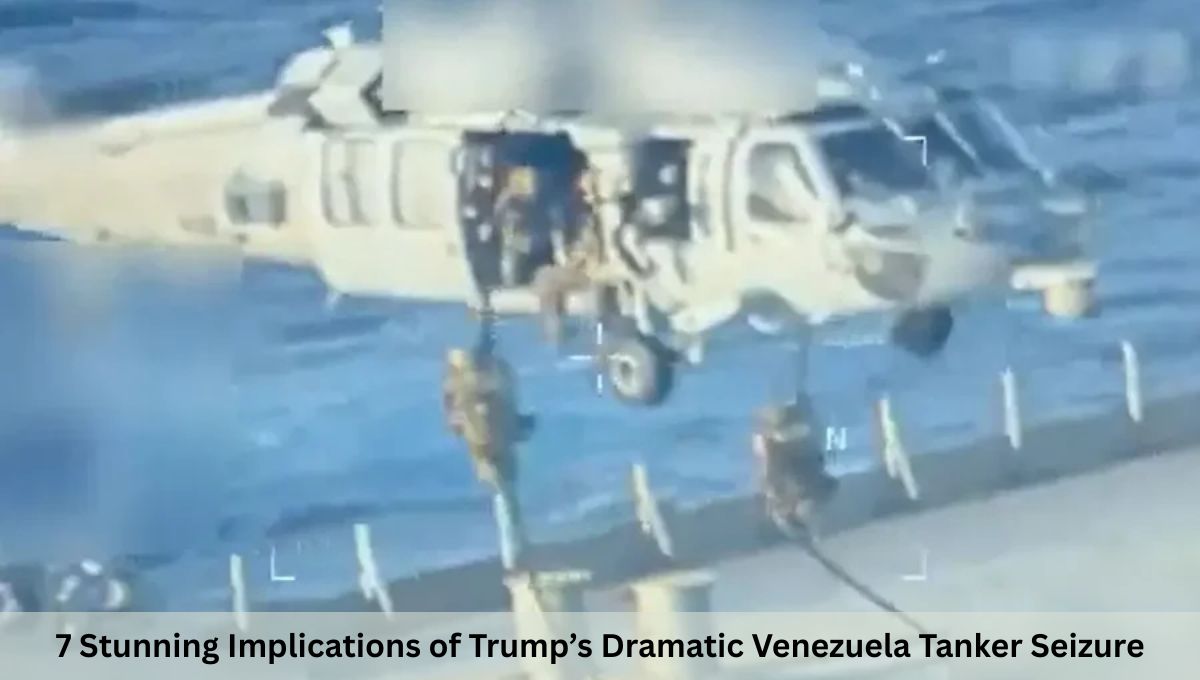
The Trump administration confirmed that U.S. Coast Guard operators, supported by the U.S. Navy, FBI, Department of Homeland Security, and the Department of Defense, boarded and seized the Skipper—a Very Large Crude Carrier (VLCC)—in international waters.
A federal judge had issued a seizure warrant due to its alleged involvement in transporting sanctioned crude linked to Iran-backed terrorist networks.
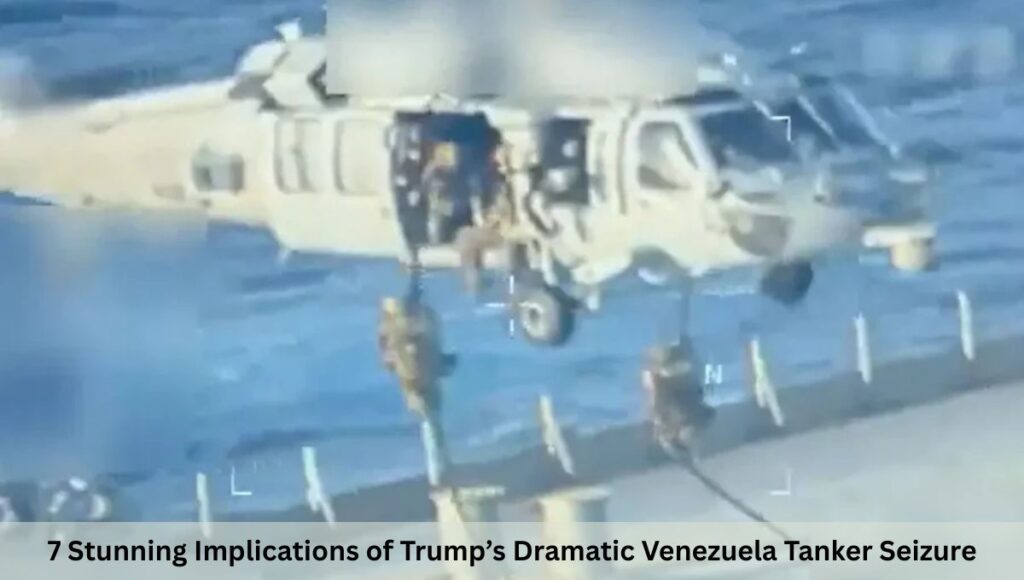
Attorney General Pam Bondi publicly released a 45-second video showing U.S. personnel rappelling down from military helicopters onto the tanker’s deck, giving the world an unprecedented look at a sanctions enforcement operation typically shrouded in secrecy.
Trump himself delivered the news theatrically:
“We’ve just seized a tanker on the coast of Venezuela—large tanker, very large, largest one ever seized, actually.”
The president refused to identify the ship’s owner or destination, but hinted bluntly:
“I assume we’re going to keep the oil.”
The visibility, political framing, and scale of the operation immediately set it apart from prior seizures of sanctioned cargo.
Why this tanker matters
The Skipper was reportedly carrying 1.1 million barrels of Venezuelan crude loaded covertly in mid-November. Analysts indicated it was likely bound for Cuba—an important ally of Maduro and a major player in Venezuela’s sanctions-busting oil network.
Its interdiction is likely to put tanker captains, shipowners, insurers, and middlemen on notice:
Load Venezuelan oil under U.S. sanctions risk—and your vessel may be next.
This, in effect, weaponizes maritime pressure in a new, more assertive direction.
II. How the Seizure Fits Into Trump’s Expanding Military Pressure Campaign
A regional military build-up without modern precedent
Since returning to office for a second term, Trump has overseen the largest U.S. military deployment in the Caribbean and Eastern Pacific in decades.
Assets include:
• the USS Gerald R. Ford—the world’s most advanced aircraft carrier
• destroyers, surveillance aircraft, and Coast Guard cutters
• a growing number of special operations units conducting maritime interdictions
The administration has justified these deployments as counter-narcotics operations and sanctions enforcement. But the scale and posture increasingly resemble preparations for contingency operations—possibly including land strikes.
Lethal strikes at sea: a new frontier
In addition to the tanker seizure, the U.S. has launched at least 22 deadly strikes on alleged drug-trafficking vessels in the Caribbean and Pacific. These attacks have killed at least 87 people.
One strike on September 2 included a second, “double-tap” attack that reportedly killed survivors attempting to flee.
Human rights groups and some members of Congress argue that these tactics may violate international law and bypass constitutional limits on presidential war powers.
Is Venezuela really a narcotrafficking hub?
While Trump repeatedly insists Venezuelan territory is a major fentanyl corridor, most independent analysts—and U.S. government reports—do not classify Venezuela as a primary route into the United States. Critics argue the narcoterrorism narrative is being stretched to justify military pressure.
“Maximum pressure” reborn
The tanker operation makes clear the administration is shifting:
from financial sanctions to physically blocking Venezuelan oil exports by force.
This is a much more escalatory posture—and one with profound implications for Maduro’s survival.
III. Maduro Responds: Fury, Defiance, and Talk of Sovereignty
Venezuela reacted with predictable outrage, calling the seizure:
• “blatant theft”
• “an act of international piracy”
• “a violation of sovereignty, natural wealth, and national dignity”
Caracas pledged to denounce the United States before international bodies and declared the tanker seizure proof that the crisis “was never about democracy, migration, or human rights,” but about U.S. desire for “our oil, our energy, our natural resources.”
Maduro responded by ordering additional military deployments to coastal regions and placing naval assets on high alert.
The Venezuelan leader has long accused Washington of seeking regime change, but the scale, brazenness, and publicity of this operation are likely to deepen his sense that military conflict may be near.
IV. What Is at Stake for Trump? Why This Crisis Matters
A high-risk gambit with major political implications
For the Trump administration, destabilizing the Maduro regime—or forcing his removal—would represent a significant geopolitical victory.
But it carries risks:
- Mission creep
Large U.S. deployments in hostile regions tend to take on lives of their own. - Invalid or stretched legal justification
The Constitution limits unilateral presidential military action absent Congressional authorization. - Potential refugee and humanitarian crises
If Venezuela’s fragile state implodes, the region may be flooded with displaced civilians. - International backlash
Allies in Europe and Latin America remain split on military solutions. - Uncertain endgame
Critics draw comparisons to Iraq in 2003—where regime collapse created a vacuum.
Despite these risks, Trump appears committed.
As he put it:
“Maduro’s days are numbered.”
V. Why This Seizure Could Hit Venezuela’s Oil Sector Hard
Oil exports: the lifeblood of the Maduro regime
Venezuela has the world’s largest proven oil reserves. Despite decades of mismanagement, sanctions, and infrastructure collapse, the country still exports between 750,000 and 900,000 barrels per day—mostly to China, Cuba, and India.
Illicit shipments, often via “shadow fleet” tankers:
• Disable AIS tracking
• Conduct secret ship-to-ship transfers
• Operate under flags of convenience
• Are owned through maze-like shell companies
The Skipper was reportedly part of this network.
A seizure that rattled global oil markets
After news of the operation broke:
• WTI crude rose 1.2%
• Brent crude rose 1.15%
Market analysts warn that even the perception of a blockade around Venezuelan crude could tighten supplies globally.
Why this pressure is existential for Maduro
Oil is how Maduro pays:
• the military
• internal security forces
• political loyalists
• social welfare programs
• foreign allies
If exports slow substantially, the regime’s core power structures could fracture.
VI. The Legal Battlefield: Is Trump Overstepping His Authority?
Constitutional concerns
Democrats in Congress argue Trump’s actions amount to the use of military force without Congressional authorization.
Representative Chrissy Houlahan said:
“It is definitely escalatory; there is no other way to put it.”
This is especially true given:
• the double-tap strike on September 2
• repeated threats of strikes on Venezuelan soil
• the deployment of offensive military assets close to the coast
If Trump intends regime change by force, the Constitution requires legislative approval.
International law questions
While the Skipper was in international waters and subject to a duly issued U.S. warrant, opponents argue:
• unilateral seizures set a dangerous precedent
• military boarding of civilian vessels is escalatory
• using counter-narcoterrorism claims for oil seizures may be legally questionable
UN experts already issued a warning about “mounting U.S. pressure.”
Public opinion—divided, but wary of war
Polls show:
• Only 17% of Americans support a military overthrow of Maduro
• 45% oppose using force to remove him
• 48% oppose U.S. attacks on alleged drug vessels
Support for aggressive military action remains weak, even if Maduro is widely disliked.
VII. A Region Braces for Escalation: What Happens Next?
The tanker is just the beginning
U.S. officials privately suggest more seizures are coming. The administration views tanker interdiction as:
• cost-effective
• legally defensible
• politically advantageous
• strategically impactful
It also avoids the risk of civilian casualties associated with airstrikes.
Possible next steps
Analysts point to several potential escalations:
1. Pre-emptive airstrikes inside Venezuela
Trump has threatened this several times, though he declined to discuss specifics.
2. A maritime blockade—informal or explicit
Interdicting multiple tankers would effectively reduce Venezuelan oil exports to a trickle.
3. Support for opposition leaders now emerging abroad
Opposition figure María Corina Machado’s surprise travel to Oslo opened a new symbolic front that the U.S. may exploit.
4. Covert operations to encourage military defections
Trump has hinted that Maduro’s generals “know what is coming.”
5. Diplomatic pressure on Cuba and Iran
Both countries rely on Venezuelan crude for energy and revenue.
The Maduro regime’s possible counter-moves
Maduro may respond through:
• cyber operations
• detaining American citizens
• seizing U.S.-aligned companies
• strengthening ties with Russia or China
• military exercises near U.S. assets
But his options are limited. Venezuela’s military is stretched, its economy is collapsing, and its diplomatic credibility is thin.
VIII. Comparison to Historical Precedents
Is this like Iran, Iraq, or Panama?
Analysts see similarities to:
• Iran tanker seizures (reciprocal and escalatory)
• Panama 1989 (pressure culminating in a rapid military operation)
• Iraq 2003 (regime change without clear post-war planning)
But Venezuela’s circumstances are distinct:
• No active weapons programs
• No significant insurgent forces
• No major ethnic divisions
• No conventional military threat to the U.S.
• A regime deeply embedded in illicit financing networks
This makes the potential collapse both less predictable and potentially less violent—but still fraught.
IX. The Big Picture: Why This Moment Feels Like a Point of No Return
Trump prizes unpredictability as a strategic tool—keeping adversaries guessing, and sometimes his own advisors as well. But unpredictability cuts both ways:
• It complicates risk assessment
• It increases the chance of miscalculation
• It leaves allies unsure of U.S. intentions
• It creates uncertainty within Venezuela’s armed forces
The seizure of the Skipper was not merely a tactical law-enforcement strike. It was a symbolic escalation—one that demonstrated Trump’s willingness to use direct military force to enforce sanctions and squeeze Maduro’s regime at its most vulnerable pressure point:
oil exports.
The more pressure the U.S. applies, the more difficult it becomes to back down without a major political cost. A crisis now moving rapidly toward a decisive phase.
Whether this ends with:
• Maduro’s fall
• a negotiated transition
• a U.S. military intervention
• a protracted standoff
—remains uncertain.
But one fact is clear:
The seizure of the tanker Skipper has brought the U.S. and Venezuela closer to confrontation than at any point in the last two decades.
Also Read: 7 Urgent Signals: US Tells Maduro to Flee as Venezuela Crisis Intensifies
Also Read: ‘Blatant theft and act of piracy’: US seizes Venezuelan oil tanker in dramatic escalation