7 Explosive Claims Behind Trump’s Venezuela Oil Standoff, sovereignty, and regime change. The Trump administration’s renewed confrontation with Venezuela has escalated from sanctions and rhetoric into one of the most aggressive US pressure campaigns in the Western Hemisphere in decades.
Thank you for reading this post, don't forget to subscribe!At the center of the storm is a provocative claim: that Venezuela’s vast oil wealth was “stolen” from the United States and should be returned. That assertion—advanced publicly by White House deputy chief of staff Stephen Miller and echoed directly by President Donald Trump—has triggered diplomatic outrage, market volatility, and deep concern among legal experts and regional governments.
It has also raised a fundamental question:
Is this conflict really about drugs and security, or is it about oil and power?
This article examines the origins of the dispute, the legal realities behind Venezuela’s oil nationalisation, Trump’s blockade of Venezuelan tankers, and the broader geopolitical consequences of a crisis that could reshape Latin America’s future.
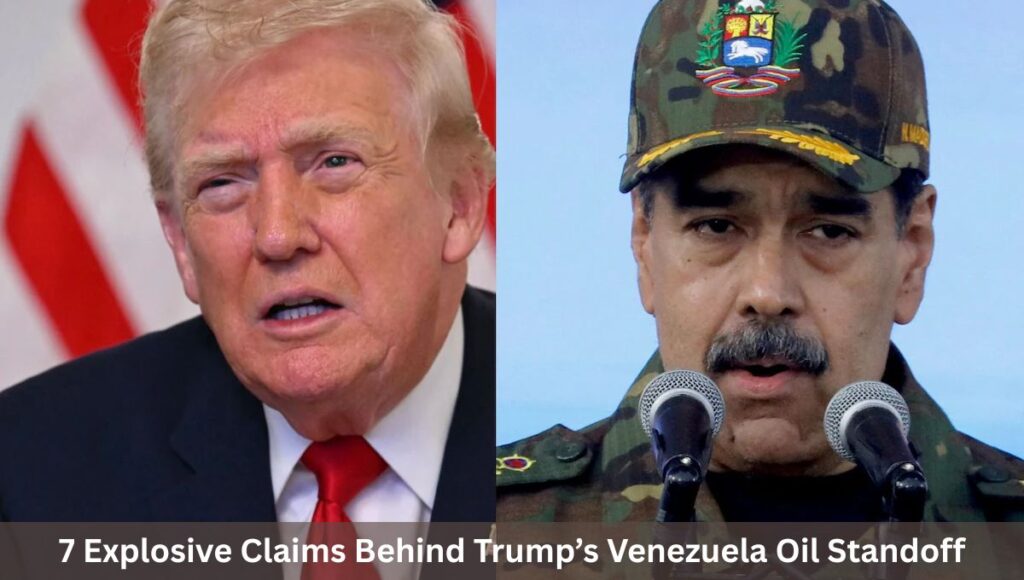
7 Explosive Claims Behind Trump’s Venezuela Oil Standoff
Stephen Miller’s Claim: “American Oil” in Venezuela
The controversy erupted after Stephen Miller declared on social media that Venezuela’s oil industry was created by “American sweat, ingenuity and toil,” arguing that its nationalisation amounted to “the largest recorded theft of American wealth and property.”
Miller framed Venezuela’s oil policy not as an exercise of sovereignty but as an act of criminal expropriation that allegedly funded terrorism, drug trafficking, and violence affecting the United States.
The claim was extraordinary—not only for its tone, but for its legal implications. Under international law, natural resources belong to the sovereign state in which they are located, regardless of who initially developed extraction infrastructure. This principle, known as permanent sovereignty over natural resources, has been upheld repeatedly by the United Nations and international courts.
While US and British firms played a major role in developing Venezuela’s early oil industry, ownership of the oil itself has never belonged to Washington.
Venezuela’s Oil Nationalisation: What Actually Happened
1976: PDVSA Is Born
Venezuela nationalised its oil sector in 1976, bringing operations under the control of the state-owned company Petróleos de Venezuela S.A. (PDVSA).
At the time, the move was widely seen as consistent with global trends, as oil-producing nations across the Middle East, Africa, and Latin America sought greater control over strategic resources.
2007: Hugo Chávez Expands State Control
The most contentious phase came in 2007, when President Hugo Chávez nationalised remaining foreign-run oil projects. Major US companies, including Exxon Mobil and ConocoPhillips, were forced out or had their stakes reduced.
Several firms pursued arbitration claims. In 2014, a World Bank tribunal ordered Venezuela to pay Exxon Mobil $1.6 billion. Other claims—some totaling tens of billions of dollars—remain tied up in ongoing legal proceedings.
Crucially, these disputes were about corporate compensation, not national ownership of oil reserves. No international tribunal has ruled that Venezuela’s oil belongs to the United States.
Trump’s Blockade: A Dramatic Escalation
The situation escalated sharply when President Trump announced a “total and complete” blockade of sanctioned Venezuelan oil tankers entering or leaving the country.
In a Truth Social post, Trump claimed Venezuela was surrounded by “the largest armada ever assembled in the history of South America” and warned that pressure would continue until Caracas returned “all of the oil, land, and other assets they previously stole from us.”
The blockade followed the US seizure of a Venezuelan-linked oil tanker off the country’s coast—an action Caracas denounced as “international piracy.”
Legal and Strategic Concerns
Legal experts warn that a unilateral blockade, absent UN authorization or a declared state of war, risks violating international maritime law. Critics also argue that the move blurs the line between sanctions enforcement and acts of war.
For Venezuela, the blockade threatens a critical lifeline. The country currently exports around 749,000 barrels per day, with at least half going to China. Any prolonged disruption could cripple state revenues and deepen an already severe humanitarian crisis.
Oil Markets React: Prices Rebound
Global oil markets responded immediately. US crude futures rose more than 1 percent after Trump’s announcement, rebounding from near four-year lows.
- WTI crude: $55.94 per barrel (+1.21%)
- Brent crude: $59.68 per barrel (+1.29%)
Analysts noted that while Ukraine peace prospects had pushed prices down earlier, the Venezuelan blockade injected fresh supply risks into an already fragile market.
Venezuela is a founding member of OPEC and holds the largest proven oil reserves in the world, making any disruption geopolitically significant.
Is This Really About Drugs?
The Trump administration insists its actions are driven by national security and narcotics concerns. Officials claim Venezuela is a hub for drug trafficking and accuse President Nicolas Maduro of leading or protecting criminal networks.
However, US data complicates that narrative. While Venezuela is a transit route for cocaine, it is not a major source of fentanyl, the drug responsible for most US overdose deaths.
There is also no conclusive evidence that Maduro personally leads a drug cartel, despite Washington’s designation of the loosely defined “Cartel de los Soles” as a foreign terrorist organisation.
Many critics argue the drug rationale is being used to justify a far broader agenda.
Regime Change Allegations Grow Louder
According to reports, the US has carried out more than 20 deadly strikes on vessels it claims were drug boats near Venezuela since September. Legal scholars have questioned the legality of these actions under both US and international law.
In a revealing interview, White House chief of staff Susie Wiles was quoted as saying Trump wants to keep “blowing boats up until Maduro cries ‘uncle.’” Democrats and foreign policy analysts say such remarks expose the true goal: regime change.
“Trump is provoking a new war right in our backyard,” warned Congressman Gregory Meeks, cautioning that escalation could destabilize the entire region.
The Monroe Doctrine Returns
Trump’s latest National Security Strategy explicitly revives the Monroe Doctrine, framing Latin America as a US sphere of influence.
The document argues that Washington must prevent rivals—particularly China and Russia—from gaining strategic footholds in the hemisphere. Venezuela’s deepening energy ties with Beijing, Moscow, and Tehran are seen as unacceptable under this framework.
From this perspective, Venezuela’s oil is not just an economic asset—it is a geopolitical prize.
Private Oil Companies: Cautious and Unenthusiastic
Despite aggressive rhetoric, enthusiasm among US oil companies appears limited.
According to Politico, the Trump administration has quietly approached private firms to gauge interest in reentering Venezuela should Maduro be removed. The response has been lukewarm.
Executives cite:
- Low global oil prices
- Better investment opportunities elsewhere
- Venezuela’s decayed infrastructure
- Political and legal uncertainty
One source summarized the mood bluntly: “There’s not a lot of interest.”
Opposition Promises Privatisation
Venezuelan opposition leader Maria Corina Machado has taken the opposite stance, pledging to privatise the oil sector and open it to foreign investment if Maduro falls.
Machado, who won the Nobel Peace Prize earlier this year, has publicly endorsed Trump’s pressure campaign, calling it long overdue. Her position highlights a sharp divide within Venezuela over the future of its most valuable resource.
What Assets Did Venezuela ‘Steal’?
Fact-checkers have found no evidence that Venezuela seized US sovereign land or government-owned oil fields. Trump’s claims appear to refer to corporate expropriations during the Chávez era—actions for which compensation has been, and continues to be, litigated.
These disputes, while costly and contentious, do not amount to the theft of US national assets under international law.
A Dangerous Precedent
If accepted, the idea that a powerful country can claim ownership over another nation’s natural resources based on historical corporate involvement would upend decades of international norms.
It would also set a precedent with far-reaching implications for resource-rich countries across Africa, Asia, and Latin America.
Conclusion: Oil, Power, and an Uncertain Future
Trump’s confrontation with Venezuela represents more than a bilateral dispute. It is a collision of legal principles, energy politics, and 21st-century great-power rivalry.
At stake are:
- The meaning of sovereignty
- The future of US influence in Latin America
- Global oil stability
- The risk of military escalation
Whether framed as counter-narcotics, national security, or historical justice, the campaign increasingly appears driven by strategic control over resources and regional dominance.
As pressure mounts, one reality remains clear:
Venezuela’s oil has become the fault line of a much larger global struggle.
Also Read: 7 Stunning Implications of Trump’s Dramatic Venezuela Tanker Seizure
Also Read: Russia warns Trump against ‘fatal mistake’ in Venezuela standoff