4 Explosive Takeaways from Trump’s Defiant White House Address, exposing political anxiety. President Donald Trump delivered a rare 20-minute primetime address to the nation on Wednesday night, speaking from the White House as Americans prepare for the holiday season — and as his presidency enters a politically precarious phase.
Presidential addresses broadcast live on network television are traditionally moments of reassurance or national unity. This one was neither. Instead, Trump used the platform to defend his economic record, shift blame to his predecessor, and repackage familiar campaign rhetoric amid mounting evidence that public confidence in his leadership is slipping.
While the speech contained little genuine policy news, it was revealing in other ways. From its tone and pacing to its heavy reliance on grievances and statistics, the address offered a clear look at how the White House intends to frame Trump’s first year back in office — and why it may not be working.
Here are the four most important takeaways from Trump’s year-end address to the nation.
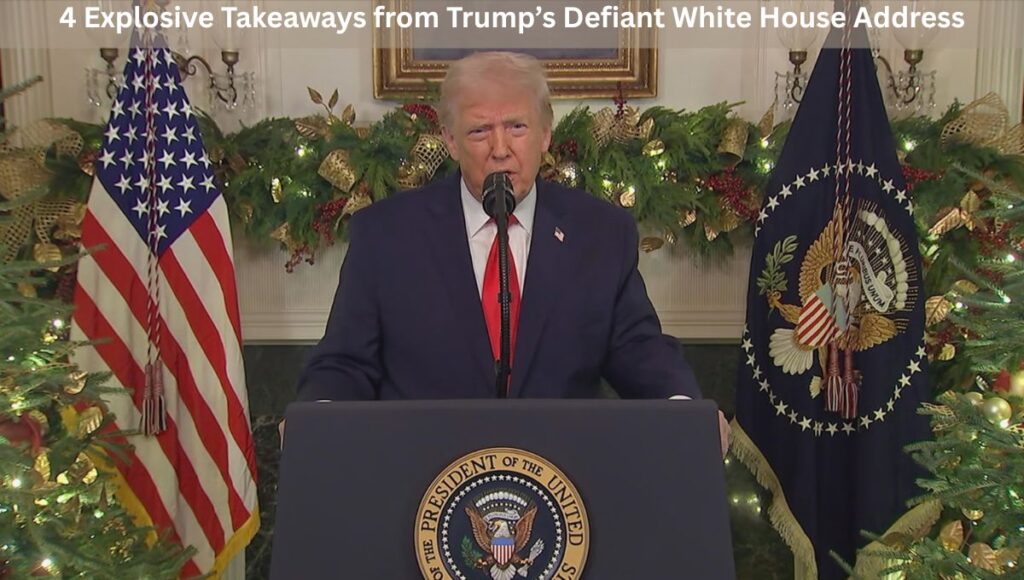
4 Explosive Takeaways from Trump’s Defiant White House Address
1. “Inherited a Mess”: Biden Was the Central Character of the Speech
If the address had a central message, it was this: Nothing is Trump’s fault.
Trump opened his remarks with a line that encapsulated the theme of the entire speech:
“Eleven months ago, I inherited a mess, and I’m fixing it.”
From that moment on, former President Joe Biden loomed over nearly every policy discussion. Trump mentioned Biden by name at least seven times, repeatedly attributing high prices, crime, immigration challenges, and healthcare costs to the previous Democratic administration.
The Biden blame strategy
Trump argued that:
- Inflation was a creation of the Biden years
- Affordability only became an issue under Democrats
- Immigration chaos stemmed entirely from Biden-era policies
- Crime surged because of Democratic governance
“This [inflation] happened during a Democrat administration,” Trump said, adding that Biden’s presidency was when Americans first began hearing the word “affordability.”
The strategy is straightforward:
if voters believe Trump was handed an economic disaster, they may give him more time to fix it.
Why the argument is struggling
Polling suggests the message is not landing.
A recent Fox News poll found:
- 62% of registered voters believe Trump is more responsible for current economic conditions
- Just 32% blame Biden
That gap underscores the challenge Trump faces. While he insists he is cleaning up a mess, many Americans believe he now owns the economy — especially after imposing tariffs that have pushed prices higher.
Complicating matters further, Trump’s current economic indicators closely resemble where Biden’s numbers stood at their weakest points, undercutting the idea of a dramatic turnaround.
2. A Speech About the Economy — Without Much Empathy
The address was clearly designed to refocus attention on the economy, which remains Trump’s weakest political issue. Inflation has ticked back up, hiring has slowed, and household budgets remain strained.
Yet despite acknowledging affordability concerns, Trump rarely addressed them in human terms.
A disconnect with public sentiment
Americans are worried about:
- Grocery prices
- Housing costs
- Utilities
- Insurance premiums
- Holiday expenses
Trump, however, spoke largely in charts, figures, and promises, asserting that the country is “poised for an economic boom the likes of which the world has never seen.”
He emphasized:
- Rising investment commitments
- Falling gas prices
- Strong stock market performance
- Manufacturing growth
What was missing was a sense of empathy for families struggling to make ends meet.
Advisers vs. Trump’s instincts
Trump’s advisers have reportedly urged him to:
- Spend more time acknowledging economic pain
- Speak directly to affordability concerns
- Avoid overly rosy messaging
Wednesday’s scripted address appeared closer to that advice than his rally speeches — but even here, Trump seemed disengaged. His delivery was rushed, mechanical, and at times visibly irritated, suggesting the topic itself does not hold his interest.
The result was a speech that talked about struggling Americans without ever really talking to them.
3. The Delivery Was Rushed, Messy, and Distracting
Even by Trump’s standards, the delivery stood out — and not in a good way.
A frantic pace
Trump spoke at an unusually rapid clip, racing through talking points as though he were on a countdown clock. His voice often rose to the point of distortion, creating the impression that he was shouting rather than addressing the nation.
He stumbled repeatedly over teleprompter lines, including a notable flub while announcing a new benefit for military personnel.
At one point, Trump attempted to say 1.45 million service members but instead read:
“More than one thousand, four hundred fifty thousand.”
The mistake was minor, but in a tightly scripted presidential address, it was emblematic of a performance that lacked polish.
“You were 20 minutes on the dot”
After the cameras stopped rolling, Trump asked White House Chief of Staff Susie Wiles how he did on timing.
“I told you 20 minutes, and you were 20 minutes on the dot,” she replied.
That exchange reinforced the sense that Trump had been rushing to get through the speech — less focused on connecting with viewers than on finishing exactly on schedule.
Critics were quick to react:
- Some viewers asked why he appeared to be yelling
- Others questioned why the address felt like a campaign speech
- Several commentators said it “could have been a Truth Social post”
For a president trying to reassure an anxious public, the optics were far from ideal.
4. Big Claims, Few New Policies — and Familiar Falsehoods
Despite White House hints that Trump might unveil new initiatives, the speech offered very little substantive policy news.
What was actually new
The main announcements were:
- $1,776 “warrior dividend” checks for 1.45 million U.S. service members
- A vague promise of “the most aggressive housing reform plans in American history” sometime next year
The $1,776 figure was symbolic, referencing the upcoming 250th anniversary of the Declaration of Independence. The total cost would be roughly $2.6 billion.
Beyond that, the address largely recycled Trump’s greatest hits.
Familiar — and false — claims
Even while reading from a script, Trump repeated several assertions that have been widely disputed, including:
- Claiming inflation was the worst “in the history of our country” when he took office
- Saying nearly 12,000 murderers crossed the border under Biden
- Describing his 2024 victory as a “landslide,” despite failing to win a majority of the popular vote
- Claiming drug prices fell by “hundreds of percentage points”
He also overstated:
- The scale of crime under Biden
- Illegal immigration figures
- His role in ending global conflicts
CNN fact-checkers noted that several false claims appeared within the first minute of the speech.
Why the primetime slot mattered
Presidential addresses carried live on network television are rare — and valuable. Networks have previously declined to broadcast speeches deemed too political.
That made Wednesday night’s address notable. Its existence suggested a White House eager to reset the narrative, even if it meant stretching traditional norms.
Trump himself appeared to acknowledge this unease, later telling aides that Susie Wiles had insisted he give the speech.
The Political Context: A Presidency Under Pressure
The address came at a difficult moment for Trump.
Slipping approval ratings
According to a Reuters/Ipsos poll:
- Trump’s approval rating stands at 39%
- Down from 47% when he began his term in January
- Near the lowest point of his presidency
Inflation has reaccelerated since Trump announced tariffs in April. The consumer price index is rising at an annual rate of 3%, up from 2.3%.
Meanwhile:
- Job growth has slowed dramatically
- Unemployment has risen from 4% to 4.6%
- Monthly job gains average just 17,000 since April
Midterms loom large
With 2026 midterm elections approaching, Trump and Republicans face a referendum on their leadership. Losses in recent elections have already raised questions about the durability of Trump’s coalition.
The primetime address was meant to halt that slide. Instead, it underscored the administration’s challenge: convincing Americans that things are improving when many feel they are not.
The Bottom Line
Trump’s White House address was less about policy than positioning.
It revealed:
- A president deeply invested in blaming his predecessor
- A White House worried about economic messaging
- A leadership style that prioritizes defiance over reassurance
- A growing gap between official optimism and public experience
For 20 minutes on a Wednesday night, Trump had the nation’s attention. What he delivered was a familiar argument, delivered urgently, and undercut by polling, performance, and perception.
Whether the speech stabilizes his presidency — or further exposes its vulnerabilities — remains to be seen. But one thing is clear: the White House would not have gone to primetime if it weren’t feeling the pressure.
Also Read: 7 Explosive Impacts of Trump Declaring Fentanyl a Weapon of Mass Destruction
Also Read: Trump’s dark Christmas story doubles down on a political error