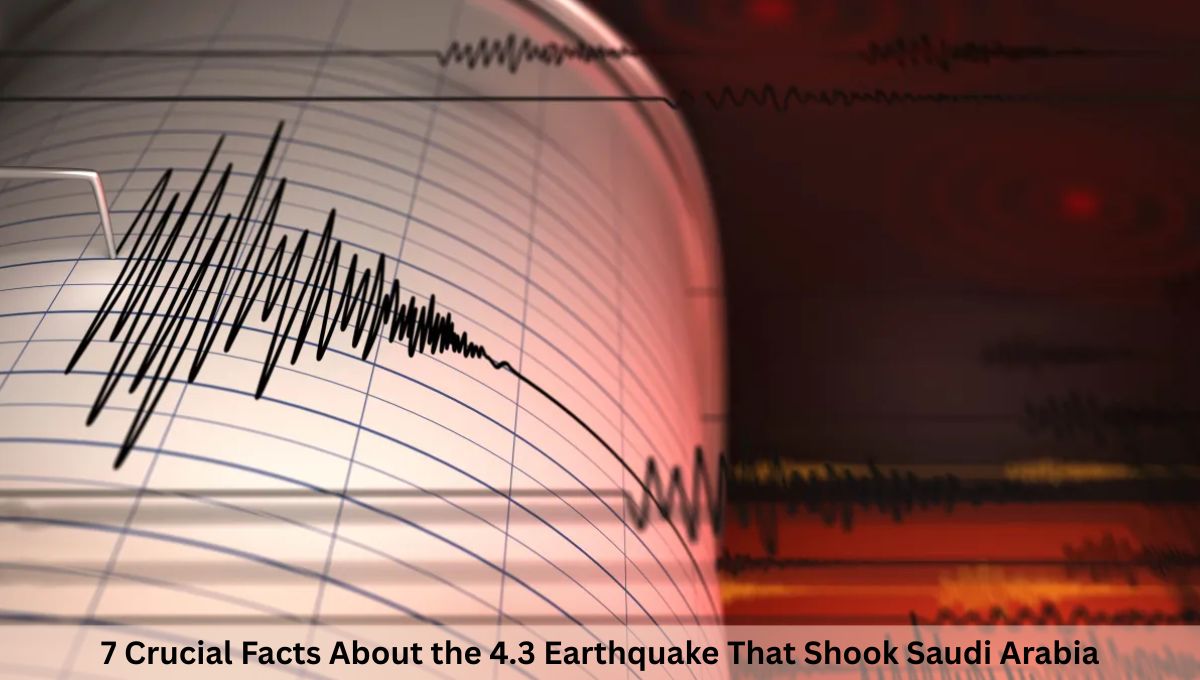
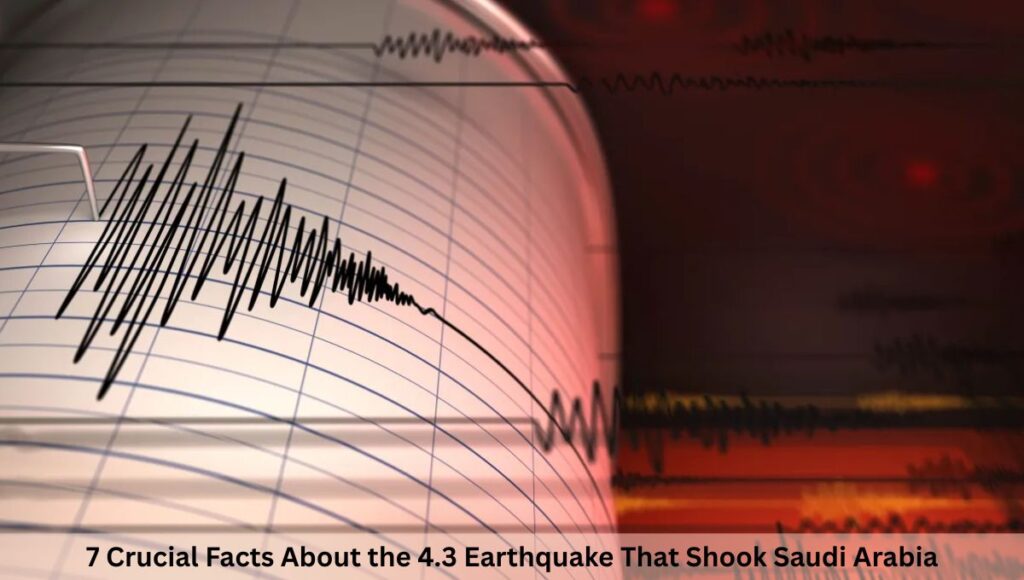
7 Crucial Facts About the 4.3 Earthquake That Shook Saudi Arabia early on December 17. A moderate earthquake measuring 4.3 on the Richter scale struck Saudi Arabia’s Eastern Province in the early hours of Wednesday, December 17, briefly raising concerns across the Gulf region.
While tremors were detected by seismic monitoring networks, authorities in both Saudi Arabia and the UAE confirmed that the quake caused no damage, no injuries, and no impact on neighbouring countries.
The event is the fourth notable seismic occurrence recorded in Saudi Arabia in 2025, highlighting the region’s ongoing — though generally mild — tectonic activity.
Here is a detailed breakdown of what happened, where it struck, whether it was felt in the UAE, and why such earthquakes occasionally occur in the Arabian Gulf.
7 Crucial Facts About the 4.3 Earthquake That Shook Saudi Arabia
When and Where Did the Earthquake Occur?
According to the National Centre of Meteorology (NCM) of the UAE, the earthquake occurred at 2:11am UAE time in Saudi Arabia’s Eastern Province, close to the Arabian Gulf.
Seismic data indicated:
- Magnitude: 4.3
- Depth: Approximately 50 kilometres beneath the surface
- Region: Eastern Province, Saudi Arabia
Meanwhile, the Saudi Geological Survey (SGS) reported a closely related reading, measuring the quake at 4.0 magnitude, recorded at 1:11am local Saudi time, with a shallower depth of around 8 kilometres. Minor variations in magnitude and depth are common due to differences in monitoring equipment and calculation methods.
Was the Earthquake Felt in the UAE?
No.
The UAE’s National Seismic Network, operated by the NCM, confirmed that the earthquake had no impact on the Emirates and was not felt by residents anywhere in the country. Despite the Eastern Province’s proximity to the Arabian Gulf, the quake’s moderate strength and depth significantly reduced the possibility of tremors travelling far enough to be felt across borders.
Authorities reassured residents that:
- There was no seismic threat to the UAE
- Coastal areas were completely unaffected
- No emergency response was required
Did the Earthquake Cause Any Damage or Injuries?
Both Saudi and regional authorities confirmed that the earthquake caused no damage to infrastructure and no injuries or casualties.
Official statements confirmed:
- No buildings were damaged
- No roads or utilities were affected
- No evacuations were necessary
Tareq Aba Al Khail, spokesperson for the Saudi Geological Survey, explained that the relatively low magnitude meant the tremor posed no risk to residents or infrastructure in the Eastern Province.
Why Do Earthquakes Occur in Saudi Arabia?
Although Saudi Arabia is not commonly considered a major earthquake hotspot, it lies on the Arabian Tectonic Plate, which is slowly moving and interacting with surrounding plates.
The primary cause:
- The collision between the Arabian Plate and the Eurasian Plate
- Tectonic stress generated in the Zagros Mountain range (Iran and Iraq)
These stresses can occasionally reactivate old geological faults beneath parts of Saudi Arabia, particularly in the Eastern Province near the Gulf. According to seismologists, such activity is normal and expected, and often releases built-up energy in small, non-destructive tremors.
Why Are Gulf Countries Sometimes Affected by Tremors?
Countries across the Gulf region — including Iran, Iraq, Oman, and Saudi Arabia — experience earthquakes more frequently due to active fault systems. While the UAE itself is not located on a major fault line, it lies close to the Zagros seismic belt, one of the world’s most active tectonic zones.
As a result:
- Strong earthquakes in neighbouring countries can sometimes be felt in the Northern Emirates
- Areas such as Fujairah and Ras Al Khaimah are more susceptible to mild tremors
In a previous interview with Khaleej Times, Mohamed Alhassani, Acting Head of the Seismic Monitoring Section at the NCM, explained:
“These events, though often centred hundreds of kilometres away, can produce tremors that may be felt in parts of the UAE, especially in the Northern Emirates.”
Recent Earthquakes Felt Near the UAE
Although the December 17 Saudi quake was not felt in the UAE, the region has experienced several mild tremors in recent months.
Notable recent events include:
- November 4: A 4.6-magnitude earthquake struck south of Musandam, with tremors felt in the UAE
- August: A 2.2-magnitude quake hit Madha, an Omani exclave within the UAE
- August 22: A 3.3-magnitude earthquake occurred in Safad, Fujairah
- December 1: A 3.3-magnitude quake struck Bahrain, with no UAE impact
- November 22: A 5.0-magnitude earthquake occurred in Iraq, also unfelt in the Emirates
These events underscore the UAE’s proximity to seismically active zones, even though the country itself remains relatively stable.
Saudi Arabia’s Earthquakes in 2025: A Growing Pattern?
The December 17 earthquake marks the fourth notable seismic event recorded in or near Saudi Arabia in 2025.
Timeline of notable tremors this year:
- April 2025: 4.0-magnitude quake, 55 km east of Jubail
- July 2025: Stronger 5.1-magnitude tremor near the Farasan Islands
- October 2025: 4.34-magnitude quake in the Arabian Gulf, northeast of Khafji
- December 2025: 4.3-magnitude quake in the Eastern Province
Experts stress that this does not indicate rising danger, but rather normal tectonic adjustments occurring over time.
Weather Alerts and Precautionary Measures
The earthquake occurred while Saudi Arabia’s Eastern Province remained under a red weather alert issued by the National Center of Meteorology.
Due to:
- Unstable weather conditions
- Rainfall and thunderstorms
- Reduced visibility
Authorities suspended in-person classes across parts of the region as a precautionary measure, though the suspension was not directly related to the earthquake.
Understanding the Science: Why Small Quakes Matter
Seismologists emphasize that small to moderate earthquakes often act as natural pressure-release mechanisms within the Earth’s crust.
Rather than signalling impending danger, these tremors:
- Prevent the buildup of larger seismic energy
- Help scientists better understand fault behaviour
- Improve regional monitoring and preparedness
Saudi Arabia’s National Seismic Monitoring Network continuously tracks such events in real time, ensuring swift communication with authorities and the public.
The Bottom Line
The 4.3-magnitude earthquake that struck Saudi Arabia’s Eastern Province on December 17 was:
- Moderate in strength
- Non-destructive
- Not felt in the UAE
- Part of routine tectonic activity in the region
Authorities across Saudi Arabia and the UAE have reassured residents that the situation remains stable, with no cause for alarm.
While the Gulf region will continue to experience occasional tremors due to its geological setting, experts agree that strong building standards, continuous monitoring, and public awareness significantly reduce risk.
For now, daily life across the Kingdom and neighbouring countries continues as normal — with scientists keeping a watchful eye beneath the surface.
Also Read: 7 Alarming Facts About Japan’s 7.5 Earthquake and Tsunami Threat
Also Read: Top 10 deadliest earthquakes of the 21st century: Mega-quake lurking around the corner?