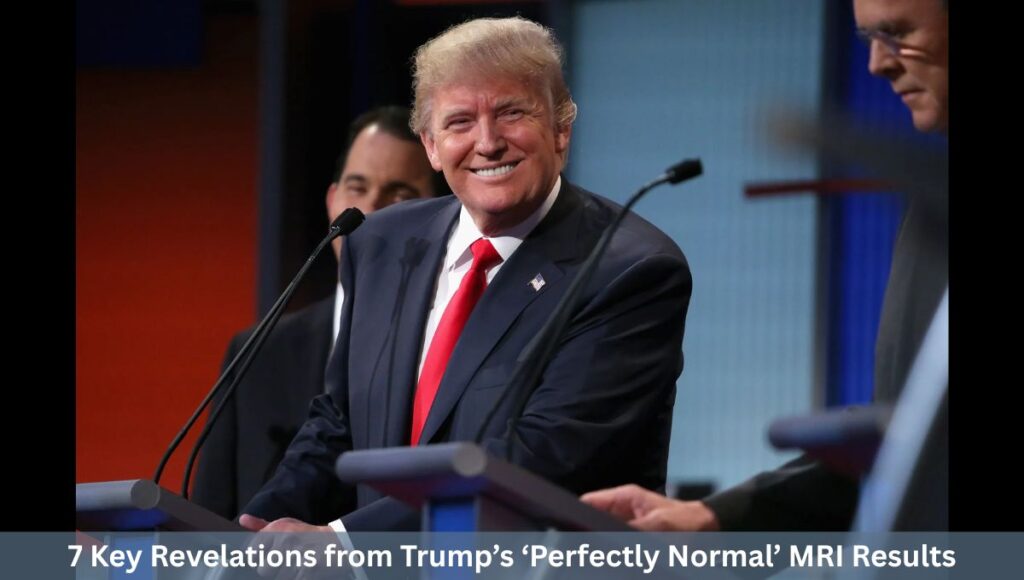
7 Key Revelations from Trump’s ‘Perfectly Normal’ MRI Results, amid rising speculation over his age, photos, and political attacks. The White House on Monday released a detailed breakdown of President Donald Trump’s recent advanced imaging results, asserting repeatedly that his cardiovascular and abdominal scans were “perfectly normal.”
The unusually comprehensive update is the administration’s strongest attempt yet to quell speculation surrounding the 79-year-old president’s health—speculation intensified by political rivals, medical experts, and the public following recent comments, photographs, and unanswered questions about the purpose of his MRI.
Press Secretary Karoline Leavitt, reading from a memo authored by White House physician Dr. Sean Barbabella, emphasized that President Trump remains in “excellent physical health” and that his advanced imaging revealed no signs of arterial narrowing, inflammation, clotting, or organ abnormalities.
Still, questions persist regarding why the scan was performed, why the White House initially avoided clarifying its purpose, and why the president himself claimed he had “no idea” which body part was scanned.
Below is a detailed, comprehensive overview of the findings, context, political reaction, and medical perspectives surrounding the latest Trump MRI results.
7 Key Revelations from Trump’s ‘Perfectly Normal’ MRI Results
The Memo: A Clean Bill of Health for Trump’s Cardiovascular System
According to the memo released by Dr. Sean Barbabella, President Trump’s cardiovascular imaging was “perfectly normal,” showing:
- No arterial narrowing
- No impairments in blood flow
- No abnormalities in the heart or major blood vessels
- Normal heart chamber size
- Smooth, healthy vessel walls
- No signs of inflammation or clotting
Dr. Barbabella wrote that the president’s cardiovascular system demonstrates “excellent health,” an assessment that the administration has repeatedly echoed since Trump retook the presidency.
Why the Cardiovascular Scan Matters
Cardiovascular issues are a common concern among men in Trump’s age group. According to the memo, the imaging was conducted “because men in his age group benefit from a thorough evaluation of cardiovascular and abdominal health.”
The White House framed the preventive scan as standard practice for an “executive physical,” a more comprehensive version of wellness screening often used by corporate leaders, heads of state, and people with access to high-tier healthcare.
Abdominal Imaging: “Perfectly Normal” With No Acute Concerns
Dr. Barbabella’s memo also emphasized the president’s abdominal health, stating that the MRI and related imaging revealed:
- Healthy and well-perfused organs
- No acute abnormalities
- No chronic issues
- Normal functioning across all evaluated systems
The memo repeatedly used the term “perfectly normal,” a phrase mirrored by Leavitt during the White House press briefing and by Trump himself during recent exchanges with reporters.
Routine or Not? The Medical Debate
While the White House insists the scans were preventive, multiple medical experts have expressed skepticism.
- Dr. Jonathan Reiner, a cardiologist and CNN medical analyst, described the imaging as “not standard procedure” for preventive care.
- Reiner emphasized that “there really is no preventative cardiac MRI,” suggesting the imaging was likely performed in response to a possible clinical concern.
- Experts interviewed by BBC noted that executive physicals may include a broad array of tests, but MRIs remain unusual unless symptoms are present.
Trump’s Statements: “It Was Just an MRI… I Have No Idea What Part of the Body”
President Trump’s own comments about the MRI have fueled controversy.
When initially asked what part of his body the MRI examined, Trump responded:
“I have no idea. It was just an MRI. What part of the body? It wasn’t the brain because I took a cognitive test and I aced it.”
He then urged reporters to “ask my doctors” why the scan was performed. Trump said on Air Force One that he was “open” to releasing the results and claimed the scan was “perfect.”
Cognitive Test Boasts
Trump again touted his performance on a cognitive test, a recurring theme in his public communication. He stated:
“It wasn’t the brain because I took a cognitive test and I aced it.”
He also taunted reporters, saying two of them would be “incapable” of passing such an exam.
Political Pressure: Governor Tim Walz Demands MRI Release
Minnesota Governor Tim Walz emerged as one of the most vocal critics demanding the release of the MRI results. His frustration grew after Trump used a slur to criticize him on Truth Social during Thanksgiving.
Walz stated:
“Has anyone in the history of the world ever had an MRI assigned to them and have no idea what it was for, as he says?”
He questioned Trump’s physical decline, referring to the president as “fading physically” and raising concerns over his “mental capacity.”
Walz doubled down on X (formerly Twitter), calling for the release of the MRI results and accusing Trump of political projection.
Intensified Scrutiny After Mar-a-Lago Photo Sparks Concern
A recent photo taken at Trump’s Mar-a-Lago club went viral, showing him sitting by a window with his eyes closed and mouth open, appearing fatigued or asleep. Social media users compared the image to former President Jimmy Carter in his later years, suggesting Trump looked frail.
Comments on X included:
- “He is seen falling asleep frequently.”
- “Clearly not well.”
- “Release the MRI results.”
The photo reignited discussions about Trump’s age—79—and whether his political workload is affecting his health.
Not the First Time Trump Appeared to Doze Off
Trump has occasionally been photographed appearing to doze during meetings or public events over the years, giving critics ammunition for claims about his stamina.
The White House dismissed such concerns, stating that Trump is in “optimal physical health.”
Earlier Diagnoses: Chronic Venous Insufficiency and Hand Bruising
This summer, the White House disclosed that Trump had been diagnosed with chronic venous insufficiency, a condition caused by weakened valves in the veins of the legs. Symptoms can include:
- Leg swelling
- Discomfort
- Visible venous pooling
- Occasional cramping
The condition is common in older adults and typically manageable.
Trump has also been seen with bruising on his right hand, sometimes concealed with makeup. The administration attributed this to the aspirin regimen he takes as part of cardiovascular care.
Experts Weigh In on Leg Swelling
Dr. Reiner noted that cardiac testing can help determine whether heart function contributes to leg swelling, raising questions about whether the MRI was prompted by symptoms rather than routine screening.
Questions Over Transparency and Why the MRI Was Performed
Although the White House eventually released detailed findings, the administration initially avoided answering the core question: why was advanced imaging performed during an unscheduled October visit to Walter Reed?
Press secretary Karoline Leavitt previously told reporters:
“I’ll check back on that,”
but never offered follow-up details until now.
Medical experts note:
- Preventive MRI is rare.
- Routine imaging is discouraged for asymptomatic older adults.
- Executive physicals may include more tests, but “perfectly normal” results across all categories are uncommon.
The Administration’s Explanation
The memo maintained that the imaging was performed:
“to identify issues early, confirm overall health, and ensure he maintains long-term vitality and function.”
It framed the procedure as precautionary, not diagnostic.
Trump’s Reaction: Personal Attacks and Comparisons to Biden
Trump has aggressively defended his health amid negative headlines, attacking the New York Times and one of its reporters, Katie Rogers, after an article questioned whether his age may be affecting his energy levels.
He posted on Truth Social:
- Calling Rogers “ugly, inside and out”
- Accusing the Times of being “an enemy of the people”
- Insisting he has “never worked so hard in my life”
- Claiming his medical results prove his stamina
Trump also compared himself to Joe Biden—whom he calls “Sleepy Joe”—pointing out that Biden recently turned 83 and stepped away from the 2024 race due to health concerns.
A split-image circulating on social media showing Biden looking energetic in Nantucket alongside the photo of Trump at Mar-a-Lago intensified the comparison.
The Unscheduled October 10 Walter Reed Visit: A Timeline
The root of the controversy stems from Trump’s October 10 visit to Walter Reed National Military Medical Center. Although the White House described it as a routine yearly checkup, Trump had already undergone his annual physical in April.
Key timeline points:
- April: Trump completed his annual physical.
- October 10: Unscheduled Walter Reed visit reportedly included an MRI.
- October: Trump told reporters he had received an MRI but didn’t know what part of his body was scanned.
- Subsequent weeks: The White House avoided direct answers.
- Thanksgiving weekend: Trump teased the results on Air Force One, calling the scan “perfect.”
- Monday: White House finally releases detailed memo.
The additional scan months after the annual physical raised questions among medical experts and political observers alike.
What MRI Scans Typically Detect—and Why This Matters
MRI scans can be used to detect:
- Tumors
- Strokes
- Brain abnormalities
- Vascular inflammation
- Muscular or skeletal injuries
- Organ dysfunction
- Soft-tissue damage
Because MRI is non-invasive yet highly sensitive, they are sometimes used to investigate:
- Unexplained pain
- Swelling
- Neurological symptoms
- Circulatory issues
- Cancer screening (in high-risk patients)
This context makes the lack of clarity about why Trump underwent imaging all the more notable.
Did the Scan Indicate a Concern? Experts Divided
Several physicians have remarked that:
- Preventive MRIs may create false positives.
- They are expensive and time-consuming compared to other screening tools.
- They are not typically part of standard preventive care for men Trump’s age.
Experts suspect a clinical trigger, though the memo denies this.
Trump’s Age, Workload, and Declining Public Schedule
Beyond the MRI, discussions about Trump’s age reflect broader concerns about the demands of the presidency.
Reports indicate:
- Trump has significantly reduced domestic travel.
- Public events typically occur between noon and 5 p.m.
- His first-term schedule was notably more aggressive.
While the White House insists he is “unusually vigorous,” critics argue the schedule reflects a slowing pace.
The Bigger Picture: Health Transparency in Politics
U.S. presidents face immense scrutiny over their health—especially older presidents. Trump is the second-oldest person ever to serve, after Biden.
The MRI episode highlights:
- The importance of clear communication
- The political weaponization of age
- Public sensitivity to cognitive and physical decline in leaders
- A broader debate about the transparency of presidential health records
Medical transparency remains a contentious political issue, and the Trump administration’s handling of the MRI results adds to the ongoing discussion.
Conclusion: A Clean Report, but Lingering Questions
The White House has now released a detailed, medically specific memo affirming that President Donald Trump’s MRI and advanced imaging were “perfectly normal” and showed “excellent cardiovascular and abdominal health.”
Politically, the update is intended to halt speculation amplified by rival campaigns, viral photos, and Trump’s ambiguous statements. Medically, however, experts remain divided over whether such imaging fits within standard preventive care—or whether it reflects a deeper, undisclosed clinical concern.
For now, the administration is standing firmly behind its assertion that the president is in optimal physical condition, and that the MRI was merely a routine executive evaluation.
Yet, as the president approaches his 80th birthday and enters the later years of his second term, scrutiny of Donald Trump’s health is certain to remain a central narrative in American politics.
Also Read: 7 Startling New Questions Surrounding Trump’s Mysterious MRI Scan
Also Read: Trump’s doctor says his health is ‘excellent,’ but questions remain