7 Startling New Questions Surrounding Trump’s Mysterious MRI Scan that the White House refuses to clarify. The health of any American president is a matter of global importance. But when the president is 79 years old, known for poor diet and minimal exercise, and already diagnosed with a chronic medical condition, the stakes rise sharply.
That is why President Donald Trump’s surprise disclosure that he underwent an MRI scan—followed by the White House’s refusal to explain why—has triggered a political firestorm, online mockery, and calls for transparency that grow louder by the day.
For weeks, the Trump administration has insisted that everything is routine. But the facts tell a different story: two physicals in six months, conflicting explanations, visible leg swelling, and a White House press secretary who abruptly walked out when pressed on the details of the MRI.
So what exactly is going on with Donald Trump’s health? Let’s break down the controversy, the statements, the contradictions, and the unanswered questions shaping the biggest presidential health mystery since Joe Biden’s mental-fitness scandal.
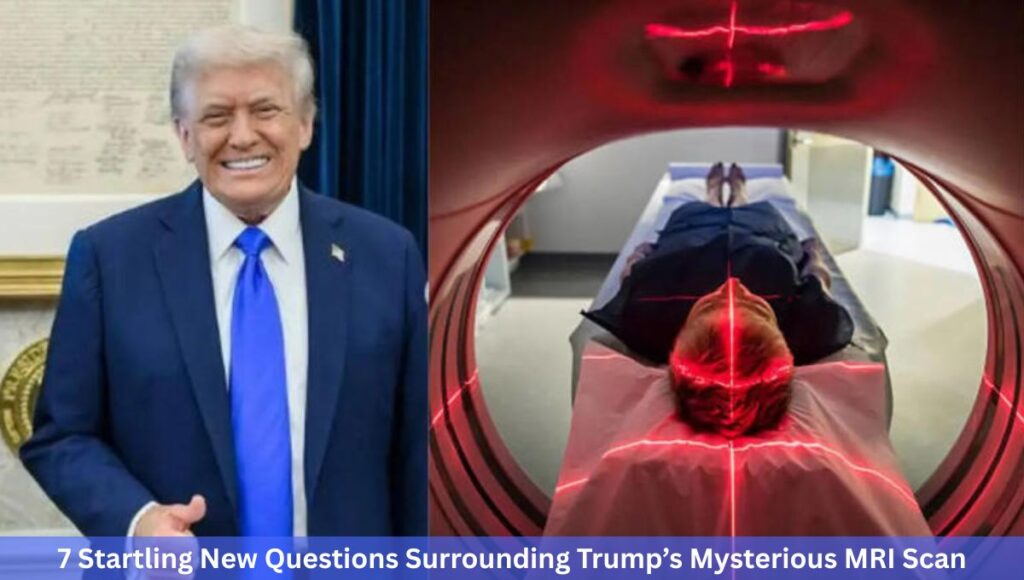
7 Startling New Questions Surrounding Trump’s Mysterious MRI Scan
How Trump Revealed the MRI—And Why It Triggered Mockery
The saga began when Trump casually mentioned to reporters aboard Air Force One that he had undergone an MRI scan earlier in October during a visit to Walter Reed National Military Medical Center.
His statement was classic Trump:
“I had an MRI. I had no idea what they analyzed, but whatever they analyzed, they analyzed it well.”
That comment alone triggered widespread online ridicule. Critics seized on the idea that the president of the United States—who claims he “aces” mental acuity tests—did not seem to know what part of his body was scanned.
Trump went on to describe the test as “very standard,” saying:
“Getting an MRI is very standard. What, you think I shouldn’t have it?”
But medical experts quickly pointed out that MRIs are not standard in routine physical exams—particularly not for someone who already had his annual physical in April, just six months earlier.
Trump’s Age and Health Issues Put the MRI Under a Microscope
Fact #1: Trump is 79 years old
At his age, any advanced imaging test is bound to raise questions.
Fact #2: His annual physical was already completed in April
The October visit to Walter Reed was the second “annual” checkup in six months.
Fact #3: He was diagnosed with chronic venous insufficiency in July
This condition—revealed by the White House only months earlier—causes leg swelling and poor blood flow. It is typically evaluated using ultrasound, not MRI.
Fact #4: The White House called his October visit “routine,” despite the timing
That explanation immediately raised eyebrows.
Fact #5: Trump claimed he gave the “full results”
He did not.
Fact #6: The White House refuses to answer the most basic questions
Including:
- What part of the body was scanned?
- Why did doctors order the MRI?
- What were they trying to rule out?
This evasiveness is what transformed a routine (or supposedly routine) medical visit into a political scandal.
Karoline Leavitt’s Scripted Non-Answer Makes Things Worse
During a White House press briefing, a reporter followed up on Leavitt’s earlier promise that she would “check with President Trump” about the MRI.
What happened next went viral.
Leavitt responded:
“As stated in the memo… President Trump received advanced imaging as part of his routine physical exam… All agreed that President Trump remains in exceptional physical health.”
Notably missing?
Everything.
No mention of:
- what the MRI focused on
- why it was required
- what triggered the need for “advanced imaging”
- whether it was related to his chronic venous insufficiency
- or any medical justification at all
Then she abruptly ended the briefing and walked off. Critics immediately pounced.
One user wrote:
“This is a bold-faced lie. MRIs are NOT routine. What part of his body was scanned?”
Another:
“You do not get advanced imaging if you’re in exceptional health.”
Even longtime observers were stunned at the evasiveness.
Mockery, Outrage, and Alarm: How Critics Reacted
Mehdi Hasan Calls It ‘25th Amendment Territory’
Journalist Mehdi Hasan wrote on X:
“Donald Trump says he does not know why he had an MRI. How is this not 25th Amendment territory?”
Symone Sanders Townsend Questions the White House Line
MSNBC host Symone D. Sanders Townsend posted:
“This is not routine. Why did the President need an MRI?”
Joe Walsh Goes Nuclear
Former GOP Congressman Joe Walsh wrote:
“The greatest country in the history of the world twice elected the most stupid, most ignorant, biggest idiot in the history of the world.”
Ed Krassenstein Shreds the ‘Routine MRI’ Claim
He noted that MRIs are only ordered when a specific medical concern exists:
“MRIs are not routine. They are given when a problem is suspected or to rule out a condition.
We need more transparency.”
So What Exactly Happened at Walter Reed in October?
Trump spent nearly three hours at the Bethesda, Maryland facility on October 10.
According to White House physician U.S. Navy Captain Sean Barbabella:
- It was a scheduled follow-up evaluation
- Trump received his flu shot and COVID booster
- “Advanced imaging, lab testing, and preventive assessments” were performed
- His “cardiac age” was found to be 14 years younger than his real age
But none of that explains the need for an MRI. The White House originally described the visit as a “routine yearly checkup.”
But that contradicts the fact that Trump had already undergone his annual physical in April. Trump later called it a “semiannual physical.” That explanation raised new questions instead of answering the old ones.
MRIs Are Highly Specialized — And Rarely Routine
Medical experts emphasize that an MRI is not like bloodwork or X-rays.
According to the National Institutes of Health, MRI scans are used to examine:
- the brain
- the spinal cord
- muscles and ligaments
- internal organs
- soft-tissue abnormalities
- tumors
- neurological issues
- unexplained pain or swelling
The test can take up to an hour and requires lying still inside a magnetic tube.
Clinicians say MRIs are ordered when:
- a doctor is concerned about a neurological condition
- a patient reports symptoms that require deeper imaging
- there is a need to rule out serious problems
They are not performed “just because.”
This is why Trump’s repeated insistence that it was “very standard” rings hollow to doctors and the public.
Chronic Venous Insufficiency: Does It Explain the MRI?
Trump’s diagnosis in July revealed:
- swelling in his legs
- poor venous blood flow
- a common condition in older adults
- typically evaluated via ultrasound, not MRI
While CVI can cause discomfort and visible swelling, it rarely requires advanced imaging.
The fact that the White House offered no medical context heightens suspicion that something else prompted the MRI.
Fox News Interrupts Programming for a Health Update
Fox News took the issue seriously enough to cut into regular programming to update viewers on Trump’s MRI after Leavitt’s press conference.
The network repeated the official line:
Trump is in “exceptional physical health,” based on radiologists’ review.
But even Fox analysts privately questioned:
- why Trump needed two major medical evaluations in six months
- why “advanced imaging” was kept secret
- why the White House cannot provide basic medical details
When the conservative network is asking tough questions, it signals a deeper problem.
The Transparency Problem: A Tale of Two Presidents
Critics on both sides have drawn parallels to the Biden administration’s secrecy over Joe Biden’s physical decline. Many of the same commentators now demanding answers about Trump’s MRI were also highly critical of limited disclosures under Biden.
One journalist wrote:
“If the lack of transparency under Biden was unacceptable, it has to be unacceptable under Trump too.”
Medical historian Jacob Appel echoed this sentiment, noting:
“Filtering information through political spin doesn’t serve the public interest.”
For decades, presidents have hidden health problems:
- Franklin Roosevelt concealed paralysis
- Grover Cleveland secretly had cancer surgery
- John F. Kennedy hid chronic pain disorders
- Ronald Reagan’s mental decline was quietly managed
Trump seems to be following a well-worn path.
The White House Strategy: Say Nothing, Reveal Nothing
The administration’s approach has been consistent:
- Acknowledge the MRI happened
- Insist it was routine
- Claim perfect health
- Offer no medical specifics
- Shut down questions
This strategy may work politically—but it fails the transparency test.
With Trump now the oldest president in American history, the public has a legitimate right to know why he is undergoing advanced imaging.
Is Trump’s Mental Health Being Evaluated?
One remark stood out during Trump’s Air Force One comments.
He said:
“I also took a very advanced test on mental acuity… and I aced it.”
It is unclear:
- whether this test was part of the Walter Reed visit
- whether the MRI was related
- whether neurological concerns exist
While Trump has long bragged about these cognitive tests, the timing—coupled with an MRI—raises further questions.
Seven Big Unanswered Questions
Here are the seven most pressing questions now fueling media pressure:
1. What body part was scanned?
Brain? Spine? Legs? Abdomen?
2. Why was advanced imaging required?
Routine exams don’t include MRIs.
3. Was the MRI related to chronic venous insufficiency?
If not, what new issue emerged?
4. Why did Trump have a second “annual” physical in October?
Especially so soon after his April exam.
5. Why did the White House not disclose the MRI in the initial statement?
What changed?
6. Why did Karoline Leavitt walk off instead of answering?
Her exit fueled speculation.
7. Is a neurological or cognitive concern being concealed?
Trump’s vague comments do not help.
Until these questions are answered, speculation will only grow.
The Bigger Picture: What Is the Public Entitled to Know?
There is no legal requirement for full presidential medical transparency. But there is a public expectation—and a national security argument—that the health of the commander in chief should be disclosed honestly.
As one medical expert said:
“You do not get advanced imaging if you’re in exceptional health.”
And that is exactly the point. The White House says everything is normal. The facts suggest otherwise.
Conclusion: A Mystery That Isn’t Going Away
Trump’s MRI scan has opened a deeper, more uncomfortable debate about presidential health transparency. The administration’s refusal to share even the most basic medical details—while insisting everything is “perfect”—has only intensified suspicions.
Trump’s age, his history of concealing health information, his diagnosis of chronic venous insufficiency, and the timing of a second physical all point to the likelihood that something prompted doctors to order advanced imaging.
Until the White House answers the core questions—what was scanned and why—the controversy will continue to swirl.
For now, Americans are left with the president’s own words:
“I had no idea what they analyzed, but whatever they analyzed, they analyzed it well.”
And that may be the most troubling part of all.
Also Read: Trump’s 2025 Health Check — Cardiac Age 14 Years Younger
Also Read: White House declines to disclose specific details of Trump’s health imaging