

7 Big Reasons Pakistan PM Aide’s Meeting with Israeli Official Is Sparking Massive Debate amid speculation over Pakistan’s potential role in a Gaza sabilization mission. When a video emerged from the World Travel Market (WTM) in London—showing Pakistan’s Prime Minister’s Adviser on Tourism, Sardar Yasir Ilyas Khan, shaking hands and briefly conversing with Michael Izhakov, Director General of Israel’s Ministry of Tourism—it ignited a storm of debate, speculation, and political backlash across Pakistan.
The encounter lasted only a few seconds. But in a country whose foreign policy forbids diplomatic engagement with Israel, even a casual handshake becomes a national talking point. The incident happened just as Pakistan is being mentioned in global discussions surrounding US President Donald Trump’s proposed Gaza ceasefire plan, which includes a controversial International Stabilization Force (ISF).
This geopolitical backdrop has only amplified the questions:
Was the meeting accidental, unauthorized, or part of something bigger?
This detailed report explores why this seemingly small moment has captured national attention and raised eyebrows across diplomatic circles, political parties, and online communities.
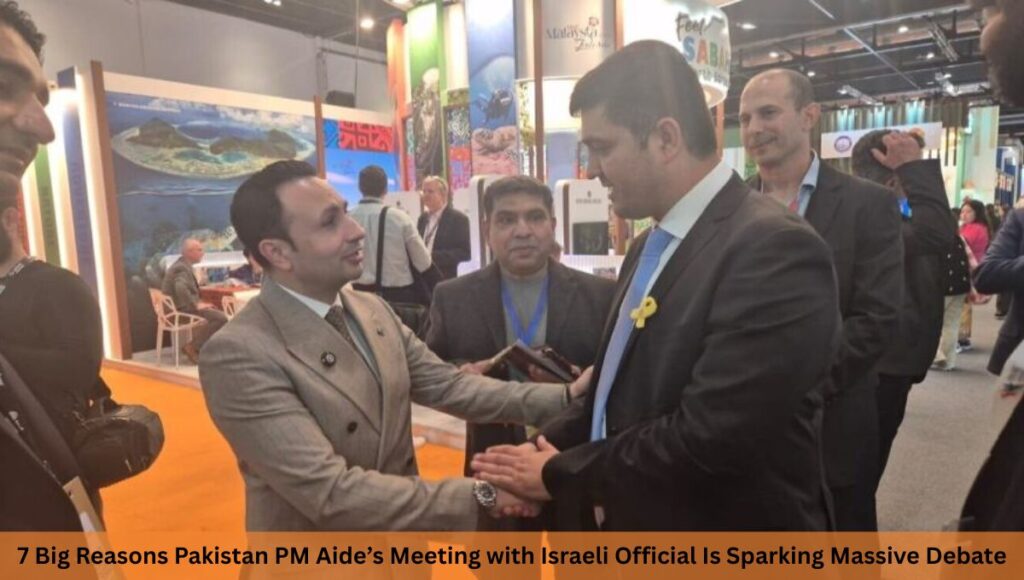
7 Big Reasons Pakistan PM Aide’s Meeting with Israeli Official Is Sparking Massive Debate
How the London Incident Unfolded
The World Travel Market (WTM) in London is one of the world’s biggest tourism exhibitions, drawing national delegations, travel companies, airlines, and ministers from over 180 nations. The 2025 edition was held from November 4 to 6.
A video recorded by attendees showed Israel’s tourism chief Michael Izhakov walking up to the Pakistan pavilion, where he greeted and shook hands with Sardar Yasir Ilyas Khan.
The exchange appeared warm and courteous, with Khan saying:
“No, no, no. We are always open to everything.”
Within hours, the video was circulating widely on South Asian social media, triggering a mix of shock, outrage, and speculation.
Why the Interaction Was So Sensitive
1. Pakistan and Israel Have No Diplomatic Relations
Pakistan:
- Does not recognize Israel
- Bars its citizens from travelling to Israel (explicitly written in passports)
- Publicly aligns with the Palestinian cause
Any public engagement—even symbolic—immediately becomes controversial.
2. Pakistan Has a History of Denying Secret Contacts
Over the past year, reports of Pakistani individuals—including journalists and educators—visiting Israel created controversy back home.
This latest encounter appears to be part of a pattern that opponents claim suggests creeping unofficial engagement.
3. Timing With Gaza Developments Intensified Reactions
The meeting comes as Pakistan is rumoured to be considered for the International Stabilization Force (ISF) in Gaza—fueling claims that Islamabad may be adjusting its stance under U.S. pressure.
What the Tourism Adviser Said
After the video went viral, Sardar Yasir Ilyas Khan issued a formal clarification.
Key points from his statement:
- He travelled to London at his own expense, leading a 31-member delegation of Pakistani tourism companies.
- The Israeli delegation visited the Pakistan pavilion unannounced.
- They did not introduce themselves as Israeli officials.
- The brief exchange was accidental and informal.
The statement added Khan was representing Pakistan “as a proud patriot” to promote a “positive tourism narrative.”
Khan’s version echoes statements from earlier controversies where Pakistanis met Israeli officials abroad. Critics argue that such repeated incidents cannot be dismissed as coincidences, while the government asserts that unauthorized informal interactions do not signal policy change.
How Islamabad Reacted to the Video
At the weekly foreign office briefing, spokesperson Tahir Hussain Andrabi strongly denied any official sanction for the encounter.
His key statements:
- “If such an interaction took place, it was without authorization.”
- The government had no prior information about the meeting.
- Linking the incident to larger diplomatic realignments was “too far-fetched.”
The foreign office highlighted that:
- Pakistan’s policy on Israel remains unchanged.
- Speculation about joining the Abraham Accords is “unjustified.”
- No decision has been made on participating in the Gaza stabilization mission.
The repetition and emphasis in Andrabi’s statements signaled the government’s desire to quickly end speculation about shifting alliances.
Political and Public Backlash in Pakistan
The response at home was swift and fierce, especially from right-wing parties and pro-Palestine groups.
Mushtaq Ahmed Khan’s Sharp Reaction
Former Jamaat-i-Islami senator Mushtaq Ahmed Khan called the meeting:
- “Shameful”
- “A betrayal of Al-Aqsa and Gaza”
- “Rubbing salt into the wounds of Pakistanis”
He accused the government of succumbing to Western pressure, particularly from the Trump administration.
PTI Demands Answers
Pakistan Tehreek-e-Insaf (PTI) reshared the video and demanded an official explanation, stating:
“Any deviation from Pakistan’s official position on Israel cannot be overlooked.”
Political observers note that with Pakistan’s tense domestic climate, even small diplomatic incidents can be leveraged as political ammunition.
The Online Storm: Trolls, Memes, and Theories
Social media responses ranged from sarcasm to conspiracy theories:
- Some users accused Pakistani officials of secret contacts with Israel.
- Others alleged the meeting was orchestrated by Pakistan’s intelligence agencies.
- Several called for boycotts of businesses linked to officials in the video.
- A few joked that Pakistan could “do anything for money,” pointing to the country’s economic struggles.
Whether exaggerated or not, the online reactions reflect deep public distrust regarding any perceived political shift on Palestine.
The Bigger Geopolitical Context: Gaza and the ISF
The video surfaced just as Pakistan is being discussed as a possible contributor to the International Stabilization Force—a proposed U.S.-backed, post-war multinational force for Gaza.
What the ISF Would Do
- Secure key areas of Gaza
- Facilitate humanitarian aid
- Assist in rebuilding basic governance
- Support post-conflict stabilization
Many expected participants are Muslim-majority countries.
Pakistan’s Position
Foreign office spokesperson Andrabi said:
- Pakistan and Jordan coordinate closely on Palestine.
- The upcoming visit of Jordan’s King Abdullah II will likely discuss Gaza.
- No decision has been made about sending Pakistani troops.
- The UN Security Council is still debating the mandate.
Yet, several international reports claim:
- Pakistan may send 20,000 troops.
- Pakistan Army Chief Gen. Asim Munir allegedly met Mossad and CIA officials in Egypt.
Islamabad, however, has not confirmed any such meetings.
Why Pakistan’s Role Matters to Washington
Analysts say the United States—under Trump’s renewed Middle East strategy—views Pakistan as a potentially important player in:
- Gaza post-war stabilization
- Countering Iran’s influence
- Developing alternate regional corridors
- Security operations in South-Central Asia
Some reports suggest Islamabad offered the U.S. development access to Pasni Port in Balochistan—near Iran’s border.
This would intersect with:
- U.S. strategic interests
- China’s CPEC investments
- Local insurgent groups like the BLA
For Pakistan, navigating these competing pressures is becoming increasingly complex.
Has Pakistan Shifted Its Policy on Israel?
Despite repeated speculation, Pakistan maintains three long-standing principles:
- Israel cannot be recognized until a sovereign Palestinian state is established.
- The state must be based on pre-1967 borders.
- East Jerusalem must serve as the Palestinian capital.
Pakistan has:
- Signed a joint declaration with 14 countries criticizing Israeli settlements.
- Denied removing “Except Israel” from its passport validity line.
- Repeatedly reaffirmed that no normalization is underway.
The government insists the London handshake was a brief, unauthorized, and insignificant occurrence.
But critics view it as part of a pattern.
Why This Incident Captured Attention Worldwide
1. It challenges entrenched political taboos in Pakistan.
Even small gestures toward Israel generate outsized reactions.
2. It coincides with global discussions about Pakistan’s military role in Gaza.
The timing fuels suspicion.
3. The incident involves tourism officials—but the implications are geopolitical.
Tourism encounters are usually harmless—except between two adversarial states.
4. It exposes Pakistan’s internal political divides.
Opposition parties quickly weaponized the moment.
5. It resurrects earlier debates about journalists and educators visiting Israel.
The pattern raises questions about unofficial “track-two dialogues.”
A Nation on Edge Over Palestine Policy
The depth of public reaction stems from Pakistan’s historical alignment with Palestine.
To many Pakistanis, even a handshake feels symbolic—signalling a possible break from the past.
While Islamabad insists no such shift is underway, the political, military, and diplomatic context ensures that every small event will be closely watched in the months ahead.
Conclusion
The handshake at WTM London lasted only moments. But in Pakistan, it opened a national conversation about foreign policy, transparency, political accountability, and the country’s role in emerging Middle Eastern realignments.
Whether the meeting was a harmless interaction or part of a larger pattern, one thing is clear:
Pakistan’s stance on Israel and Palestine remains one of its most emotionally charged and politically sensitive issues.
With the U.S. pushing its Gaza stabilization plan, and regional alliances shifting rapidly, even minor incidents like this can quickly escalate into major political debates.
For now, the government maintains its position — No recognition of Israel, no authorized contact, and no policy change. Yet the controversy shows that Pakistan’s public, political parties, and global observers will be scrutinizing every move in the months to come.
Also Read: 7 Key Developments as Pakistan Senate Passes Sweeping Amendment Expanding Military Powers
Also Read: Is Pakistan quietly engaging with Israel?
Related Posts:
- 7 Shocking Twists in Imran Khan Death Rumours and Jail Chaos

- 17-Year Shock Verdict: Imran Khan Jailed as Protests Loom

- 7 Urgent Revelations as Imran Khan’s Isolation…
- 7 Shocking Revelations as Imran Khan’s Sister…
- Afghanistan–Pakistan War 2025: Inside the 48-Hour Ceasefire

- Trump’s 20-Point Gaza Peace Plan Gains Urgent Global…
