

7 Key Developments as Pakistan Senate Passes Sweeping Amendment Expanding Military Powers under Field Marshal Asim Munir. Pakistan’s Senate has approved the 27th Constitutional Amendment Bill, a measure that significantly expands the powers of the country’s military establishment under Army Chief and Field Marshal Asim Munir.
The bill, passed on Monday, creates a new post titled Chief of Defence Forces (CDF), a role that will oversee the Army, Navy, and Air Force under a unified command structure. The amendment also introduces provisions for lifetime privileges for senior officers holding five-star ranks and alters the framework of the judiciary through the creation of a Federal Constitutional Court (FCC).
The development marks one of the most substantial changes to Pakistan’s civil-military framework in recent years and has drawn mixed reactions from political leaders, legal experts, and analysts.
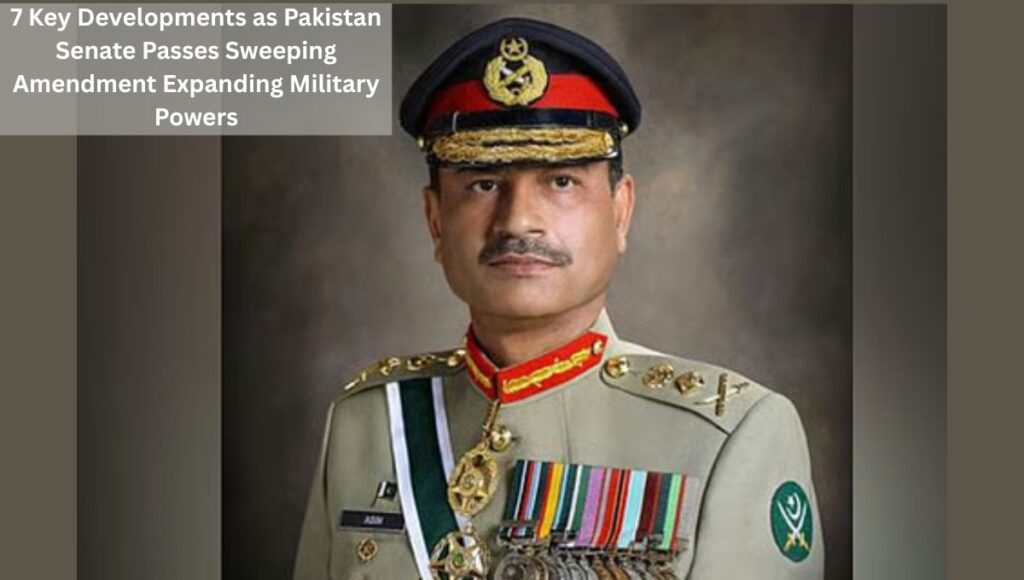
7 Key Developments as Pakistan Senate Passes Sweeping Amendment Expanding Military Powers
1. Creation of Chief of Defence Forces (CDF)
A Unified Command Structure
According to the bill, the newly created Chief of Defence Forces will serve as the supreme operational authority over all branches of the armed forces. The amendment modifies Article 243 of the Constitution, shifting the chain of command from the President and Cabinet to the new CDF role.
The government has indicated that the position will be held concurrently by the Army Chief, currently Field Marshal Asim Munir, effectively consolidating command authority under a single office.
A report by the Associated Press of Pakistan (APP) noted that the CDF will be responsible for coordination between the three military branches and will advise the Prime Minister and Cabinet on defence policy.
Government’s Position
Defence Minister Khawaja Asif told Geo News that the amendment was “designed to modernise the defence structure and improve coordination between services,” describing it as a “strategic adjustment reflecting operational realities.”
He added that the measure “does not diminish civilian control but brings efficiency to the defence establishment.”
2. Legal Immunities and Lifetime Rank Privileges
Five-Star Officers Granted Immunity
The amendment introduces lifetime privileges and protections for officers promoted to five-star ranks, including Field Marshal, Marshal of the Air Force, and Admiral of the Fleet.
According to Dawn, these officers “retain rank, privileges, and uniform for life” and are removable only through impeachment similar to that of the President under Article 47.
The amendment also grants these officers immunity from legal proceedings under Article 248, effectively shielding them from prosecution while in or out of office.
Legal Reactions
Prominent constitutional lawyer Makhdoom Ali Khan wrote in Dawn that the provisions create “a parallel authority insulated from the very rule of law it is sworn to defend.”
Critics have argued that the new protections could weaken accountability mechanisms, while supporters say the changes recognise “service continuity at the highest military level.”
3. Dissolution of Joint Chiefs Role
End of the CJCSC Post
The amendment abolishes the position of Chairman of the Joint Chiefs of Staff Committee (CJCSC)—a post historically tasked with coordination among the armed forces.
This role will now be replaced by the Chief of Defence Forces, centralising authority under a single office.
Retired Defence Secretary Lt Gen Asif Yasin Malik told Dawn that “the arrangement tilts the balance decisively in favour of one service,” warning that it “may create institutional friction.”
Concerns Over Balance
Former human rights minister Shireen Mazari questioned whether the removal of the CJCSC would also dissolve the Joint Chiefs of Staff Committee.
She told Dawn, “If the CDF is an army officer overseeing the Air Force and Navy, the new structure could invite institutional imbalance.”
4. Changes to Pakistan’s Nuclear Command
National Strategic Command Reorganized
The amendment also introduces changes to the National Strategic Command, the body responsible for Pakistan’s nuclear arsenal.
Under the new framework, the Commander of the National Strategic Command will be appointed by the Prime Minister on the recommendation of the Army Chief and must be an officer from the Pakistan Army.
Former defence officials and analysts have pointed out that this effectively places the country’s nuclear assets under army control.
Expert Concerns
Mazari noted that this could “lead to command and control problems and time delays in crisis situations,” particularly since second-strike capabilities, traditionally handled by the Navy, would also fall under army jurisdiction.
Retired Lt Gen Malik added that the 2019 Balakot incident “highlighted the value of inter-service consultation, which this structure may now limit.”
5. Judicial Reforms and the Federal Constitutional Court
Restructuring Judicial Authority
The amendment establishes a Federal Constitutional Court (FCC), which will assume some of the powers currently held by the Supreme Court, including constitutional interpretation and disputes between federal and provincial governments.
It also revises the process for appointing and transferring judges, enabling the President to move high court judges across provinces and creating new mechanisms within the Judicial Commission of Pakistan (JCP).
A commentary in Dawn described these reforms as “an obituary for judicial independence,” warning that the Supreme Court’s jurisdiction could be reduced to handling only civil and criminal appeals.
Government’s Response
Law Minister Azam Nazir Tarar, who tabled the bill, said the judicial reforms were intended to “streamline case management” and “avoid overlapping jurisdictions.” He maintained that the FCC would “enhance judicial efficiency, not limit independence.”
6. Political and Opposition Reactions
Nationwide Opposition Protests
Opposition parties, including the Pakistan Tehreek-e-Insaf (PTI), Pashtunkhwa Milli Awami Party (PkMAP), Balochistan National Party-Mengal (BNP-M), and Majlis Wahdat-e-Muslimeen (MWM), have launched protests against the amendment.
The coalition, operating under the banner Tehreek-e-Tahafuz Ayeen-e-Pakistan (TTAP), argues that the changes will “shake the foundations of the Constitution.”
MWM leader Allama Raja Nasir Abbas said in a statement, “Democratic institutions have been paralysed in Pakistan. The nation must rise against the proposed amendment.”
PkMAP chief Mahmood Khan Achakzai told reporters, “Our slogans will be: ‘Long live democracy’ and ‘Down with dictatorship.’ We have no choice but to protest what we see as the erosion of constitutional order.”
Government’s Majority Support
Despite the criticism, the government has expressed confidence that it will secure the required two-thirds majority in both chambers of Parliament to enact the amendment.
7. Debate Over Civil-Military Balance
Analyst Perspectives
Political analysts view the amendment as part of a longer pattern of civil-military rebalancing in Pakistan.
Analyst Habib Akram told Geo News that the amendment “represents one of the most far-reaching shifts in Pakistan’s institutional framework since the 1973 Constitution.”
He compared it to General Zia-ul-Haq’s 8th Amendment, saying “such structural concentration of power often produces unintended consequences.”
Civil-Military Context
Pakistan’s military has historically played an influential role in governance, with three direct interventions in 1958, 1977, and 1999.
Observers note that the current development differs in process rather than substance — representing what some have described as a “constitutional consolidation” rather than an overt takeover.
Next Steps in the Legislative Process
The bill now awaits consideration by the National Assembly, where it must also secure a two-thirds majority before being sent to the President for assent.
If enacted, the amendment will formally institutionalise the Chief of Defence Forces role and bring into effect the new judicial and strategic command structures.
Political observers anticipate continued debate over the implications for Pakistan’s separation of powers, civil-military relations, and judicial independence.
Also Read: Trump Hosts Pakistan’s Munir, Claims Credit for Averting War
Also Read: Adil Raja Exposes Asim Munir’s Plan to Wage War on India
Related Posts:
- 9 Powerful Signals Behind Saudi Arabia Honoring…

- 7 Shocking Reasons US Sees Asim Munir as a Strategic…

- 5 Major Takeaways from the US Supreme Court's…

- 3 Explosive Conditions Iran Sets to End War with US…

- 9 Critical Pressures Trapping Pakistan’s Army Chief…

- In 8 Moves, EU Targets China-Linked Refineries and…
