7 Striking Revelations from Donald Trump’s Rare Defense of H-1B Visas as he admits the US lacks domestic talent for critical jobs. In a surprising and uncharacteristic reversal, US President Donald Trump defended the H-1B visa program in a Fox News interview this week, saying the United States “does not have plenty of talented people” to fill critical jobs domestically.
The remarks came just weeks after his administration imposed a $100,000 visa fee hike, sparking outrage among American employers and Indian professionals who form the majority of H-1B holders. Trump’s latest comments reveal a nuanced — and perhaps softening — view on the issue of skilled immigration.
Despite years of campaigning on a “Hire American” platform and enacting sweeping restrictions on legal immigration, the former president acknowledged the necessity of bringing in global talent to sustain American industries.
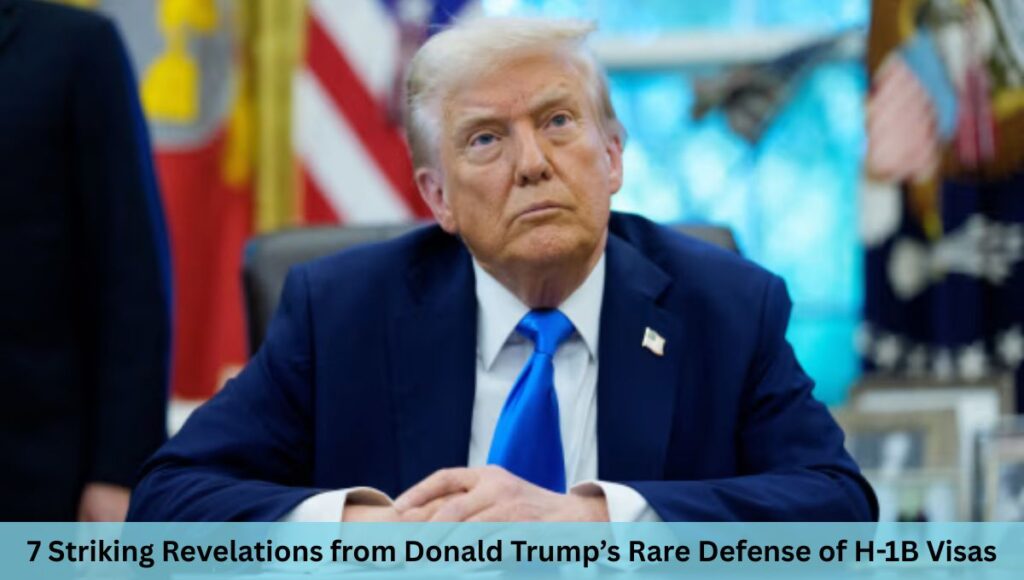
7 Striking Revelations from Donald Trump’s Rare Defense of H-1B Visas
1. Trump Admits the US “Doesn’t Have Talent” for Certain Jobs
During his Fox News interview with Laura Ingraham, Trump was pressed on whether his administration would cut H-1B visas amid fears they depress wages for US workers.
“I agree, but you do also have to bring in talent,” he responded. When Ingraham countered that the US already had “plenty of talented people,” Trump disagreed sharply.
“No, you don’t. You don’t have certain talents,” Trump said. “People have to learn. You can’t take people off an unemployment line and say, ‘I’m going to put you into a factory where we’re going to make missiles.’”
The comment marks a rare public acknowledgment from Trump that certain highly specialized technical roles cannot be filled by domestic workers alone — a key argument often made by Silicon Valley companies and economists who support the H-1B program.
2. A Rare Endorsement of the H-1B Visa Program
Trump’s remarks are particularly striking given his administration’s history of tightening H-1B rules. For years, he portrayed the visa as a loophole that allowed corporations to replace American workers with cheaper foreign labor.
However, in the Fox News interview, Trump took a different tone — seemingly defending the program as essential to America’s technological and industrial competitiveness.
“You have to bring in talent,” he said plainly, reiterating that the country needs to import certain skills that are not readily available domestically.
This rare endorsement stands in sharp contrast to his past rhetoric and has stirred debate among his supporters, many of whom view visa reforms as central to his “America First” agenda.
3. The $100,000 H-1B Visa Fee Shock
Just two months ago, the Trump administration issued a proclamation imposing a $100,000 application fee on new H-1B visa petitions — one of the steepest costs ever introduced in US immigration history.
Under the “Restriction on Entry of Certain Nonimmigrant Workers” proclamation signed in September, all new H-1B applications filed after September 21, 2025, must include the massive payment. The rule applies only to new petitions and lottery entries, not existing visa holders.
While the White House said the move was aimed at curbing visa abuse, the sharp increase drew backlash from employers and universities who rely on foreign talent to fill critical positions.
The US State Department later clarified that the new fee would not apply to renewals or petitions filed before the cutoff date.
Also Read: Trump Imposes $100,000 H-1B Visa Fee: Impact on Indian Tech Workers and US Companies
4. Georgia Hyundai Factory Raid Highlights the Need for Skilled Workers
To support his argument that the US depends on skilled immigrants, Trump cited a September Immigration and Customs Enforcement (ICE) raid at a Hyundai facility in Georgia, where hundreds of South Korean contractors were detained over immigration violations.
“They raided because they wanted illegal immigrants out,” Trump said. “There were people from South Korea who made batteries all their lives. Making batteries is very complicated — very dangerous, a lot of explosions, a lot of problems.”
He emphasized that the raid removed workers with years of specialized experience — people who were training Americans in complex manufacturing processes.
“They had like 500 or 600 people, early stages, to make batteries and to teach people how to do it. Well, they wanted them to get out of the country. You’re going to need that,” he added.
The comments suggest Trump recognizes the industrial cost of aggressive immigration enforcement, particularly when it affects industries reliant on foreign expertise such as defense, clean energy, and advanced manufacturing.
5. South Korea Protests, Trump Says He Was “Opposed” to the Raid
The Georgia ICE raid created diplomatic tension with South Korea, whose government condemned the detention of more than 300 of its nationals. Seoul launched an investigation into potential human rights violations and said it was not notified beforehand.
During a later visit to South Korea, Trump distanced himself from the raid, saying he was “very much opposed” to how it was handled — another surprising departure from his typically tough immigration stance.
The episode underscores a broader contradiction within Trump’s immigration policy: while advocating for stricter borders, his administration’s own economic policies — including defense production, clean energy manufacturing, and chip fabrication — depend on imported technical talent.
6. Trump’s Long Relationship with the H-1B Program
This is not the first time Trump has expressed pragmatic support for skilled immigration. Earlier in January, he told business leaders, including Oracle CTO Larry Ellison and SoftBank CEO Masayoshi Son, that he “liked both sides of the argument” on H-1B visas.
“I like very competent people coming into our country,” he said. “I use the program. Maître d’, wine experts, even high-quality waiters — you’ve got to get the best people. People like Larry [Ellison], he needs engineers. NASA also needs engineers like nobody’s ever needed them.”
The comment revealed that even as a businessman, Trump recognized the H-1B visa’s role in bringing specialized expertise to sectors ranging from hospitality to aerospace.
7. Balancing Populism with Pragmatism
Trump’s Fox News interview highlights an ongoing tension between his populist rhetoric and economic pragmatism. On one hand, his “America First” policies aim to protect US workers; on the other, his acknowledgment of the need for foreign specialists aligns with the realities of a competitive global economy.
Economists argue that restricting the H-1B program could backfire by driving innovation and investment overseas. A report by the National Foundation for American Policy found that every 100 approved H-1B workers create about 183 new jobs for Americans through expansion and innovation.
The tech industry, particularly in Silicon Valley, relies heavily on H-1B visas to fill engineering, AI, and software development roles. Companies like Google, Apple, Microsoft, and Amazon collectively sponsor tens of thousands of such visas annually.
Trump’s new stance may therefore be a strategic recalibration, recognizing that curbing skilled immigration too sharply could harm sectors he seeks to champion, including defense manufacturing, clean energy, and AI research.
The Broader Context: H-1B Visa Reforms Under Trump
The H-1B visa — a non-immigrant work permit allowing US employers to hire foreign professionals in specialty occupations — has long been a cornerstone of America’s knowledge economy. Each year, about 85,000 H-1B visas are issued, with Indians making up nearly 70% of recipients.
Since 2017, Trump’s administration has introduced multiple reforms to tighten the program:
- Higher wage thresholds: Designed to prioritize higher-paid, “best and brightest” candidates.
- Increased scrutiny: Many companies saw a sharp rise in visa rejections and requests for additional evidence.
- Employer accountability: Firms were required to pay return transportation costs for rejected applicants.
- Weighted lottery proposal: A new selection model favoring applicants with higher salaries or advanced degrees.
- $100,000 application fee: Intended to reduce “visa misuse” and fund US training programs.
While these moves were framed as protecting US jobs, critics argue they undermined America’s ability to attract top global talent and hurt innovation.
Economic and Political Reactions
Trump’s latest remarks drew mixed reactions from political commentators and business leaders.
Supporters praised his candid acknowledgment of skill shortages in key industries, calling it a sign of policy maturity. “This is the kind of pragmatism the US needs to stay competitive,” one tech CEO said.
However, immigration advocates and labor unions accused Trump of contradicting his own policies, pointing out that his administration’s visa restrictions have already caused severe backlogs and uncertainty for thousands of Indian professionals.
Economists note that the H-1B visa program not only fills skill gaps but also boosts economic growth, as foreign workers often start companies, file patents, and create American jobs.
Indian Professionals at the Center of the Storm
Indian nationals remain the largest beneficiaries of the H-1B visa program, representing the backbone of America’s tech and healthcare industries. From software engineering to research labs, Indian talent has been critical in sustaining US innovation.
The $100,000 visa fee, however, sparked panic across India’s IT sector, with companies like Infosys, TCS, and Wipro warning that costs could skyrocket. Many fear that the new rules could discourage US employers from hiring Indian professionals altogether.
Still, Trump’s recent comments have offered a glimmer of hope to thousands of aspiring workers and students awaiting clarity on future immigration policies.
A Strategic Shift Ahead of Elections?
Analysts suggest Trump’s softened tone on skilled immigration may also have a political motive. With the US economy increasingly dependent on advanced manufacturing, AI, and renewable energy — all industries facing massive talent shortages — the administration may be pivoting toward a more pro-business stance ahead of upcoming elections.
By acknowledging that America “doesn’t have enough talent,” Trump is effectively validating corporate concerns while distancing himself from the image of an anti-immigration hardliner.
Conclusion: A Turning Point in Trump’s Immigration Narrative
Donald Trump’s rare defense of the H-1B visa program marks a significant — and perhaps strategic — shift in his stance on skilled immigration. While his administration continues to enforce tough new rules, the president’s public recognition that America needs foreign talent is a powerful acknowledgment of the realities shaping the modern economy.
For Indian professionals, tech giants, and global employers alike, this may signal the start of a more balanced approach — one that values both American jobs and the indispensable contributions of skilled immigrants.
Also Read: Wall Street ramps up India hirings as Trump’s H-1B visa crackdown drives shift to GCCs: Report