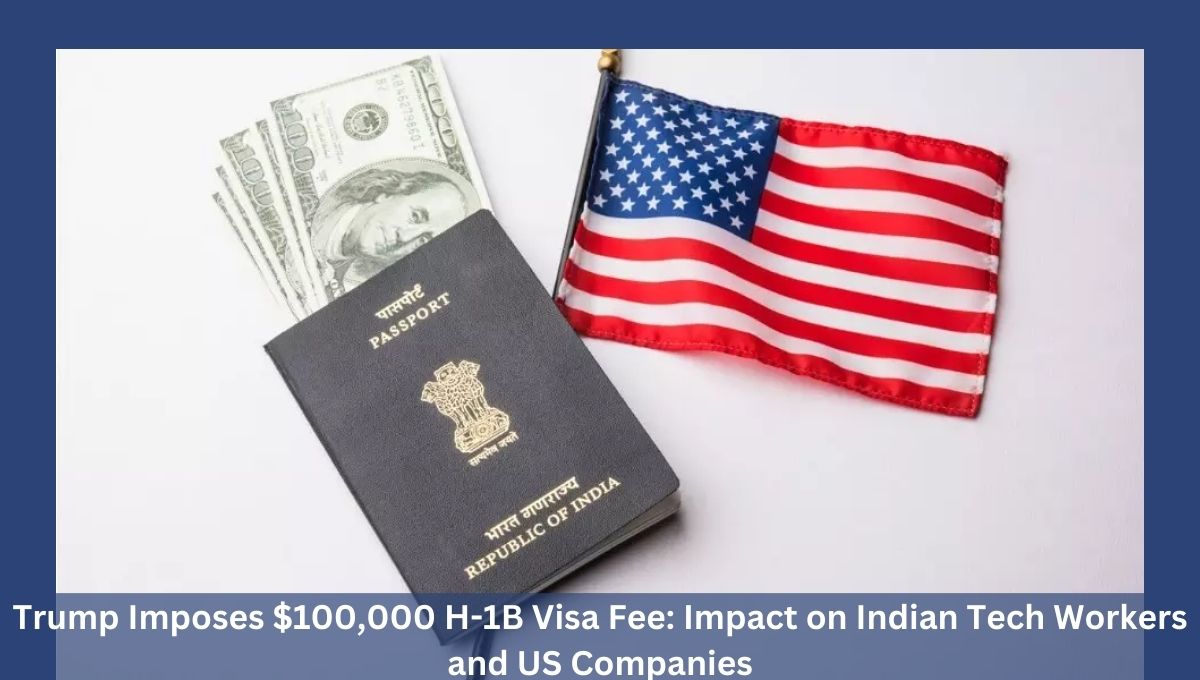
In a new policy, Trump Imposes $100,000 H-1B Visa Fee: Impact on Indian Tech Workers and US Companies. US President Donald Trump has signed a proclamation imposing a $100,000 annual fee on H-1B visa applicants, a landmark decision expected to impact Indian tech professionals, US-based IT companies, and the global technology sector. The move is part of a broader immigration overhaul aimed at prioritizing American talent while curbing the alleged abuse of the H-1B visa program by foreign workers.
The H-1B visa, historically used by US companies to hire highly skilled foreign professionals, particularly in IT, has seen over 65% of applicants from India in recent years. With companies like Amazon, Microsoft, TCS, and Meta relying heavily on this program, the new fee represents a substantial financial and strategic shift.
Trump Imposes $100,000 H-1B Visa Fee: Impact on Indian Tech Workers and US Companies
Top Companies Sponsoring H-1B Visas
According to federal data, the largest H-1B visa sponsors in 2025 include:
| Company | H-1B Visa Holders |
| Amazon Com Services LLC | 10,044 |
| Tata Consultancy Services LLC | 5,505 |
| Microsoft Corporation | 5,189 |
| Meta Platforms | 5,123 |
| Apple Inc | 4,202 |
| Google LLC | 4,181 |
| Cognizant Technology Solutions | 2,493 |
| JP Morgan Chase & Co | 2,440 |
| Deloitte Consulting LLP | 2,353 |
| Walmart Associates Inc | 2,390 |
Amazon leads the list with over 10,000 H-1B visa holders, while Indian IT firms like TCS, Infosys, and Wipro also occupy top positions. The new $100,000 fee will heavily impact these companies, which rely on H-1B talent for critical IT and engineering roles.
Also Read: O-1 Visa – Indians Seek ‘Extraordinary Ability’ Route Amid $100K H-1B Fee Hike
Trump Administration’s Rationale
The Trump administration has framed the policy as a measure to protect American jobs and ensure H-1B visas are granted only to the “most highly skilled” foreign workers.
US Commerce Secretary Howard Lutnick emphasized that the fee would incentivize companies to hire recent American graduates rather than relying heavily on foreign labor.
“If you’re going to train somebody, you’re going to train one of the recent graduates from one of the great universities across our land. Train Americans. Stop bringing in people to take our jobs,” Lutnick said.
White House staff secretary Will Scharf described the H-1B program as one of the “most abused visa” systems, targeting outsourcing companies that allegedly use foreign labor to replace American workers at lower costs.
How the New Fee Works
Under the new proclamation, effective September 21, 2025, no H-1B worker can enter the United States unless the sponsoring employer pays the $100,000 fee. The Department of Homeland Security and the State Department have been directed to reject petitions without proof of payment. The fee applies annually and remains in effect for 12 months, unless extended.
Trump also unveiled a “gold card” program, which allows certain high-skilled immigrants to fast-track visa applications by paying fees starting at $1 million. Employers can also pay $2 million to expedite the process for sponsored employees.
Impact on Indian IT Professionals
Financial Burden
For Indian techies joining companies like Microsoft, Google, or Amazon, the $100,000 fee translates to approximately ₹88 lakh, making it prohibitively expensive for many employers to sponsor foreign employees.
“Imagine yourself as an Indian techie who just landed at a Big Tech firm, and your dream of working in the US has been fulfilled. Your employer wants to file your H-1B visa but has to shell out a whopping USD 100,000 to complete the process. That’s the harsh reality today,” noted experts.
Potential Upsides
Despite the challenges, some analysts argue the policy could encourage highly skilled workers to negotiate better compensation packages and incentivize companies to invest more in top talent.
Reactions from Tech Companies
Microsoft and JP Morgan
Microsoft and JP Morgan issued advisories for their H-1B and H-4 visa holders, urging employees abroad to return to the US by September 21, 2025, to ensure compliance before the new fee takes effect.
“We strongly recommend H-1B and H-4 visa holders return to the US before the deadline,” an internal Microsoft email stated.
Impact on Startups and Small Businesses
Immigration attorneys have warned that small and medium-sized companies may struggle under the new fee structure. Tahmina Watson of Watson Immigration Law described the move as a potential “nail in the coffin” for startups reliant on skilled foreign talent.
“Almost everyone’s going to be priced out. Many small businesses will tell you they actually can’t find workers to do the job,” she added.
Historical Context of H-1B Visas
The H-1B visa allows US companies to hire foreign professionals in specialty occupations such as IT, engineering, finance, healthcare, and science. Since its introduction, the program has been capped at 85,000 visas per year, including 20,000 for US advanced degree holders (master’s cap).
- Fiscal Year 2003: 32% of IT workers were on H-1B visas
- Recent years: Over 65% on average
The visa system has been frequently criticized for enabling outsourcing firms to undercut American labor costs. Studies show a 36% cost saving on entry-level H-1B positions compared to US employees.
Also Read: ‘Trump has no authority…’: What lawsuit challenging $100,000 H-1B visa fee hike says
Criticism of the Trump Policy
US lawmakers and community leaders have voiced concerns over the $100,000 fee:
- Congressman Raja Krishnamoorthi: Called it a “reckless” policy that could hurt innovation and employment.
- Ajay Bhutoria, former Biden advisor: Warned of a potential crisis for the US tech sector, especially for startups dependent on foreign STEM talent.
- Khanderao Kand, Foundation for India and Indian Diaspora Studies: Highlighted the negative impact on software and tech industries.
Critics argue the policy may push talent to competitor nations like Canada and Europe, potentially harming US competitiveness in high-tech industries.
Potential Upsides for Indian Tech Industry
While the US faces talent shortages, Indian IT companies may see opportunities:
- Higher demand for remote work from Indian professionals as US employers seek to fill roles without incurring the $100,000 fee.
- Strengthened domestic IT ecosystem in India, as firms retain talent locally.
- Global expansion opportunities for Indian companies to serve US clients from India.
Key Companies Affected
Amazon
Amazon has the highest number of H-1B visa holders at 10,044 employees, and the new fee will impose a massive financial burden.
Indian IT Giants
- TCS: 5,505 H-1B holders
- Infosys: 2,004 H-1B holders
- Wipro: 1,523 H-1B holders
Other Big Tech
- Microsoft: 5,189
- Meta: 5,123
- Apple: 4,202
- Google: 4,181
The cumulative effect on these companies is expected to be billions of dollars in additional costs, forcing them to reconsider workforce strategies.
Global Implications
Outsourcing and Competitiveness
Many companies may explore offshoring and remote solutions to avoid the fee. While operationally challenging, this could strengthen IT ecosystems outside the US, particularly in India and other tech hubs.
US Innovation Ecosystem
Critics argue the policy may stifle innovation, as H-1B workers often fill highly specialized roles critical to research, product development, and emerging technologies.
Geopolitical Considerations
The move also affects Indian diaspora relations, as Indian professionals constitute the largest group of H-1B visa holders. Diplomatic discussions may arise regarding the economic impact on Indian talent mobility.
Timeline and Implementation
- September 21, 2025: Policy goes into effect at 12:01 am EDT
- Duration: 12 months, unless extended
- Fee: $100,000 annually per H-1B visa
- Exemptions: None currently announced; startups and SMEs expected to face the full fee
Conclusion
The Trump administration’s $100,000 H-1B visa fee represents a seismic shift in US immigration and labor policy. While it aims to prioritize American talent and curb perceived visa abuse, the move poses serious challenges for Indian IT professionals, global tech companies, and the innovation ecosystem in the United States.
Companies like Amazon, TCS, Microsoft, and Google must navigate a dramatically higher cost structure, while Indian IT firms could leverage remote and offshoring opportunities to sustain operations. Meanwhile, Indian professionals face uncertainty about career opportunities in the US, prompting debates over the long-term impact of the policy on talent mobility and global competitiveness.
The next few months will reveal whether this bold policy reshapes US workforce dynamics, or whether it inadvertently drives talent and innovation to alternative markets like India, Canada, and Europe.