
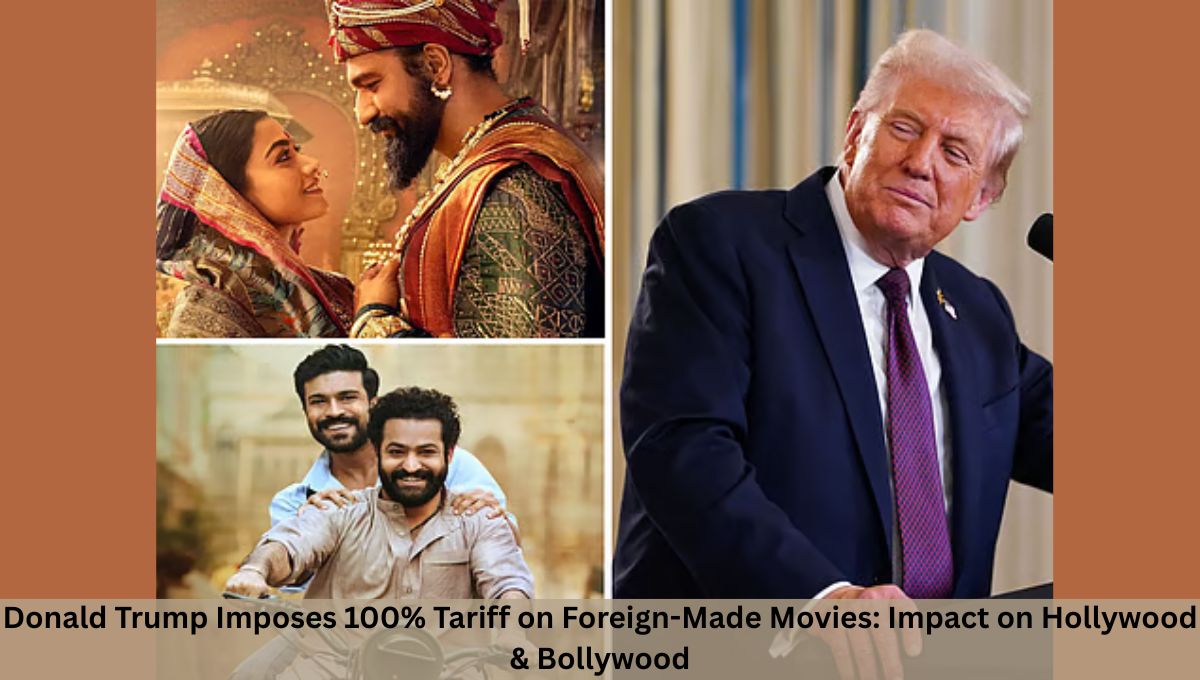
In an unprecedented move, Donald Trump Imposes 100% Tariff on Foreign-Made Movies: Impact on Hollywood & Bollywood. US President Donald Trump has announced a bold and unprecedented decision to impose a 100% tariff on all movies produced outside the United States, raising questions about the future of international film production and distribution. The move has sparked widespread debate among filmmakers, industry analysts, and global trade experts, as it threatens to reshape the economics of Hollywood, Indian cinema, and other foreign film markets.
Donald Trump Imposes 100% Tariff on Foreign-Made Movies: Impact on Hollywood & Bollywood
Trump’s Announcement: A Move to Protect US Film Industry
On Monday, Trump took to his social media platform, Truth Social, to justify his latest trade measure. He stated,
“Our movie-making business has been stolen from the United States of America, by other Countries, just like stealing ‘candy from a baby.’ California, with its weak and incompetent Governor, has been particularly hard hit!
Therefore, in order to solve this long-time, never-ending problem, I will be imposing a 100% Tariff on any and all movies that are made outside of the United States.”
Trump framed the move as an effort to safeguard local jobs and investment, and to bring film production back to the US, which he claims has shifted largely to countries such as Canada, Spain, South Korea, and others.
Producers Guild of India Reacts
Shibasish Sarkar, President of the Producers Guild of India, weighed in on the potential impact of the tariff on foreign-language films, including Bollywood and regional Indian cinema. He explained that Trump’s order is likely targeted at Hollywood productions abroad, rather than films released in the US by other countries.
“My interpretation of Trump’s statement on the face of it is more to address the Hollywood production, which is currently happening outside the USA. We will wait till we see more material to read, such as circulars or the executive order,” Sarkar said.
He added that the tariffs may not significantly affect foreign-language films but acknowledged that the exact impact would depend on the final text of the executive order.
Trump’s Tariff: Beyond Hollywood
Trump’s tariffs are part of a broader protectionist agenda. Last week, the administration announced a sweeping new package of import taxes covering pharmaceuticals, kitchen cabinets, vanities, upholstered furniture, and heavy trucks, with the highest tariffs reaching 100%.
“I’m putting a 100 percent import tax on pharmaceutical drugs unless the companies are building plants right here in the United States,” Trump said, highlighting his focus on domestic manufacturing and his “Make America Great Again” agenda.
For movies, this tariff represents an extraordinary development, as it targets a service rather than a physical product, raising questions about how such duties could be calculated and enforced in an industry dominated by digital production and international co-productions.
Potential Impact on Hollywood
Industry experts have expressed concern over the impact of Trump’s 100% tariff on Hollywood studios. Many large productions, including blockbusters like Deadpool & Wolverine, Gladiator II, and Wicked, have been filmed abroad to take advantage of tax incentives, lower labor costs, and modern production facilities.
Dan Coatsworth, an investment analyst at AJ Bell, noted:
“The threat of 100% tariffs on movies made outside the US raises more questions than it does answers. Filmmakers have been progressively lured by tax incentives abroad, and the Los Angeles film industry has lost some of its glitz and glamour.”
The Canadian Chamber of Commerce also expressed concern, highlighting the reliance of US studios on Canadian crews and facilities. Catherine Fortin-LeFaivre, senior vice president of international policy, warned that tariffs could stifle investment, increase costs, and jeopardize thousands of middle-class jobs.
Also Read: Hollywood is shaken by Trump’s tariff plan for the movie industry
Digital Distribution and Streaming Challenges
A unique aspect of the proposed tariff is its effect on digital distribution platforms, including streaming services like Netflix, Disney+, and Amazon Prime Video. Unlike physical goods, movies can be distributed digitally, making it unclear how a tariff would apply to films streamed in the US but produced abroad.
Paolo Pescatore, a movie business analyst, explained:
“For now, as things stand, costs are likely to increase, and this will inevitably be passed on to consumers.”
Streaming services, which rely heavily on international content, could face rising operational costs and the challenge of pricing content competitively under a 100% levy regime.
Impact on Indian Cinema
Indian films, including Bollywood blockbusters like Jawan, Baahubali, Pathaan, and Animal, have recently generated substantial box office revenue in the US. The Indian diaspora spends around $100 million annually on films in various languages, including Hindi, Telugu, Tamil, Malayalam, Punjabi, and Bengali.
Experts have warned that a 100% tariff could double the cost of screening Indian films in the US. Sreedhar Pillai, a trade expert, explained:
“If you have bought a film for ₹5 crore to screen in the US, under the tariff you might have to spend ₹10 crore. This will increase ticket prices and could reduce audience footfall.”
Vivek Lath, a distributor of entertainment content, added:
“US accounts for roughly 5-7% of box office revenues for Indian movies. Already stressed US theatre owners will not be happy, and if the rest of the world reciprocates, Hollywood will also lose a large share of its international revenues.”
Key Points of Trump’s Movie Tariff
- 100% tariff on all films produced outside the United States.
- Potentially targets Hollywood productions abroad, not necessarily foreign-language films.
- Raises questions about digital distribution and streaming services.
- Could lead to higher ticket prices and reduced footfall for international cinema.
- Part of a larger protectionist agenda, including tariffs on pharmaceuticals, furniture, and heavy trucks.
Also Read: Trump Imposes 100% Tariff on Foreign Movies, Cites National Security Threat to Hollywood
Challenges in Implementation
Legal and logistical challenges complicate the enforcement of the tariff. American studios often co-produce films internationally, with financing, post-production, and visual effects handled across multiple countries. Jay Sures, vice chairman of United Talent Agency, highlighted:
“It’s cheaper for Hollywood studios to pay for travel and accommodation overseas than to produce entirely in the US, where labor costs and lack of rebates are higher.”
Moreover, defining a film as “American-made” could be complex, particularly if a production involves foreign actors, directors, or funding sources.
Market Reaction
Following Trump’s announcement, US entertainment stocks experienced minor fluctuations, with Netflix dipping 1.4% and Warner Bros Discovery falling 0.6% in premarket trading. Analysts suggest that investors do not yet see this as an immediate threat, though uncertainty remains high.
Global Implications
The tariffs could have far-reaching consequences for international film markets.
Canada
- Canada has been a key hub for Hollywood production, offering tax incentives and experienced crews.
- The tariff could discourage US studios from filming in Canada, affecting local jobs and economies.
UK, Australia, and Europe
- Other countries attracting US productions through incentives may see reduced investment.
- Countries with growing co-production agreements with the US could face higher costs or reconsider partnerships.
India
- Bollywood and regional cinema may see higher costs for US releases, potentially impacting box office performance and audience engagement.
- Indian films like RRR, Pathaan, and Baahubali 2 have earned millions in the US; the tariff could reduce profitability and audience reach.
Industry Experts Weigh In
Ashish Kulkarni, animation and VFX expert, warned:
“Under such a high tariff regime, all channels of movie showing and viewing will be impacted and become more costly. It will overall increase the cost of content consumption for the Indian diaspora.”
Paolo Pescatore, movie business analyst, said:
“There is too much uncertainty, and this latest move raises more questions than answers. For now, costs are likely to increase, and this will inevitably be passed on to consumers.”
Historical Context
Trump has repeatedly emphasized tariffs as a tool to protect domestic industries, starting with goods like steel, pharmaceuticals, and furniture. The decision to extend tariffs to movies represents a novel application of trade policy to a creative and digital industry.
This is not the first time the US film industry has faced challenges abroad. Studios have long taken advantage of cheaper production costs, skilled labor, and tax breaks in foreign countries. The new tariffs mark a potential turning point in global film economics.
Concerns About Enforcement
Several challenges exist in implementing a 100% tariff on foreign films:
- How to calculate the tariff on digitally distributed content.
- Determining whether co-productions qualify as foreign-made.
- Potential legal challenges from studios and international trade bodies.
- Impacts on ticket pricing, subscriptions, and consumer demand.
Conclusion
President Donald Trump’s decision to impose a 100% tariff on foreign-made movies marks an unprecedented moment in the history of global film trade. While intended to protect US jobs and incentivize domestic production, the move carries complex implications for Hollywood, Bollywood, and international streaming platforms.
Industry leaders, including Shibasish Sarkar of the Producers Guild of India, caution that the exact impact on foreign-language films in the US remains uncertain. Meanwhile, analysts warn of higher costs, disrupted production plans, and reduced international collaboration.
As the world waits for the executive order and detailed regulations, the move could reshape global film economics, affecting audiences, studios, and distributors alike. The film industry, long accustomed to international collaboration, now faces a potentially transformative policy that could redefine where and how movies are made.
Related Posts:
- Trump Imposes 100% Tariff on Foreign Movies, Cites…
- Can the EU and NATO Impose Tariffs on India and…

- 5 Powerful Highlights as Trump Lands Second Nobel…

- Trump’s 2025 Gaza Peace Plan Signing and Historic…

- 9 Explosive Revelations as Trump Declares His Health…

- 7 Shocking Reasons FIFA’s Peace Prize for Trump…
