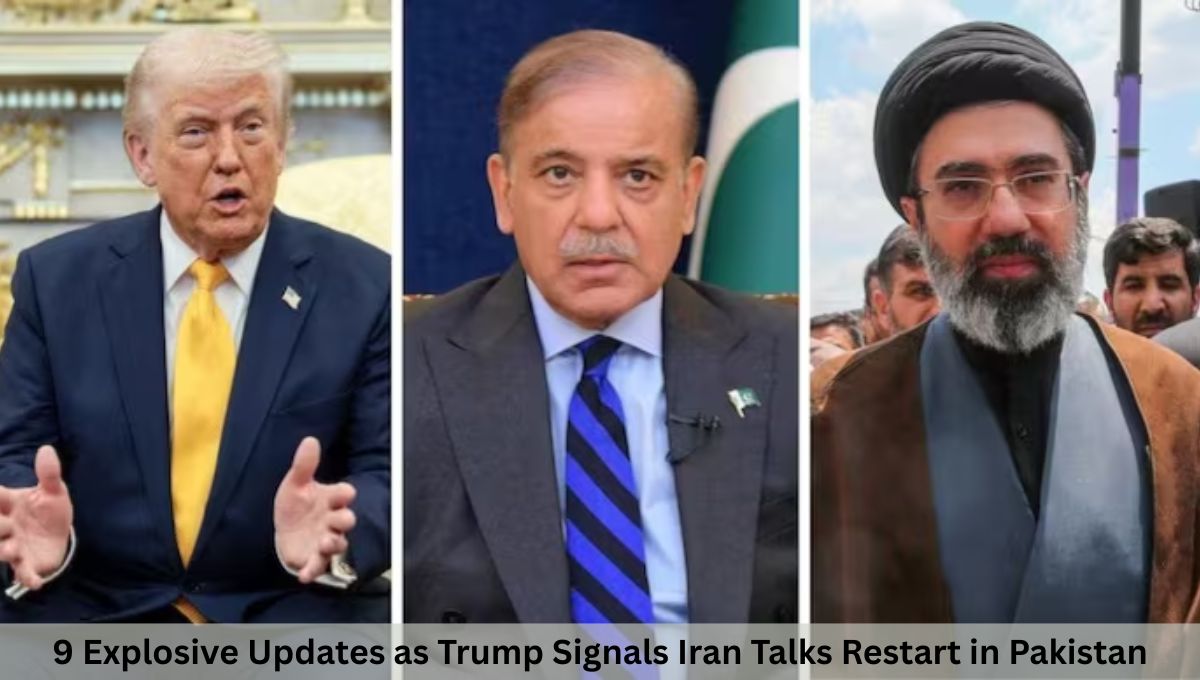
9 Explosive Updates as Trump Signals Iran Talks Restart in Pakistan, raising hopes for peace. Global attention is once again fixed on the evolving crisis between the United States and Iran, as fresh diplomatic signals emerge amid one of the most volatile geopolitical standoffs in recent history.
US President Donald Trump has indicated that negotiations with Tehran could resume within the next two days, potentially returning to Islamabad as the venue.
The announcement comes just days after intense, high-level talks collapsed without agreement, followed by the imposition of a sweeping US naval blockade targeting Iranian maritime trade.
This convergence of diplomacy and military escalation highlights a critical inflection point—one that could either lead to a breakthrough agreement or trigger a deeper and more dangerous phase of conflict.
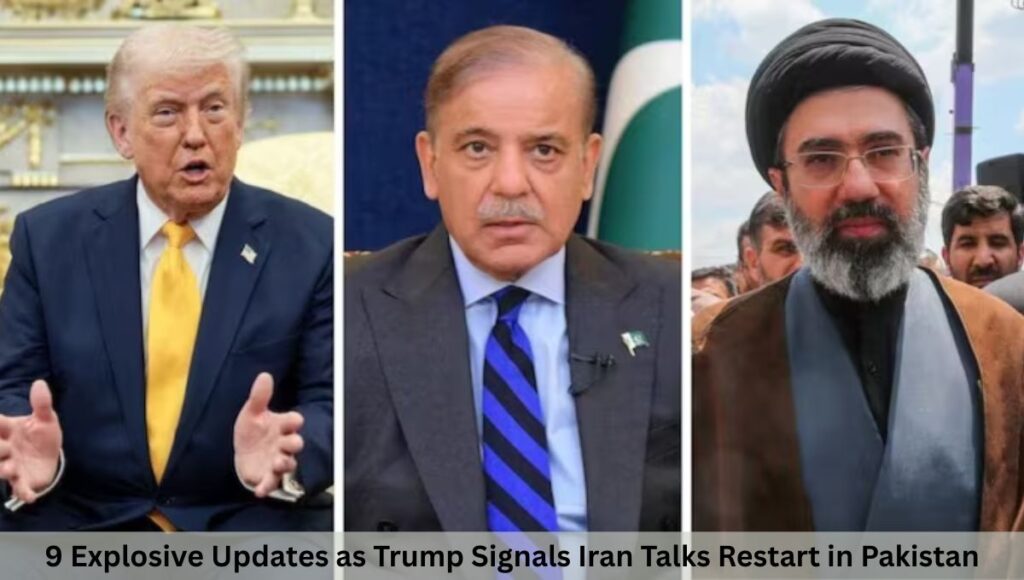
9 Explosive Updates as Trump Signals Iran Talks Restart in Pakistan
Trump Signals Imminent Return to Talks in Pakistan
Speaking in multiple interviews, Trump expressed optimism that negotiations with Iran could restart soon.
“Something could be happening over the next two days,” he said, emphasizing that Pakistan remains the preferred venue.
Trump’s renewed endorsement of Islamabad marks a notable shift, as he had earlier suggested moving negotiations to a European country.
However, he later clarified that returning to Pakistan made strategic sense given its direct involvement in facilitating earlier talks.
He also praised Pakistan’s military leadership, particularly Field Marshal Asim Munir, describing him as “fantastic” and instrumental in moderating discussions.
Why Pakistan Remains Central to Negotiations
Pakistan has emerged as a key diplomatic intermediary in the ongoing crisis.
Islamabad hosted the first round of direct talks between US and Iranian officials—marking the highest-level engagement between the two sides in over a decade.
Key Reasons for Pakistan’s Role
- Neutral but influential regional position
- Established communication channels with both sides
- Strategic interest in regional stability
Despite the failure of the first round, both Washington and Tehran appear willing to return, signaling that Pakistan’s mediation efforts remain credible.
Inside the Failed Islamabad Talks
The initial round of negotiations in Islamabad lasted more than 21 hours but ended without a deal.
The US delegation was led by Vice President JD Vance, alongside key envoys, while Iran’s delegation was headed by parliamentary speaker Mohammad Bagher Ghalibaf.
Key Sticking Points
- Iran’s nuclear program
- Sanctions relief demands
- Control and reopening of the Strait of Hormuz
- Regional security concerns, including Lebanon
Although no agreement was reached, officials on both sides acknowledged “progress,” suggesting that gaps may be narrowing.
Nuclear Dispute: The Core Obstacle
At the heart of the negotiations lies a deep disagreement over Iran’s nuclear ambitions.
Competing Proposals
- US Position: 20-year suspension of nuclear activity
- Iran’s Position: 3–5 year temporary halt
Washington has also pushed for the removal of enriched uranium from Iran, while Tehran insists on lifting international sanctions.
The involvement of the International Atomic Energy Agency is expected to be crucial for any verification mechanism.
Strait of Hormuz: Strategic and Economic Flashpoint
The Strait of Hormuz remains one of the most critical elements in the conflict.
Why It Matters Globally
- Carries about 20% of global oil supply
- Key route for Gulf energy exports
- Essential for economies in Asia and Europe
Iran has effectively restricted access to the strait during the conflict, while the US has imposed a naval blockade targeting Iranian ports.
This dual pressure has created unprecedented uncertainty in global energy markets.
Following the breakdown of talks, the United States escalated its strategy by enforcing a maritime blockade aimed at cutting off Iran’s economic lifelines.
Key Features of the Blockade
- Targets ships entering or leaving Iranian ports
- Enforced by over 10,000 US personnel
- Includes warships, aircraft, and surveillance systems
US Central Command claims the blockade has already halted most of Iran’s seaborne trade, which accounts for approximately 90% of its economy.
However, maritime data suggests that some vessels continue to pass through the strait, highlighting enforcement challenges.
Oil Markets React: Volatility with a Hint of Optimism
The geopolitical tensions have had a direct impact on global oil markets.
Market Trends
- Prices surged above $100 per barrel during peak tensions
- Fell slightly on renewed hopes of diplomacy
- Continued volatility due to uncertainty
Analysts warn that even if talks resume, lingering risks could keep prices elevated for weeks.
Ceasefire Under Pressure: Will It Hold?
The ongoing two-week ceasefire, brokered earlier this month, is now under significant strain.
Trump has indicated that he does not intend to extend the ceasefire, stating that a more permanent agreement would be preferable.
“It could end either way, but I think a deal is preferable,” he said.
The ceasefire is set to expire soon, making the next round of talks crucial.
Global Powers React: Divisions Emerge
The crisis has drawn reactions from major global players.
Europe
Trump criticized European allies, calling them ineffective in resolving the conflict:
“They want to help, but they just don’t know how.”
China
China, a major importer of Iranian oil, condemned the US blockade as “dangerous and irresponsible.”
International Institutions
The International Monetary Fund has warned that prolonged conflict could push the global economy toward recession.
Israel-Lebanon Tensions Complicate Peace Efforts
Adding another layer of complexity, Israel’s continued military operations in Lebanon against Hezbollah remain a major sticking point.
While the US and Israel argue these actions fall outside the ceasefire, Iran insists they violate the agreement.
Recent diplomatic engagement between Israel and Lebanon, facilitated by US Secretary of State Marco Rubio, has opened another negotiation track—but tensions remain high.
Backchannel Diplomacy: Signs of Progress
Despite public disagreements, sources indicate that backchannel negotiations have made progress.
Key Developments
- Narrowing differences on nuclear timelines
- Increased willingness to compromise
- Continued communication between delegations
These developments suggest that a framework for agreement may already be taking shape behind the scenes.
Economic Fallout: A Global Concern
The impact of the conflict extends far beyond the Middle East.
Key Economic Effects
- Rising energy costs
- Disrupted supply chains
- Increased inflation risks
The IMF has already downgraded growth forecasts, warning that prolonged disruption could have lasting global consequences.
“Very Close to Over”? Trump’s Optimistic Outlook
Trump has repeatedly stated that the conflict may be nearing its end.
“I think it’s very close to being over.”
However, he also emphasized that the United States is “not finished,” indicating that military pressure will continue alongside diplomatic efforts.
This dual-track approach—combining negotiation with coercion—defines the current US strategy.
Who Holds the Upper Hand?
The current situation resembles a strategic standoff.
US Advantages
- Military superiority
- Global economic influence
Iran’s Strengths
- Experience under sanctions
- Regional alliances and proxies
- Ability to disrupt shipping lanes
Analysts remain divided on which side is more likely to make concessions first.
Timeline: What Happens Next?
The coming days are critical.
Expected Developments
- Possible talks in Pakistan within 48 hours
- Ceasefire expiration approaching
- Continued enforcement of naval blockade
Any breakthrough—or breakdown—could significantly alter the trajectory of the conflict.
Conclusion: A Narrow Window for Peace
The renewed push for US-Iran talks offers a glimmer of hope in an otherwise tense and uncertain landscape.
However, the combination of military escalation, economic pressure, and deep political disagreements makes a swift resolution far from guaranteed.
As the world watches closely, the next round of negotiations could determine whether the crisis moves toward peace—or plunges into a deeper conflict with far-reaching global consequences.
Final Takeaway
The situation remains fluid, with diplomacy and confrontation unfolding simultaneously. While optimism is growing, the risks are equally high.
The next “two days,” as Trump described them, may well define the future of the Middle East—and the global economy.
Also Read: 11 Shocking Developments as Israel Slams Pakistan Over Ceasefire Row
Also Read: US sets fresh conditions for Iran talks as Strait of Hormuz reopening becomes key demand
Related Posts:
- 11 Explosive Warnings as Trump Vows to ‘Knock the…

- 12 Explosive Claims as Donald Trump Says Iran War…
- 10 Explosive Warnings as Donald Trump Calls Iran…
- Trump’s 2025 Gaza Peace Plan Signing and Historic…

- Trump to Host 2026 G20 Summit at His Florida Golf…

- 10 Explosive Signals Trump Says Iran War Could End…