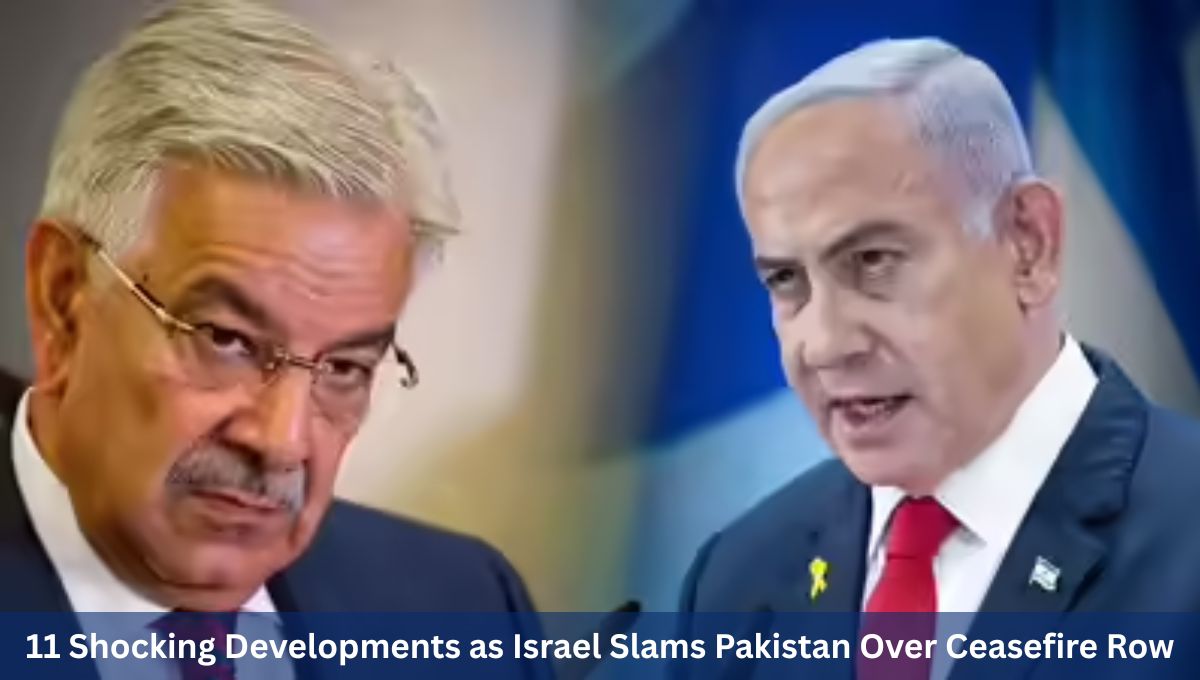
11 Shocking Developments as Israel Slams Pakistan Over Ceasefire Row ahead of US-Iran talks in Islamabad. A major diplomatic controversy has erupted between Israel and Pakistan just ahead of high-stakes US-Iran peace talks in Islamabad, raising serious concerns about the future of fragile ceasefire efforts in the Middle East.
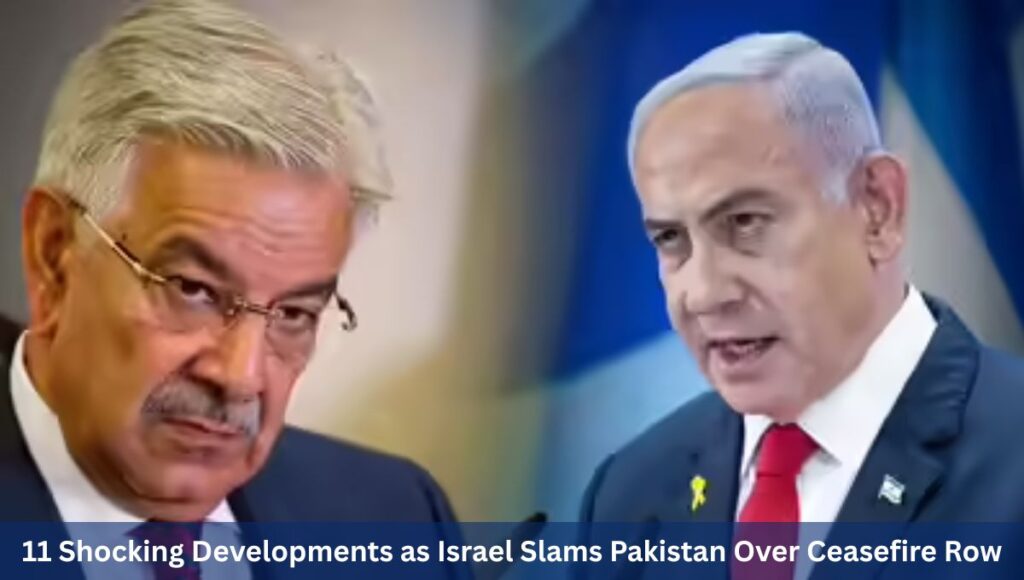
The row was triggered by controversial remarks made by Pakistan’s Defence Minister Khawaja Asif, who accused Israel of committing “genocide” in Lebanon and used highly inflammatory language to describe the country.
Israel responded sharply, with Prime Minister Benjamin Netanyahu calling the remarks “outrageous” and questioning Pakistan’s credibility as a neutral mediator.
The escalating war of words has added fresh uncertainty to an already volatile geopolitical situation, where diplomacy, military action, and global economic concerns are deeply intertwined.
11 Shocking Developments as Israel Slams Pakistan Over Ceasefire Row
What Sparked the Diplomatic Crisis?
The controversy began when Khawaja Asif posted a series of strongly worded messages on social media platform X (formerly Twitter).
In these posts, he described Israel as:
- “Evil”
- “A curse for humanity”
- A “cancerous state”
He also accused Israel of carrying out “genocide” in Lebanon while peace talks were underway in Islamabad.
The remarks went beyond standard diplomatic criticism and were widely seen as inflammatory, especially given Pakistan’s role as a facilitator in ongoing negotiations between the United States and Iran.
Shortly after the backlash intensified, Asif deleted the posts, but the damage had already been done.
Israel’s Strong Rebuttal
Israel’s response was swift and unusually direct.
The office of Benjamin Netanyahu issued a statement condemning the remarks, saying:
“This is not a statement that can be tolerated from any government, especially not from one that claims to be a neutral arbiter for peace.”
Israel also interpreted Asif’s language as effectively calling for the country’s destruction.
Foreign Minister Gideon Sa’ar went further, describing the comments as:
- “Blatant antisemitic blood libels”
- A dangerous escalation in rhetoric
- Incompatible with any claim of neutrality
He added that Israel would continue to defend itself against threats to its existence.
Why Pakistan’s Mediator Role Is Under Scrutiny
Pakistan has recently positioned itself as a diplomatic intermediary in the ongoing US-Iran crisis.
Key developments include:
- Hosting planned talks between US and Iranian delegations in Islamabad
- Being credited with helping facilitate a temporary two-week ceasefire
- Engaging with regional leaders to de-escalate tensions
However, Asif’s remarks have cast serious doubt on Islamabad’s ability to remain neutral.
From a diplomatic standpoint, neutrality requires:
- Balanced public messaging
- Avoidance of inflammatory language
- Credibility with all parties involved
The latest controversy undermines all three, making Pakistan’s role significantly more complicated.
Timing: Why This Row Matters Now
The timing of the controversy is critical.
It comes just hours before scheduled talks between the United States and Iran aimed at stabilising the region and extending the ceasefire.
At this sensitive juncture:
- Any diplomatic misstep can derail negotiations
- Trust between mediators and participants is essential
- Public rhetoric can influence negotiating positions
Analysts warn that the incident could weaken momentum toward a broader peace agreement.
Iran’s Position and New Uncertainty
The situation has been further complicated by signals from Iran that it may reconsider its participation in the Islamabad talks.
Reports suggest Tehran could:
- Delay or suspend negotiations
- Demand changes in mediation arrangements
- Link participation to developments involving Israel’s actions in Lebanon
This introduces a new layer of uncertainty, potentially undermining the already fragile ceasefire.
The Israel-Lebanon Conflict: A Key Trigger
At the heart of the controversy lies the ongoing conflict involving Israel and Lebanon.
Israel has continued military operations targeting Hezbollah, despite the broader US-Iran ceasefire.
Benjamin Netanyahu has made it clear that:
- There is no ceasefire in Lebanon
- Military operations will continue “with full force”
- Israel prioritises its national security above diplomatic optics
This position directly contradicts claims by some mediators that the ceasefire extends across the region.
Contradictions Over Ceasefire Scope
One of the major sources of tension is disagreement over what the ceasefire actually covers.
Pakistan’s Position
Pakistan has suggested that the ceasefire includes broader regional de-escalation, possibly covering Lebanon.
Israel and US Position
Both Israel and the United States have rejected this interpretation, insisting:
- The ceasefire applies only to US-Iran hostilities
- It does not restrict Israel’s operations in Lebanon
This fundamental disagreement has added confusion and tension to diplomatic efforts.
Internal Dynamics Within Pakistan
The controversy has also highlighted internal challenges within Pakistan’s decision-making structure.
Reports indicate that:
- Military leadership may have intervened to manage the fallout
- Civilian officials may not have full control over foreign policy messaging
- Differences within leadership could affect diplomatic consistency
Such dynamics raise questions about Pakistan’s ability to act as a coherent and reliable mediator on the global stage.
Global Reactions and Strategic Implications
The diplomatic clash has drawn reactions beyond Israel and Pakistan.
International observers and policymakers are concerned about:
- The impact on ongoing peace talks
- Rising tensions in an already unstable region
- The risk of escalation into a broader conflict
Some analysts argue that Pakistan’s credibility as a mediator has been significantly weakened, at least in the short term.
The US-Iran Ceasefire Under Pressure
The controversy comes at a time when the US-Iran ceasefire is already showing signs of strain.
Key challenges include:
- Disruptions in oil shipments through the Strait of Hormuz
- Continued military activity in the region
- Mutual accusations of violating ceasefire terms
US President Donald Trump has already criticised Iran over oil flow disruptions, further complicating the situation.
The added diplomatic tension involving Pakistan risks pushing the ceasefire closer to collapse.
Economic Stakes: Oil and Global Markets
Beyond diplomacy, the crisis has significant economic implications.
The Strait of Hormuz remains under pressure, affecting:
- Global oil supply chains
- Energy prices worldwide
- Investor confidence
Any escalation or breakdown in talks could trigger:
- Sharp increases in oil prices
- Supply shortages
- Broader economic instability
This makes the success of diplomatic efforts even more critical.
Israel-Pakistan Relations: A Rare Direct Confrontation
Israel and Pakistan do not maintain formal diplomatic relations, making this public exchange particularly notable.
Historically:
- Communication between the two has been limited
- Criticism has been indirect or restrained
- Public confrontations have been rare
The current episode marks a shift toward more direct engagement, signalling a potential change in how such disputes are handled.
India Factor and Regional Alignments
The controversy also highlights broader regional dynamics.
India, a close strategic partner of Israel, has:
- Supported Israel on security matters
- Criticised Pakistan on issues related to terrorism
- Strengthened defence and diplomatic ties with Tel Aviv
These alignments add another layer of complexity to the situation, influencing how different countries perceive and respond to the crisis.
Could This Derail Peace Talks?
One of the biggest questions is whether the controversy will derail the upcoming US-Iran talks.
Possible Outcomes
1. Talks Proceed as Planned
Diplomatic pragmatism prevails, and negotiations continue despite tensions
2. Delays or Adjustments
Talks are postponed or relocated due to concerns over neutrality
3. Breakdown of Negotiations
The controversy leads to a collapse of talks, escalating regional tensions
At present, the outcome remains uncertain.
Diplomatic Lessons from the Crisis
The episode underscores several key lessons for international diplomacy:
- Language matters: Public statements can have immediate geopolitical consequences
- Neutrality is fragile: Even perceived bias can undermine mediation efforts
- Timing is critical: Remarks made during sensitive negotiations carry greater weight
These factors highlight the delicate balance required in high-stakes diplomacy.
What Happens Next?
The coming days will be crucial in determining the direction of the crisis.
Key developments to watch include:
- Whether Iran proceeds with talks in Islamabad
- Any further statements from Pakistan’s leadership
- Israel’s continued military actions in Lebanon
- US efforts to stabilise the ceasefire
Each of these factors will play a role in shaping the next phase of the conflict.
Conclusion: A Fragile Moment in Global Diplomacy
The diplomatic clash between Israel and Pakistan has added a new layer of complexity to an already volatile situation in the Middle East.
At a time when careful diplomacy is essential, the controversy highlights how quickly tensions can escalate—and how difficult it can be to maintain trust among competing global actors.
With the US-Iran ceasefire hanging in the balance and critical talks on the horizon, the stakes could not be higher.
Whether this episode proves to be a temporary setback or a turning point in regional dynamics will depend on how leaders respond in the days ahead.
For now, the world watches closely as diplomacy, conflict, and global interests continue to collide in one of the most strategically important regions on Earth.
Also Read: 7 Shocking Impacts of Pakistan’s $3.5 Billion UAE Debt Crisis
Also Read: Lebanon seeks Pakistan’s help as ceasefire exclusion row deepens
Related Posts:
- Pakistan Defence Minister Khawaja Asif Contradicts…

- 5 Key Takeaways as Pakistan–Afghanistan Peace Talks…

- Afghanistan–Pakistan War 2025: Inside the 48-Hour Ceasefire

- 5 Explosive Admissions: Pakistan Defence Minister…
- Israel–Hamas Ceasefire Under Strain: 4 More Hostage…

- 5 Major Takeaways from the US Supreme Court's…