In an interview with Mehdi Hasan, Pakistan Defence Minister Khawaja Asif Contradicts Himself on Imran Khan’s X Account, Hybrid Model & US-China Ties. Pakistan’s Defence Minister Khawaja Asif has landed in a fresh controversy after giving contradictory statements about Imran Khan’s X (formerly Twitter) account, raising eyebrows over his fumbling remarks in an interview with journalist Mehdi Hasan.
From claiming that the imprisoned former Prime Minister was operating his X account from Adiala Jail, to earlier alleging that the account was being run from India, Asif’s contradictory remarks quickly turned into an embarrassment. In addition, he was grilled about Pakistan’s much-debated “hybrid model of governance”, the dominance of the military in civilian affairs, and Islamabad’s balancing act between China and the United States.
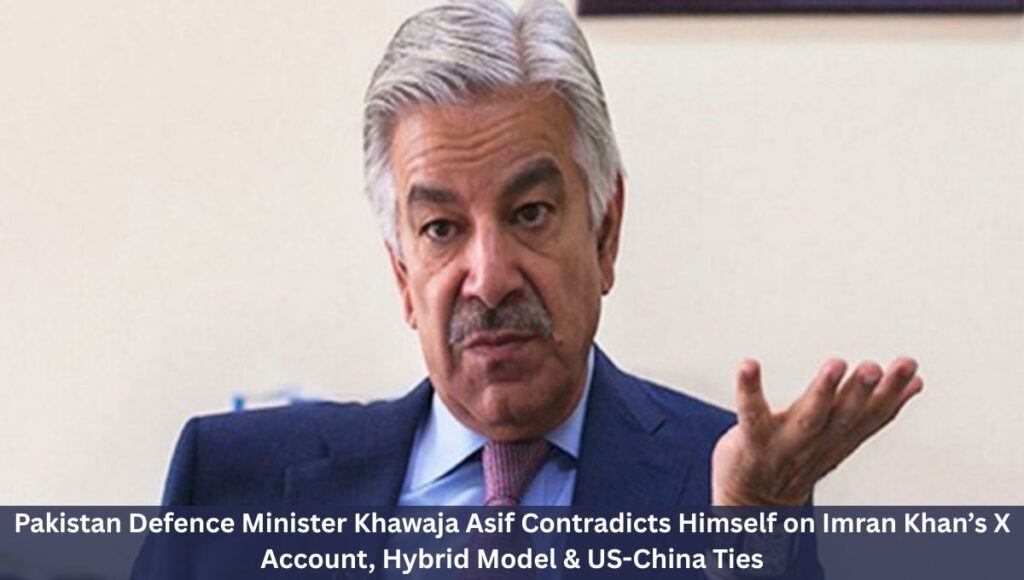
Pakistan Defence Minister Khawaja Asif Contradicts Himself on Imran Khan’s X Account, Hybrid Model & US-China Ties
Khawaja Asif vs Mehdi Hasan: The X Account Controversy
The interview took a dramatic turn when Mehdi Hasan pressed Khawaja Asif on his shifting claims about Imran Khan’s X activity.
At first, Asif claimed confidently:
“He is operating a Twitter account from the jail cell.”
Hasan immediately pushed back, reminding Asif of his earlier claim that Khan’s X account was being controlled by India.
“You said he was operating from India the other day. I saw you say that. You just made two different allegations. Is it Imran in his prison cell or is it India?”
Caught off guard, Asif stammered in his reply:
“Either he is operating from the cell or he should at least identify who is operating the jail cell.”
This back-and-forth exposed the contradictions in the Defence Minister’s narrative, raising doubts about the credibility of the government’s stance.
Evidence or Mere Allegations?
When Mehdi Hasan demanded evidence, Asif insisted he had intelligence-based information but refused to share details.
- “The evidence I cannot publicly disclose,” he said.
- When Hasan pressed further — “Why make the claim then?” — Asif responded vaguely: “No, because it is there.”
This evasive approach made the Defence Minister appear defensive and cornered, with Hasan repeatedly pointing out the inconsistencies.
Imran Khan’s Imprisonment: A Point of Global Scrutiny
The discussion also touched upon Imran Khan’s imprisonment, which international human rights groups, including UN experts, have labelled “illegal”.
Imran Khan has been in custody since August 2023, following a three-year prison sentence in a corruption case. Despite mounting criticism from the international community, the Pakistani government continues to resist calls for his release.
When asked about the fairness of Khan’s trial, particularly hearings conducted via WhatsApp under dubious conditions, Asif dodged the question:
“He must prove that he has clean hands.”
This dismissal further highlighted the government’s unwillingness to address concerns about political persecution.
Pakistan’s Hybrid Model of Governance
Beyond Imran Khan, Hasan shifted focus to Pakistan’s governance structure, widely described as a hybrid model — where the military holds decisive influence over civilian governments.
Hasan asked bluntly:
“In most countries, the head of the army answers to the defence minister. In your country, you, the defence minister, answer to the head of the army, don’t you? Asim Munir is a more powerful person than you are.”
Asif rejected the assertion:
“No, it’s not like that… I’m a political worker, you know.”
But when pressed about who gets the final say if he and Army Chief General Asim Munir disagree, Asif admitted decisions are made by “consensus”, not by the elected government alone:
“It’s not equal… We can agree to disagree. It is by consensus, whatever is taking place.”
This statement, analysts argue, confirmed the military’s overwhelming influence, validating the “hybrid” label.
The Deep State Comparison
When confronted with the fact that in the US, the Secretary of Defense can dismiss generals, unlike in Pakistan, Asif shot back:
“They (the US) have a different model over here. It’s called deep state.”
Hasan replied sharply:
“In your country, the deep state’s in charge.”
This back-and-forth exchange revealed how Pakistani officials often try to normalize or deflect criticism of military dominance, while still struggling to justify it.
China or the US? Pakistan’s Strategic Future
The interview also focused on Islamabad’s balancing act between China and the United States.
Asif admitted that Pakistan’s long-term strategic partnership lies with China, which he described as a “time-tested ally”.
“In the past, even today and in the future also, China has been a very reliable ally, a very reliable provider of arms of all kinds to us. Our Air Force, submarines, and planes… a major portion of our arms are from China.”
According to Asif, Pakistan’s defence cooperation with China has grown more robust than ever, particularly due to the “unreliability” of the United States.
“China Not Worried About Pakistan Flirting with US”
When asked whether China was concerned about Pakistan’s growing closeness with the US under President Donald Trump, Asif downplayed the risks:
“China is not worried about our flirtations or whatever you call it. They’re reliable, and they are our neighbours.”
He acknowledged that Pakistan’s relationship with the US has historically been transactional and flirtatious, but stressed that China remains Islamabad’s most dependable partner.
The Saudi-Pakistan Defence Pact & Nuclear Umbrella
The interview also touched upon the Saudi-Pakistan defence pact, which has fueled speculation about whether Saudi Arabia is protected by Pakistan’s nuclear umbrella.
When asked directly, Asif refrained from confirming or denying, saying only that the pact has formalized defence arrangements between the two countries.
This evasive response left analysts speculating about the extent of nuclear assurances provided to Riyadh.
Khawaja Asif on Pakistan’s “Practical Necessity”
Asif has previously defended Pakistan’s hybrid system, calling it a “practical necessity” given the country’s economic and political crises.
Earlier this year, in an interview with Arab News, he even claimed that the model was “doing wonders”, despite criticism from democratic institutions and rights activists.
For Asif, the partnership between the civilian government and military is the only way to maintain stability, though many argue it comes at the cost of true democracy.
International Fallout of Asif’s Contradictions
The Defence Minister’s contradictory remarks on Imran Khan’s X account have sparked criticism both at home and abroad.
- Domestic critics accuse the government of running a disinformation campaign against Khan.
- International observers view the contradictions as proof of weak governance and lack of institutional credibility.
- Political analysts suggest that Asif’s performance exposed the nervousness of Pakistan’s leadership, especially when questioned by foreign journalists.
Conclusion: A Minister in the Spotlight
Khawaja Asif’s fumbling interview with Mehdi Hasan has brought Pakistan’s governance challenges into sharp focus.
From contradictory statements on Imran Khan’s X account, to vague justifications of Pakistan’s hybrid model, and evasive responses on foreign policy, the Defence Minister left more questions than answers.
At a time when Pakistan is under international scrutiny for its human rights record, its military dominance in politics, and its delicate position between the US, China, and Saudi Arabia, such contradictions only weaken Islamabad’s global standing.
For now, the question remains unanswered: Who really controls Imran Khan’s X account — the jailed former PM, a foreign hand, or a carefully crafted political narrative?
Also Read: Over 200 Inmates Escape Malir Jail After Karachi Earthquake: One of Pakistan’s Worst Jailbreaks
Related Posts:
- 7 Shocking Twists in Imran Khan Death Rumours and Jail Chaos

- 7 Urgent Revelations as Imran Khan’s Isolation…
- 7 Shocking Revelations as Imran Khan’s Sister…

- 11 Explosive Developments as Pakistan Moves to Try…

- 11 Explosive Signals in Imran Khan’s Health Crisis…

- 17-Year Shock Verdict: Imran Khan Jailed as Protests Loom