

To delay sanctions on Iran, UN Security Council Blocks China-Russia Resolution as Tehran Faces Snapback Measures. The United Nations Security Council (UNSC) has rejected a last-minute attempt by China and Russia to delay the reimposition of sanctions on Iran, setting the stage for the “snapback mechanism” that restores sweeping economic and military restrictions a decade after they were lifted under the landmark 2015 nuclear deal.
The move, backed by the United States, the United Kingdom, France, and Germany, has reignited tensions across the Middle East and raised fresh fears of economic collapse, political instability, and military escalation in Iran and beyond.
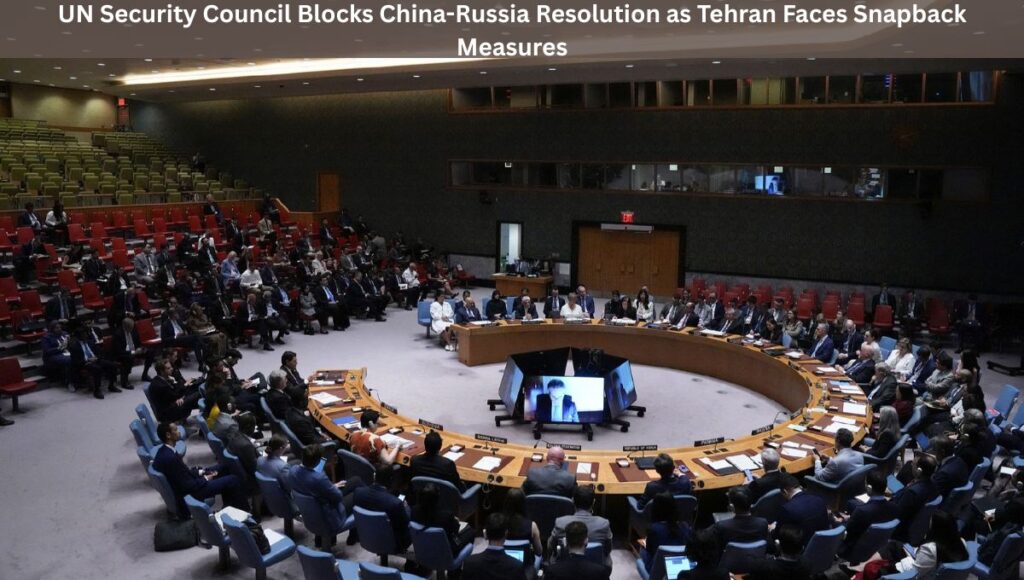
UN Security Council Blocks China-Russia Resolution as Tehran Faces Snapback Measures
Background: The JCPOA and the Snapback Clause
The Joint Comprehensive Plan of Action (JCPOA), commonly known as the Iran nuclear deal, was signed in 2015 between Iran and world powers, including the US, UK, France, Germany, China, and Russia.
The deal lifted international sanctions on Tehran in exchange for strict limits on its nuclear program. To ensure compliance, the UNSC passed Resolution 2231, embedding a “snapback mechanism” that allowed sanctions to be automatically reinstated if Iran was found in breach.
While the US under President Donald Trump withdrew from the agreement in 2018 and reimposed unilateral sanctions, the JCPOA framework remained in place at the UN — until now.
Last month, France, Germany, and the UK (collectively known as the E3) formally accused Iran of “significant non-performance” of its obligations, citing its continued uranium enrichment, restrictions on inspections, and military activity. This triggered the 30-day countdown for snapback sanctions.
The China-Russia Resolution: A Last-Minute Bid
On the eve of the deadline, China and Russia introduced a draft resolution to extend the JCPOA framework by six months.
The draft sought to:
- Prolong the deal until April next year.
- Extend UNSC Resolution 2231.
- Encourage engagement between Iran and the International Atomic Energy Agency (IAEA).
However, when the resolution was put to a vote, it received only four votes in favor, nine against, and two abstentions — far short of the nine affirmative votes required to pass.
Why It Failed
- Western powers accused Iran of escalating its nuclear activities without civilian justification.
- The US and E3 argued that Iran’s actions left no room for delay.
- Russia and China were isolated, with most UNSC members unwilling to back their proposal.
As a result, the snapback sanctions automatically took effect at 00:00 GMT on Sunday.
What the Snapback Sanctions Mean
The restored UN sanctions represent a sweeping rollback of economic, political, and military engagement with Iran. Key measures include:
- Arms embargo: Prohibition on buying or selling weapons to or from Iran.
- Ban on uranium enrichment: Restriction on nuclear activity beyond civilian levels.
- Missile restrictions: Ban on ballistic missile development and testing.
- Asset freezes and travel bans: Targeting key Iranian leaders, officials, and entities.
- Global trade restrictions: Ban on cooperation with Iran in shipping, finance, energy, and aviation.
These sanctions compound the unilateral measures already imposed by the US and the EU, further strangling Iran’s economy.
Western Powers Defend the Decision
Western diplomats argue that Iran has pushed the limits of the deal far beyond tolerance.
- UK Ambassador Barbara Woodward: “Iran is defying the global non-proliferation regime. Its enriched uranium stockpile lacks any credible civilian justification.”
- US Deputy Representative Dorothy Shea: Called the China-Russia resolution “a hollow effort to relieve Iran of accountability.”
- E3 Statement: France, Germany, and the UK insisted Iran’s actions left them no choice but to trigger snapback.
For these nations, Iran’s accumulation of uranium enriched up to 60% purity — dangerously close to weapons-grade — represents a red line.
Also Read: UN Security Council rejects resolution to extend Iran sanctions relief
Iran’s Angry Response: Ambassadors Recalled
Tehran reacted swiftly, recalling its ambassadors from the UK, France, and Germany for consultations.
Iran’s President Masoud Pezeshkian condemned the sanctions as “unfair, unjust, and illegal,” accusing the West of deliberately sabotaging diplomacy.
In fiery remarks at the UN General Assembly, he warned:
“Foreign powers are seeking a superficial pretext to set the region ablaze. Iran will never pursue nuclear weapons, but we will not accept humiliation.”
Iran’s Foreign Minister Abbas Araghchi accused the West of burying diplomacy, declaring that talks with the US were a “dead end.”
Iran’s Economy in Freefall
Even before snapback, Iran’s economy was under severe strain from years of sanctions, internal mismanagement, and the June war with Israel.
- The rial hit a record low: 1.1 million per US dollar.
- Inflation soared above 34%, with food prices rising over 50%.
- Essential staples such as rice, butter, beans, and meat have become unaffordable for ordinary families.
Ordinary Iranians now face shortages, unemployment, and worsening living conditions.
“Every year it’s worse than the last. Our dreams are slipping away,” said Sina, a father in Tehran.
Psychologists report a surge in patients struggling with anxiety and depression, with many warning of potential social unrest.
Military Tensions: Israel and the US
The reimposition of sanctions comes against the backdrop of military conflict earlier this year.
- In June, Israel and the US bombed Iranian nuclear sites and military bases during a 12-day war, killing over 1,000 people according to Iranian authorities.
- Iran retaliated through missile strikes and attacks via proxies, including Hezbollah.
Israeli Prime Minister Benjamin Netanyahu welcomed snapback, urging no delay and hinting at future military action against Iran’s nuclear program.
The Islamic Revolutionary Guard Corps (IRGC) responded by vowing continued “resistance” against Israel and the US, accusing them of “evil plans” to destabilize the region.
Russia and China: Defiance Continues
Despite their failed resolution, Russia and China maintain strong ties with Tehran.
- Russia signed a $25 billion deal to build four nuclear reactors in Iran.
- Chinese companies continue to buy Iranian oil despite US pressure.
Russian diplomat Dmitry Polyanskiy dismissed the sanctions as “null and void,” accusing the West of hypocrisy.
The Hybrid Pressure: Diplomacy or Escalation?
Iran insists it will remain in the Non-Proliferation Treaty (NPT), but has threatened to limit cooperation with the IAEA if sanctions continue.
While IAEA inspectors have resumed some monitoring, many sites remain off-limits, raising fears of miscalculation.
Experts warn the situation could spiral:
- Kelsey Davenport, Arms Control Association: “Snapback is dangerous. With enriched uranium stockpiles and no inspections, the risk of preemptive strikes by the US or Israel rises sharply.”
A Hungrier, Poorer, More Anxious Iran
The sanctions deepen Iran’s internal crisis:
- Food insecurity: Prices for rice, butter, and beans have doubled or tripled.
- Healthcare shortages: Medical supplies are harder to import.
- Rising executions: Rights groups say over 1,000 people have been executed in 2025, the highest since the 1980s.
- Protests and repression: Public anger is simmering, reminiscent of the 2022 Mahsa Amini protests.
As pressure mounts, the Iranian leadership faces a stark choice: double down on defiance or seek a compromise that restores stability.
What’s Next?
The snapback sanctions are designed to force Iran back to negotiations, but Tehran appears unwilling to bend.
With its economy on the brink, protests looming, and military tensions high, Iran is entering one of the most volatile chapters of its modern history.
For the international community, the risk is clear: a collapse of diplomacy could mean another war in the Middle East — one with nuclear stakes.
Conclusion
The rejection of the China-Russia resolution at the UN Security Council marks a turning point. Iran now faces renewed UN sanctions, plunging its economy deeper into crisis, while its leadership lashes out at perceived Western betrayal.
The snapback mechanism, once designed as a safeguard, may instead fuel confrontation. With Israel threatening strikes, the US firm on pressure, and Russia and China openly defying sanctions, the world is watching a dangerous standoff unfold.
The coming months will test whether Iran, its rivals, and world powers can navigate back to diplomacy — or whether the snapback becomes the spark that ignites a wider regional conflict.
Also Read: UNSC Meeting on Pahalgam Terror Attack: Pakistan Faces Tough Questions, No Outcome Reached
Related Posts:
- 7 Powerful Facts About Ayatollah Ali Khamenei’s…

- 3 Explosive Conditions Iran Sets to End War with US…
- 5 Major Takeaways from the US Supreme Court's…

- 9 Explosive Claims as Trump Says US Winning Iran War
- 7 Heartbreaking Facts About Venezuela's Earthquake Disaster
- In 8 Moves, EU Targets China-Linked Refineries and…
