James Comey Indicted: False Statement Charge Over Clinton Email Probe as critics warn of justice department politicization. The political storm around James Comey, former Director of the Federal Bureau of Investigation (FBI), has taken a dramatic new turn. Comey has been indicted on charges of making false statements to Congress and obstructing a congressional proceeding, stemming from his 2020 testimony about whether he authorized leaks to the media during the FBI’s investigations in 2016.
At the heart of the indictment is not the Russia investigation that dogged Donald Trump’s presidency, but rather the Hillary Clinton email probe, the case that helped define the 2016 election and has haunted American politics ever since.
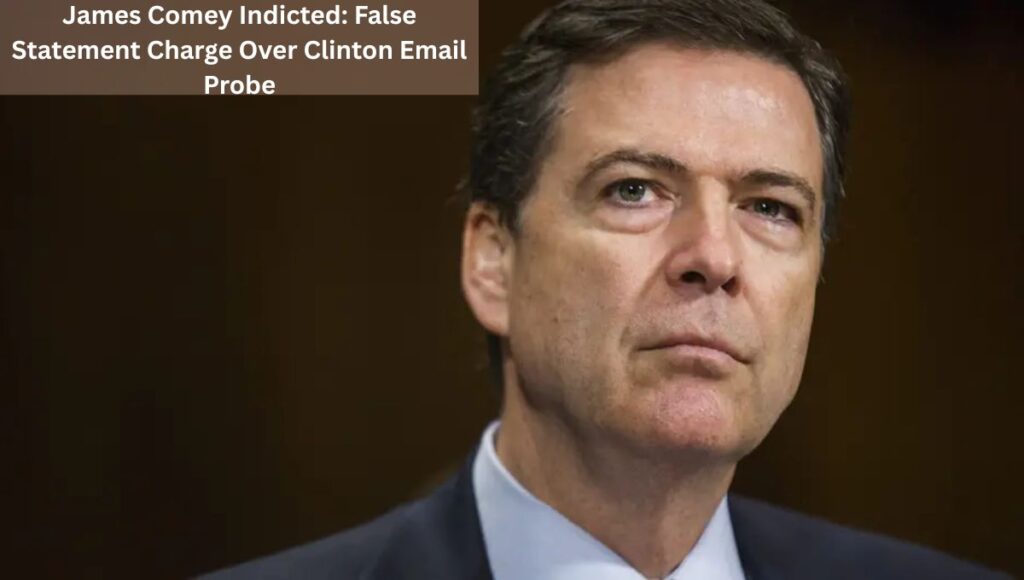
James Comey Indicted: False Statement Charge Over Clinton Email Probe
Who Is James Comey?
James Comey served as FBI Director from 2013 to 2017, first under President Barack Obama and then under Donald Trump.
- Comey became a household name in July 2016, when he held a press conference announcing that while Hillary Clinton’s use of a private email server was “extremely careless,” the FBI would not recommend criminal charges.
- Just days before the 2016 election, he informed Congress that the FBI was re-opening the email investigation due to material found on Anthony Weiner’s laptop — a decision Democrats believe cost Clinton the presidency.
- In 2017, Trump fired Comey while the FBI was investigating possible ties between Trump’s campaign and Russia. That dismissal triggered the appointment of Special Counsel Robert Mueller.
Comey has since written books, testified against Trump, and become a frequent critic of the former president, ensuring their feud remained central to US political drama.
What Is Comey Accused Of?
The indictment centers on his 2020 testimony before the Senate Judiciary Committee. During that hearing, Republican Senator Ted Cruz asked whether Comey had ever authorized anyone at the FBI to leak information to the press about investigations into Clinton’s emails or Trump’s possible ties to Russia.
Comey replied that he had “never authorized anyone at the bureau to be an anonymous source in news reports.”
But prosecutors allege that testimony was false. They claim Comey had indeed authorized an FBI associate — identified in the indictment as Person 3 — to leak information about the Clinton probe to the media.
The charges are:
- Count 1: False Statements – Lying under oath to Congress.
- Count 2: Obstruction of a Congressional Proceeding – Misleading lawmakers during an active investigation.
If convicted, Comey could face up to five years in prison.
Who Are Persons 1, 2, and 3?
The indictment uses anonymized references — Persons 1, 2, and 3 — that insiders have worked to decode.
- Person 1 – Hillary Clinton. Officials and people briefed on the case told CNN that the references in the indictment point to her. In another filing, she is described in relation to “approving a plan concerning Person 2.”
- Person 2 – Donald Trump. In the documents, Trump is tied to the plan allegedly mentioned by Clinton.
- Person 3 – Daniel Richman. Comey’s longtime friend and Columbia Law School professor, Richman reportedly acted as Comey’s liaison with the press.
Richman was once a special government employee at the FBI. After Comey’s firing in 2017, Richman was the one who leaked Comey’s memos about his meetings with Trump — a move that helped trigger the Mueller investigation.
Richman has recently been interviewed by the FBI and received a subpoena. However, he is not accused of wrongdoing in this case.
There is speculation that Andy McCabe, former FBI Deputy Director, could also fit the description of Person 3, but most indications point toward Richman.
The Clinton Email Investigation at the Center
The irony of this indictment lies in its connection to Hillary Clinton, not Trump.
- Trump has long railed against Comey for supposedly undermining him with leaks during the Russia probe.
- Clinton, on the other hand, has blamed Comey for derailing her 2016 campaign with his public announcements.
Now, prosecutors say the alleged lies under oath were tied to leaks about the Clinton email investigation — not Russia.
That twist has left both political camps divided: Trump’s allies are cheering, Clinton’s allies feel vindicated, and critics worry the Justice Department is being weaponized.
Trump’s Reaction: “Brilliant Work”
President Donald Trump wasted no time celebrating the indictment.
On Truth Social, he praised FBI Director Kash Patel for his “brilliant work” in pursuing Comey, calling the former FBI chief a “dirty cop” and a “slimeball.”
Trump wrote:
“I’d like to thank Kash Patel, and the outstanding members of the FBI, for their brilliant work on the recent Indictment of the Worst FBI Director in the History of our Country, James ‘Dirty Cop’ Comey… He was a total SLIMEBALL!”
Trump has made no secret of his desire to see Comey prosecuted. He has often blamed the Russia probe — launched under Comey’s leadership — for damaging his presidency.
Kash Patel and the FBI’s Role
FBI Director Kash Patel, appointed by Trump, issued a statement alongside the indictment announcement.
Patel declared:
“Nowhere was this politicization of law enforcement more blatant than during the Russiagate hoax, a disgraceful chapter in history we continue to investigate and expose.”
His comments underscored how the FBI itself is divided, with current leadership aligning with Trump’s view that the Russia investigation was a political attack.
Comey’s Response: “I’m Innocent… Let’s Have a Trial”
Comey has denied all charges, releasing a defiant statement and a video message.
He said:
“My family and I have known for years that there are costs to standing up to Donald Trump. But we couldn’t imagine ourselves living any other way. We will not live on our knees and you shouldn’t either. I have great confidence in the federal judicial system and I’m innocent. So let’s have a trial and keep the faith.”
His attorney, Patrick J. Fitzgerald, echoed those sentiments, calling the indictment baseless and politically motivated.
What Happens Next?
Comey’s arraignment is scheduled for October 9 in Virginia.
The process will follow typical federal court steps:
- Formal reading of charges.
- Entry of a plea (Comey is expected to plead not guilty).
- Pretrial proceedings, including evidence exchange.
- Potential trial before a jury.
Prosecutors will need to show beyond a reasonable doubt that Comey knowingly lied under oath. Legal experts say such cases are notoriously difficult, requiring corroborating witnesses and documentation.
Trump’s Pressure on the DOJ
Critics argue the case is tainted by Trump’s direct pressure on the Justice Department.
- Trump publicly urged Attorney General Pam Bondi to bring charges.
- He complained when prosecutors hesitated, then installed Lindsey Halligan, a loyal aide, as the top prosecutor in Virginia.
- Veteran prosecutors reportedly resisted the move, warning it would undermine the office’s independence.
Legal analysts say this opens the door for Comey’s defense team to argue selective or vindictive prosecution.
Legal Experts: A Weak Case?
Some former prosecutors question the strength of the indictment.
- Kevin Flynn, ex-federal prosecutor: “This looks like a slapdash rush to the courthouse with one goal in mind: to achieve the president’s aims.”
- Marcos Jiménez, former US Attorney: Called the two-page indictment “beyond unusual” for such a high-profile case.
- Jeffrey Bellin, Vanderbilt Law professor: “From the outside, it looks like this prosecution was brought at the direct request of the president.”
Prosecutors must convince a jury that Comey knowingly misled Congress — not merely misspoke or contradicted someone else’s account.
What This Means for US Politics
The indictment of James Comey is seismic for several reasons:
- First senior official charged over Trump’s grievances – It fulfills Trump’s long-standing call for Comey’s prosecution.
- Deepens political divisions – Democrats see it as an authoritarian move, while Republicans view it as overdue accountability.
- Rewrites the Clinton saga – By centering on the Clinton investigation, it reopens old wounds from 2016.
- Tests DOJ independence – The case highlights concerns that law enforcement is being weaponized for political ends.
The Bigger Picture: Politicization of Justice
For years, Comey has been at the center of the intersection of law enforcement and politics.
- To Democrats, he cost Hillary Clinton the 2016 election.
- To Republicans, he spearheaded the “witch-hunt” against Trump.
- To many legal experts, his indictment raises alarms about the erosion of democratic norms.
Sahar Aziz, a Rutgers law professor, warned:
“This is unprecedented because Trump is using the criminal justice system to threaten the liberty of a former senior official. This is an authoritarian slide.”
Conclusion: Trial by Law, Trial by Politics
The indictment of James Comey is more than a legal case — it’s a political earthquake.
It revives debates about Hillary Clinton’s emails, the Russia investigation, and the boundaries of presidential power. It pits Trump’s allies against critics of politicized justice. And it forces Americans to confront whether accountability is being delivered or democracy is being undermined.
As Comey heads to trial, the stakes extend beyond his personal fate. The outcome will shape perceptions of law, politics, and power in the United States for years to come.